In this guide 6 sections
An AS9100 auditor picks a part and follows its paper trail: first article inspection, certificates of conformance, special process approvals, nonconformances and serial or lot links to raw material. Software does not certify you. It keeps these records linked and findable.
The auditor follows one part, not your folders
An audit sample starts with a shipped part number and works backwards. The auditor asks for the order, the drawing revision, the routing, the inspection results and the material certificate. Each answer must lead to the next.
Folders organised by department make this slow. Quality holds the reports, purchasing holds the certificates, production holds the travellers. Finding one trail means three people and a morning. That is too slow.
The system should hold a single chain per serial number or lot, so one search opens the whole story.
First article inspection and drawing control
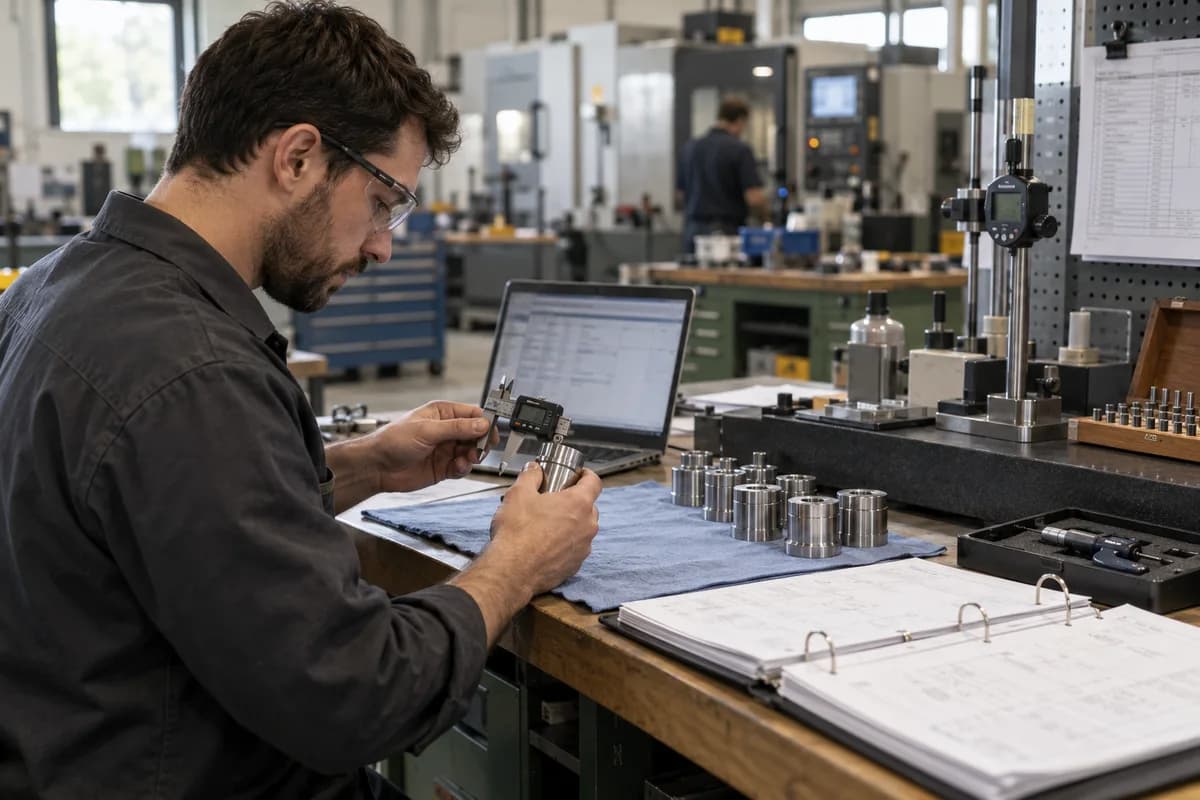
A first article inspection report records every dimension and note on the drawing against what was measured on the first part from a new process. It is tied to a specific drawing revision, and it must be repeated when something material changes.
That tie matters a great deal. If the customer issues revision C and your floor still cuts to revision B, the report no longer proves anything. The system should show which revision each work order used and block release on an outdated one.
Keep ballooned drawings, measurement data and gauge identity in the same record as the report.
- Part number, revision and customer drawing file
- Ballooned drawing and inspection results per feature
- Gauge and CMM program identity with calibration date
- Reason a repeat inspection was triggered
Certificates, special processes and approved suppliers
Raw material arrives with a mill test certificate. Finished lots leave with a certificate of conformance. In between, work such as heat treatment, anodising, plating, welding, non-destructive testing and shot peening is often done by outside processors.
Customers approve those processors, and the approval can be limited to a process specification. Sending a batch to a vendor whose approval lapsed is a finding waiting to happen.
Store approved sources with scope and expiry. Link every outside operation to the vendor’s own certificate and the process specification it cites.
- Mill certificate linked to the heat or lot number
- Approved processor list with scope and expiry date
- Process certificate attached to each outside operation
- Certificate of conformance generated from the chain
Nonconformances and serial or lot links
A nonconformance report names the defect, the quantity, the disposition (scrap, rework, use as is with customer approval, return to supplier) and the corrective action. It is useful only if it is tied to the work order and lot that produced it.
Serial and lot links are what make a recall bearable. If one bar of titanium is found out of specification, you must list every part cut from it and where each went. With paper, that is a week of digging through binders. With linked records, it is a query.
Corrective actions need owners and dates, and the system should show which are still open at audit time.
Check your trail with a mock pull
Pick three shipped part numbers at random. For each, try to produce the order, drawing revision, inspection report, material certificate, outside process certificates and any nonconformance within fifteen minutes.
Note every place you had to ask someone or search a drive. Those gaps are the links your system must hold. Count them.
Take the list to your certification body’s guidance or your quality manager before building anything. This article explains what software supports; the standard and your auditor decide what is required.
Part trail audit sheet
Use this sheet for a mock record pull. Each row is one shipped lot. Columns cover order, drawing revision, first article report, material certificate, outside process certificates, nonconformances, certificate of conformance and time taken to find each item. A last column marks the gap. Fill it honestly.
Open a blank worksheet to printQuestions owners ask
Does software make us AS9100 certified?
No. Certification comes from an audit of your quality system by an accredited body. Software only helps you hold and retrieve the records that audit asks for.
How long should aerospace records be kept?
It depends on the customer contract, the standard and any regulatory requirement. Ask each customer and your certification body, then set retention in the system to match the longest.
Is a lot number enough, or do we need serial numbers?
That is set by the customer’s drawing or purchase order. Some parts require serial traceability; others only lot. Follow the stricter instruction on the order.
Can we keep these records in Excel and shared folders?
Small shops do, and it can work. The weakness is linking: a certificate saved under the wrong name is lost. The mock pull above tests whether your method holds up.