In this guide 6 sections
A shop proves it cut to the current revision by tying one released drawing revision to the job, the traveller and every inspection record. Operators see only the released revision, superseded prints are pulled from the machine, and final inspection compares the revision on the traveller with the customer’s latest release.
Where the wrong revision actually gets in
Shops rarely cut from an unapproved drawing. The usual failure is quieter. A customer issues Rev C, the planner updates the program, and an old Rev B print stays clipped to a binder beside the Haas. Walk the shop floor with a clipboard and list every spot where a drawing for a live job can be found, including phone photos and the programmer’s second monitor.
Four places hold copies: the email attachment, the shared drive folder, the CAM project and the paper at the machine. Each one drifts on its own schedule. An auditor will ask which revision was live at the spindle on the day this serial number was cut, and a folder of mixed PDFs cannot answer.
Answer that question once, in one record, and the other copies stop mattering, because nobody on the floor needs to hunt through folders again.
- Customer release email saved as an attachment
- Shared drive folder with old and new PDFs side by side
- CAM program tied to a model, not a revision
- Printed prints in binders at the machine
Release the revision before anything else moves
Treat each drawing revision as a controlled record with one of four statuses: received, under review, released or superseded, and the status decides who sees it. Only released revisions attach to jobs.
Review is where the contract reviewer checks the purchase order revision against the drawing revision, along with the notes, flow-down clauses and specification callouts. A mismatch here costs an email. At final inspection it costs a scrapped lot. Record the date the customer’s release arrived and who accepted it, because a revision left unreleased for a week can explain a job that started on the wrong print.
When a new revision arrives, mark the old one superseded in the same step, and flag every open job on it for a decision to finish, rework or stop. Planners should see a clear list of open jobs affected, with quantities complete and material already cut, so the decision about each one rests on facts rather than memory.
Carry the revision onto the traveller
The traveller is the document the operator trusts, so the revision letter must print on it from the controlled record, never typed by hand. A retyped letter is a fifth copy. Programs deserve the same discipline as drawings. A post-processed G-code file named only by part number cannot say which revision of the model it came from, so the program name must carry the revision as well.
Every operation on the traveller should point at the same revision, along with the program name and tool list, so no operation runs a different revision from the first. When the CAM programmer changes a program for Rev C, the traveller for new jobs picks up the new program name automatically.
Reprints matter. A traveller reprinted halfway through a job should show the same revision it started with, or a loud warning when the released revision has since moved.
- Revision letter printed from the record
- Program name and version on each operation
- Print date and job number in the footer
- Warning when the released revision has changed
Make the operator and the inspector confirm it
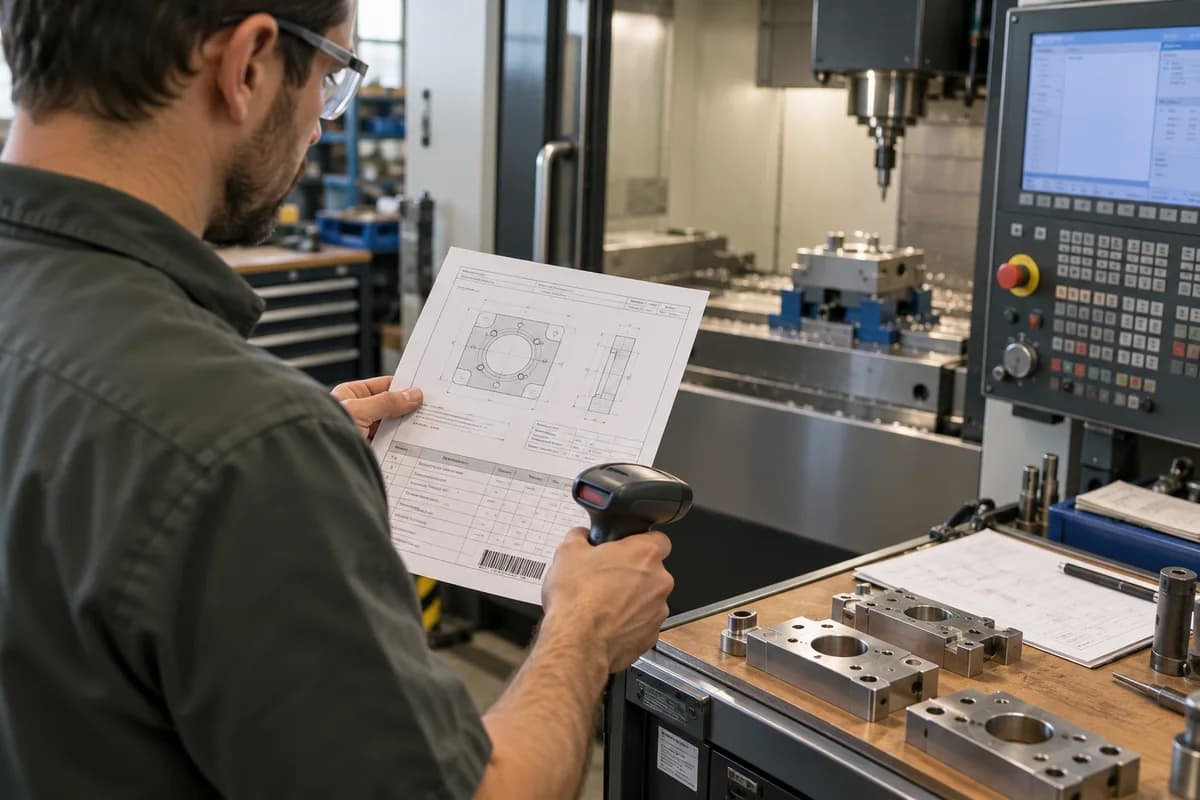
A printed revision means nothing if nobody looks. Ask the operator to scan or enter the revision shown on the print at the machine before the first cut. A mismatch blocks the start. Where machines have a shared terminal, a barcode on the traveller scanned at the control can pull the revision and program together. That removes typing errors on a busy shift.
Inspection repeats the check. The first piece inspection sheet records the drawing revision used for measurement, and the final inspector confirms it equals the latest released revision at the moment of sign-off.
These are short steps. Together they leave a trail of who confirmed what, and when, which is exactly what a customer source inspection asks to see.
- Operator confirms revision before first cut
- First piece sheet records revision measured against
- Final inspection compares with current release
- Timestamp and user stored with each confirmation
Prove it later without a hunt
The test of any revision control is the audit question months afterwards: pick a serial number, then pull the revision, the program, the operator confirmation and the inspection sheet. Ten minutes is the limit.
If that takes a day of searching folders, the control exists on paper only, and the first closed job you test will show you exactly where it breaks. Run it this week on a closed job. Note every place you had to look. Auditors also like the reverse trace, where you start from one drawing revision and list every serial cut to it. Build that view before a Friday request.
Fix the first gap you find, then repeat the drill with another closed job, and keep going until a serial number traces from release to shipment in minutes. One gap at a time.
Revision control check sheet
One A4 side, one copy per job. The header block holds job number, part number, serial range, customer and purchase order revision, so the sheet identifies itself when it is separated from the traveller. A middle table has five rows, one per control point: release review, traveller print, program match, operator confirmation and final inspection. Columns record the revision seen, initials, date and any exception, and a bottom box records the superseded revision and what happened to open jobs.
Open a blank worksheet to printQuestions owners ask
Who owns drawing revision control in a small shop?
Usually the quality manager owns the rule, and the contract reviewer or planner runs it daily, checking each customer release against the purchase order before anything is issued. One named person releases revisions. Nothing reaches the floor through side channels.
What happens to a job already in progress when a new revision arrives?
Stop and decide. Compare the change against the work done so far, then finish on the old revision with customer approval, rework, or restart. Record the decision against the job.
Do operators need to read the whole drawing?
They need the revision letter, the features for their own operation, the tolerances on those features and any note that changes the process or the inspection method. The traveller can pull those notes forward. They are not buried on sheet three.