In this guide 6 sections
Pick software that records an IMEI or serial number for every unit sold and starts a warranty record from the sale. It should also store exact device fit, absorb daily supplier price changes, build bundles from live stock and take returns by serial. Test each one with products of your own.
Can it record a serial number or IMEI for each unit sold?
Have the vendor sell one phone on screen. Then ask where its identifier landed. Most store builders count stock as a quantity, so ten handsets become one number and no single unit carries a name of its own. That is fine for cables. It fails for anything covered by a warranty.
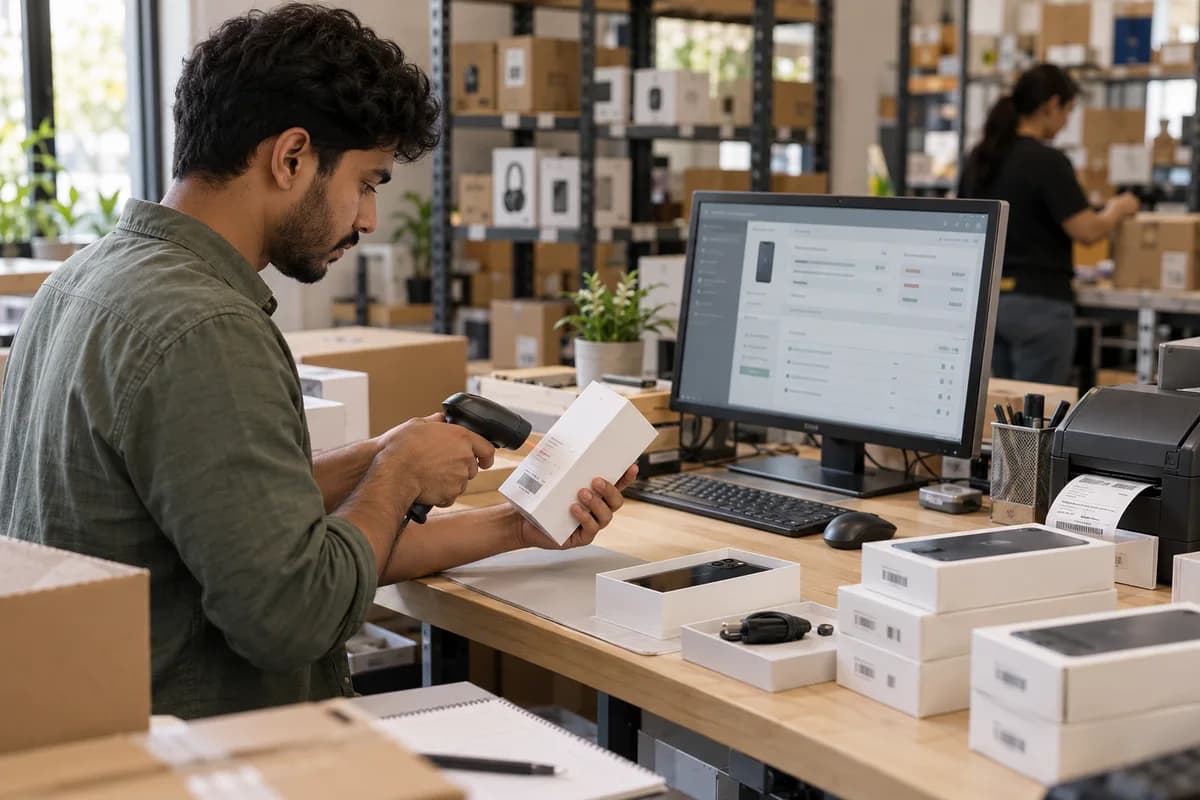
The scan belongs at the packing bench, where someone reads a barcode instead of retyping a long string, and it attaches to the order line. Many dual SIM phones carry two IMEI numbers. Test the awkward case. Have a packer scan a unit that already left the shop, then scan one serial on two lines of one order.
- Scan at packing instead of typing from the label
- One order line holding several serials
- A second IMEI field for dual SIM phones
- A duplicate scan that stops with a clear message
- Search by serial from the order and customer screens
Does a sale start a warranty record without anyone typing?
Cover runs from a date against a serial, so the platform should write the record at dispatch or delivery, with the brand’s terms already attached to the product. No more hunting through manufacturer PDFs.
Open the lookup screen. An agent types a serial and should see the start date, the end date, the plan name and every earlier ticket for that unit, all on one screen. If it takes three screens, claims will crawl.
Extended plans need their own row, linked to the same serial, because a brand may pay for one kind of repair while your shop pays for another. Keep the two apart. Ask about open box resale too.
Is compatibility stored as data or typed into the title?
A case titled for eleven handsets is a sentence, not a filter field, and marketplaces and mobile screens trim long titles before anyone reads the fit. A title is a poor database.
Ask the vendor to link a charger to a list of exact devices, then filter a category page by one handset and read what comes back. Use model numbers, not marketing names, because two regional variants of one phone can differ in radio bands and in the bundled plug. A good platform remembers the shopper’s device.
- Model numbers stored beside marketing names
- Compatibility held in a table, never only in the title
- A fit check on the product page
- Regional variants of one handset kept apart
- Notes such as works with the case on or needs an adapter
How does it cope with daily price changes and bundles?
Supplier prices arrive as spreadsheets. Import a file of a few hundred rows during the demo and watch which products change, which fail and which fall below cost without a warning. A margin floor should catch the last one.
Then build a bundle from a monitor, a keyboard and a headset, and check that it sells only while all three sit on the shelf. Change the headset price. The bundle price should follow your rule instead of staying frozen at yesterday’s number.
Scheduled changes matter too. A sale that ends at midnight on Sunday should end without anyone logging in, and the old price should return by itself.
How do returns work, and how do you test all of it?
Returns start with the serial. Receive one in the demo, look up its serial, grade the unit as sealed, open box or faulty, and watch it drop into the matching stock bin. Refunds should wait for the inspection.
Some shoppers return a cheaper unit in a premium box, and only a serial match catches that at the counter before the money moves.
Before the demo, send the vendor five hard products: a phone in two storage sizes, a laptop with a regional keyboard, a charger, a bundle and a watch. Score each scene as pass, partial or fail on one sheet. Send that sheet a week early.
Electronics platform demo scorecard
A one page grid, six rows deep: serial and IMEI capture, warranty record, compatibility, price changes, bundles and returns. Columns beside each row hold the scene to run, what the vendor showed, a pass, partial or fail mark, any paid plugin needed and who owns the workaround. The foot lists your five test products.
Open a blank worksheet to printQuestions owners ask
Do accessories need serial tracking?
Mostly no. Cables, cases and screen protectors can be counted by quantity, while phones, laptops, cameras and watches need a serial because the brand covers them.
Can a general store builder cope with an electronics catalogue?
Often yes, for a small range. Serial capture, warranty lookup and fitment tables are where add-ons creep in, so run those three scenes on the builder first and note which ones need a paid plugin.
Should refurbished stock share a page with new stock?
Keep separate listings with a visible grade. Price, box contents and cover all differ, but one shared serial history helps because the unit may have been sold before.
Who should attend the demo?
Bring whoever packs parcels, whoever answers warranty calls and whoever uploads products, because each of them hits gaps that a manager never sees in a demo. Managers see the pitch.