In this guide 6 sections
Fixed price suits vision jobs with a known part, stable lighting and a written defect list, while time and materials suits unknown defects and variable parts. Sell a paid trial first. Many firms then quote the build at a fixed price once the trial images prove that the camera, lens and light can see the defect reliably.
Feasibility is a job of its own
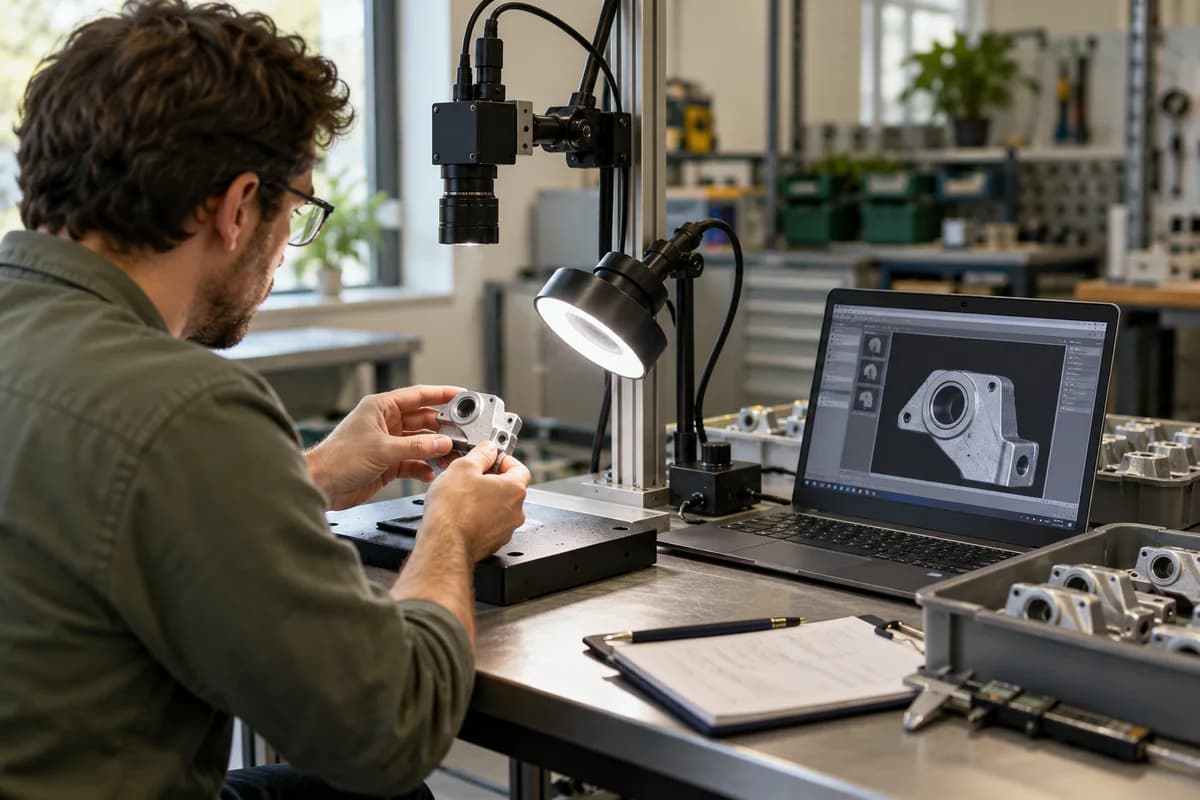
Before a vision system is sold, someone has to prove that a camera can see the defect, which means collecting sample parts, trying lenses and changing lighting angles. Hundreds of images get grabbed along the way, and the work takes bench time, an engineer and a full day on the optical rig.
Most firms give it away. The cost is real, yet it hides inside the sales budget, where nobody counts it and nobody ever bills the customer for it.
Treat each trial as a small project. Give it a record with an owner, a rig, a set of sample parts and an outcome, so that every trial can be found again when the customer returns.
- Sample parts received and returned
- Lens, camera and light combinations tried
- Image sets saved with settings
- Result: seen, not seen, or seen with conditions
When fixed price works
Fixed price fits narrow questions. The part is known, the defect list is written, the line speed is stated and the customer has agreed what a pass looks like. A barcode read on clean labels is one case, checking that a bottle cap is present is another, and measuring a stamped bracket is a third.
The risk sits with you. If the lighting on site differs from the bench, you pay for the rework, so write an acceptance test that names the good and bad sample sets. State the pass count. Surprise reflections from glossy labels are the usual source of loss; name the lighting limits in the quote and state what is excluded.
Keep a change list too. Each new part variant, extra defect type or changed line speed becomes a priced variation that the customer must approve in writing before work starts.
When time and materials works
Time and materials fits when nobody knows yet what the system must see, and shiny castings, textured plastics and food products often behave in ways that bench tests miss. Effort depends on what the images show.
Show them the hours. Send a weekly sheet listing engineer, day, task and rig used, along with the image sets that drove the next step of the trial.
Set a firm cap. A customer who fears an open bill walks away, while one who sees a ceiling usually stays and talks about what the system must detect. A ceiling forces a useful conversation.
- Open defect list with examples
- Variable surface, colour or position
- Customer cannot supply enough samples yet
- Line conditions cannot be copied on the bench
The mixed model: paid trial, then fixed build
Many vision companies settle on two steps. Step one is a paid feasibility study billed by time, ending with an image library, a method note and a recommended camera, lens and light. Step two is a fixed price build.
This protects both sides. The customer pays for learning rather than a guess, while you quote with the image library in hand and can credit the trial fee against the build.
Write down the exit rule. If the trial shows the defect cannot be seen reliably, the customer should know that outcome is a valid result and not a failure of the bench team. Say so in the proposal. That honesty brings repeat orders.
How software tracks effort before the order
Without records, trial hours vanish. Ask your team to log time against the enquiry number and not just against won jobs, so that each quote, lost or won, shows what it cost to prepare.
Software can hold the rig calendar, the sample log and the image folders, each with its camera settings and exposure times and strobe delays. When a customer returns after six months, the engineer opens the enquiry and finds the exact lens and light that worked, with no need to repeat the bench trial. It also settles pricing arguments.
Try one check now. Pull your last ten enquiries, count the engineer hours each took before a decision, and compare them with the price you quoted.
Vision quote chooser
The sheet is a scoring grid whose rows list part known, defect list written, line speed stated, lighting controlled, samples available and acceptance test agreed. Two tick columns score fixed price against time and materials, and a notes field records the reason behind each tick for later review. The last row names the model chosen. A review date closes the sheet.
Open a blank worksheet to printQuestions owners ask
Should we charge for a feasibility study?
Usually yes, because bench time, samples and an engineer are real costs, and a fee shows the customer that you take the question seriously. Credit the fee if an order follows.
What goes into a vision acceptance test?
It names the good and bad sample sets, the lighting and speed conditions, the number of parts judged and the pass rule. Both sides sign it first.
How do we stop trial hours going unrecorded?
Open an enquiry record before the first trial and log time against it from day one, including bench set-up, image review and report writing. Make the weekly sheet routine.
Can a customer change the defect list mid-project?
Yes, but each change is a variation. Under fixed price it carries a new quote, while under time and materials it simply shows up as extra hours on the weekly sheet.