In this guide 6 sections
A flush door is built as a core, two skins and a frame, so software tracks sheet stock, pressing and glue. A panel door is built from stiles, rails and panels, so it tracks timber lengths, joinery and moulding waste. Each needs its own routing and costing.
Two doors, two ways of building
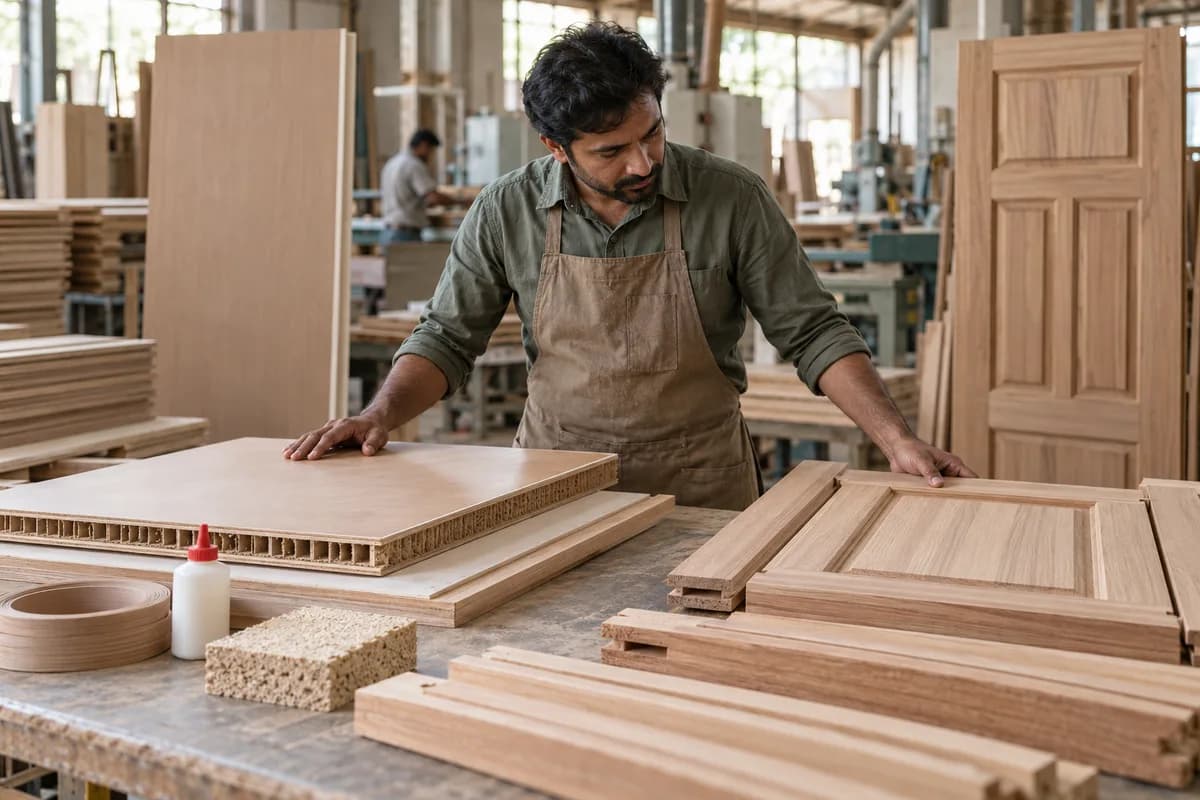
Every flush door starts as a frame with a core inside it. Skins of plywood, MDF or veneer are glued to both faces and pressed flat. The work is closer to sheet processing than to joinery.
A panel door is assembled from solid members. Vertical stiles and horizontal rails are cut, mortised and tenoned. Floating panels sit in grooves between them. This is classic joinery, with timber bought by length and section.
One workshop can build both. The stock, the machines and the failure modes still differ, so one routing cannot describe them.
- Flush: frame, core, skins, edge lipping, press
- Panel: stiles, rails, mullions, panels, beading
- Shared: sanding, finishing, hardware prep, packing
Stock records for a flush door
Flush door stock is mostly sheets and sticks. Skin sheets are held by thickness, face grade and size. Core material might be solid timber strips, honeycomb or particle core, each with its own code.
Adhesive and lipping also need records. Glue is consumed per pressed door, not per piece. Lipping is a running length that gets trimmed after pressing.
Offcuts from skins are usually reusable for smaller doors. If the system cannot hold a remnant as a stock line with its own dimensions, those sheets quietly disappear into scrap.
Stock records for a panel door
Panel door stock is timber. Planks arrive in rough sawn lengths, are dried, then machined to a finished section. Each stage changes the dimensions and loses volume.
The software should keep the species, the moisture check and the section. Teak and a pine substitute are never interchangeable on a quote. A stile cut from the wrong batch can show colour mismatch only after finishing.
Moulded panels add a second path. Raised panels may be cut in house or bought in. Either way the bill of materials needs a line for them.
- Rough timber by species and length
- Planed sections after machining
- Raised or flat panels, made or bought
- Beading and moulding by running metre
Routing and costing are not the same
The flush route runs frame assembly, core fill, skin pressing, trimming, lipping and sanding. Press time is the bottleneck, so cost depends on how many doors share one daylight in the press.
The panel route runs cross cutting, planing, mortising, tenoning, grooving, assembly and clamping. Cost leans on machine hours and on rejected members, because one bad rail stops the whole door.
Wastage is calculated differently. Flush door waste comes from sheet trimming. Panel door waste comes from knots, splits and planer snipe on each stile.
What to ask the software to hold
Start with a door type field on every order. Everything else, from the bill of materials to the routing, should follow from it. A size chart per type saves repeated quoting.
Next, make the record follow the door. Each frame or stile set should carry an order number from cutting through to dispatch. That is how a rework gets traced to the batch and the operator.
Finally, test with one real order of each type. Count what the system says was used, then weigh what is actually left on the floor.
Door type stock and routing sheet
Single-page template in two columns, flush and panel. Rows cover stock items, size chart, machine route, expected wastage, finishing path and dispatch check. The shop fills in its own sizes and species, then uses it to set up the bill of materials.
Open a blank worksheet to printQuestions owners ask
Can one bill of materials cover both door types?
Not well. A flush door lists core, skins and lipping, while a panel door lists stiles, rails and panels. Keep one template per type and let the order select it.
Which door is harder to cost?
Panel doors, usually. Timber yield varies by plank and by defects. Flush doors depend more on press cycles and sheet size, which are easier to predict.
Do I need to track lipping separately?
Yes. Lipping is bought by length, trimmed after pressing and wasted at the ends. A separate stock line shows when you are over-using it.
How should we handle door sizes that are not standard?
Record the cut size on the order and let the system draw the matching frame or stile lengths. Custom sizes then sit beside standard ones without a new item code each time.