In this guide 7 sections
A heat number identifies the batch of steel melted together at the mill. It must travel from bar stock through forging, heat treatment and machining to the customer lot. Without that chain, a rejected part cannot be tied to its material, so the whole supply must be quarantined.
What a heat number actually marks
A steel mill melts a charge in a furnace, adjusts the chemistry and casts it. That one melt gets a heat number. Every bar rolled from it shares the same chemistry within the mill’s limits, and the mill test certificate states those values.
The certificate lists carbon, manganese and other elements, along with mechanical results and the grade. It is the birth record of your raw material. Lose the heat number and the certificate is orphaned. Tensile strength and elongation sit beside the chemistry.
Grades such as EN8 or 20MnCr5 only name a family of steels. The heat number names the actual melt your part came from.
How the number travels to a finished part
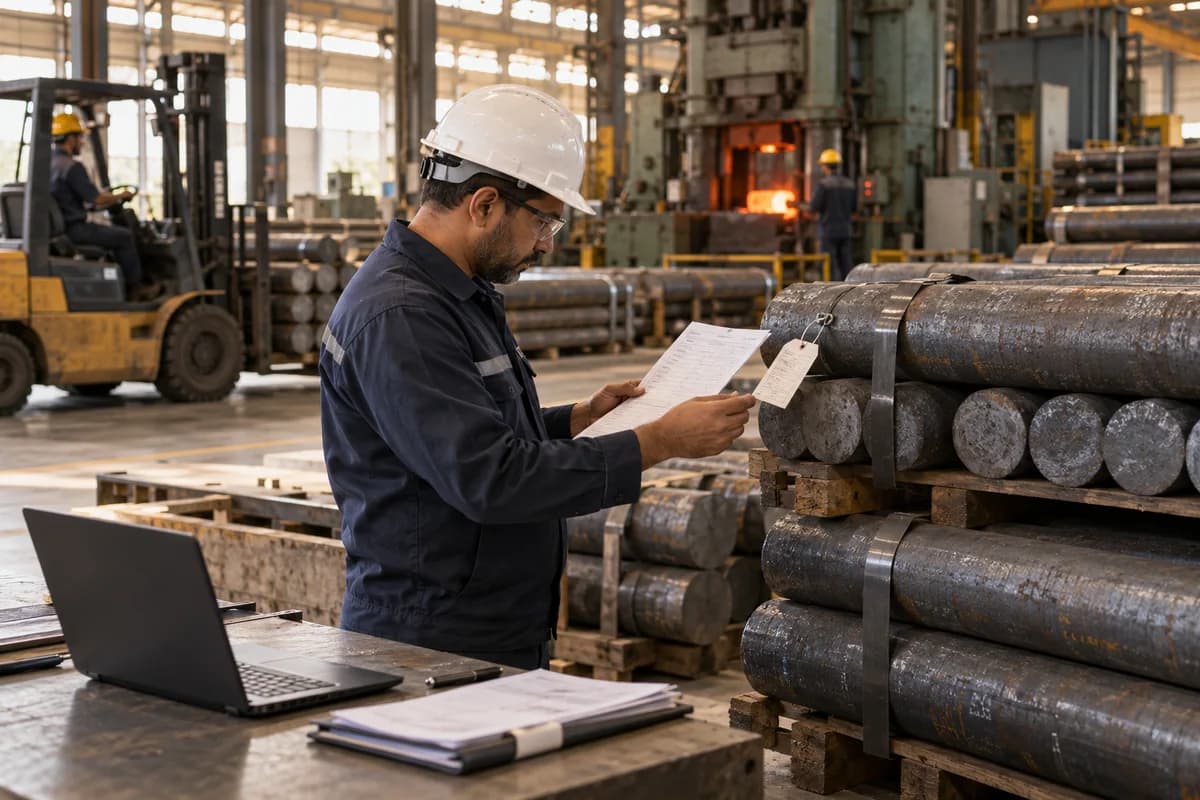
Bar stock arrives in bundles with a tag. At goods receipt, the stores clerk matches the tag to the mill test certificate and gives the bundle an internal lot. From the store the bars go to the saw, then the forging press, and each cut billet must keep its heat number.
After forging, parts go through the furnace for normalising or quenching. The furnace load record names the parts and the heat treatment batch. Machining follows, with a routing card that carries the forging lot forward to the finished part and then to the packing label. Each stage should write the previous lot onto its own record.
The chain has about six links. Break one and the rest are useless. A forged flange without its billet record is just anonymous steel.
- Mill test certificate matched to the bundle tag
- Internal lot number at goods receipt
- Billet cutting record with heat number
- Forging lot and die number
- Heat treatment furnace load record
- Machining routing card and final inspection
Where the thread usually snaps
Mixed bundles are the first break. Two heats share a rack, a billet loses its paint mark, and the sawyer guesses. Offcuts are the second. Leftover bar goes back to the store without a tag and comes out months later as unknown steel.
The third break is the furnace. Parts from different forging lots are loaded together to fill the chamber, and the load sheet records only the quantity. A Rockwell hardness failure then points to forty parts and several heats. Nobody can say which heat failed. The whole load goes to scrap or retest.
Paper routing cards that travel with a tray also get wet, torn or lost. A tray of finished shafts with no card is a tray you cannot ship. Coolant is the usual culprit.
What automotive quality systems expect
OEMs buying forged and machined parts usually ask suppliers to work under IATF 16949, with customer-specific requirements added on top. Traceability of material and process is part of that, and a customer audit will pick a finished part and ask you to walk back to its heat.
The practical test is simple. Take a part from last month’s dispatch and prove the mill, heat, forging lot, treatment batch and operators from the paperwork alone. If that takes a day of searching, a field failure would take far longer. Fix the gaps first.
Customer portals add another demand. Many OEMs expect a lot number on the dispatch note that matches the label on the box, and they compare the two on receipt.
Set up a trace you can run in minutes
Give every move a scan or an entry: receipt, cutting, forging, furnace, machining, packing. Record the parent lot on each child lot so that a search from either end reaches the other. Print the lot number on the tray label, not just on the routing card. Barcode scanners are cheap. Even a bound register with numbered pages beats loose slips.
Run a mock recall every quarter. Pick a heat, list every customer lot that holds it, then pick a customer lot and list its heats. Note how long it takes and what was missing, and fix the weakest link first.
Hold the quarterly drill with the quality head and a stores clerk in the same room. Keep it short.
- Parent lot recorded on every child lot
- Tray labels printed with lot numbers
- Furnace loads logged by part, not by quantity
- Offcuts tagged before returning to store
Heat-to-customer-lot trace sheet
Six columns run across one page, one per stage: bar receipt, billet cutting, forging, heat treatment, machining and dispatch. Each column has boxes for lot number, date, operator and the previous lot. A footer block records the mock recall date, time taken and the gap found.
Open a blank worksheet to printQuestions owners ask
Is the heat number the same as a batch number?
No. A heat number belongs to the mill’s melt. A batch or lot number is your own, created at receipt or at a later process, and it should always point back to the heat.
Do small shops need electronic records for this?
Not always at the start. Customers do expect a trace you can run quickly and repeat each time. Once volumes grow, paper cards are usually the first thing to fail.
What if a mill test certificate is missing?
Hold the bundle in quarantine and ask the supplier for a copy. Do not issue the steel to production until the certificate is matched to the tag.
How long should heat records be kept?
Keep them for as long as your customer contract and quality system require. Ask each OEM for its retention period in writing, and store the mill certificates with the lot records.
Sources
- IATF Global Oversight, IATF 16949 automotive quality management standard — verified 17 Oct 2026