In this guide 6 sections
Lead acid sales need a serial, a purchase date, water top up history and an exchange rule. Lithium sales add BMS logs, cycle counts and charger match. Record both, but expect lithium warranty claims to be settled on logs and lead acid claims on a load test.
Records both chemistries share
Every battery sold needs a serial number, model, capacity, invoice date and customer contact. Tie the serial to the invoice line, not to a free text note. Without that link, a warranty claim starts as an argument over which unit the customer actually bought.
Add the application too. A tubular battery in a home inverter and the same model on a solar bank live different lives.
Capture the dealer who sold it and the technician who fitted it. When a customer reports a swollen case or a tripped inverter, you want to know who handled the unit and which charger was in use.
What lead acid adds
Flooded batteries need water top ups, so keep the last service date and the specific gravity reading from the visit. A cell that reads low against its neighbours is the usual early sign.
Exchange rules matter most here. Record the old battery taken back, its condition and the credit given. Scrap lead goes to an authorised recycler, so keep the collection note.
Record where the top up water comes from. Hard water shortens plate life and explains many early failures in the first monsoon.
- Specific gravity per cell at each visit
- Water top up dates
- Old battery serial and credit given
- Recycler collection note
What lithium adds
Lithium packs are judged by data. Keep the BMS firmware version, cycle count, pack voltage range and any fault flags such as over temperature or cell imbalance. Download the log at installation as a baseline.
Charger match is the usual hidden cause of failure. Record the charger or inverter profile used, because a wrong charge setting can void the warranty.
Never mix lithium into a lead acid exchange stream. Fire risk changes how you store returns, so keep a separate rack and label each unit with its serial before it enters the shop.
- BMS firmware version
- Cycle count and depth of discharge
- Cell voltage spread
- Charger or inverter profile
How warranty handling differs
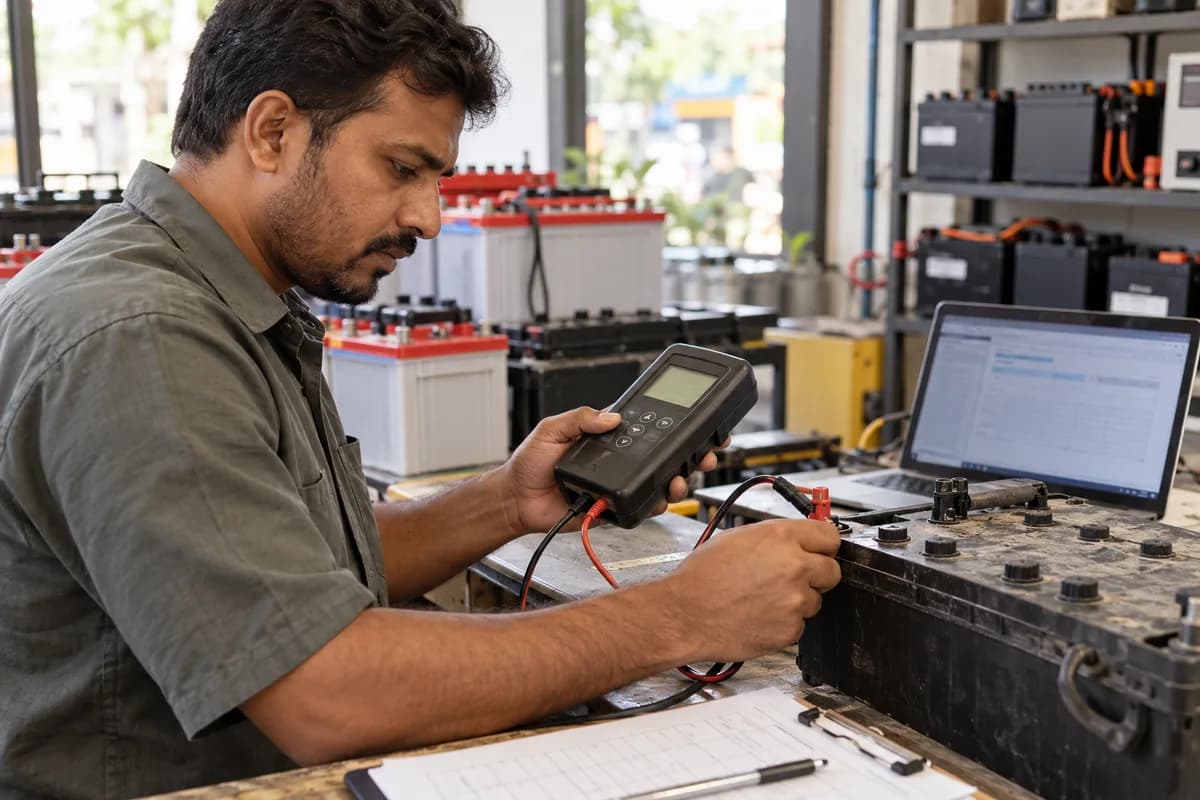
A lead acid claim usually ends with a load test and a visual check for bulging cases or sulphation on the plates. The result is a pass, a replacement or a pro rata credit. The record needed is short.
A lithium claim begins with the log. Ask the customer to export it from the BMS app, compare it with the baseline taken at installation, and send both to the manufacturer. Without logs the claim stalls.
Build one rule into the sheet. A claim cannot close until it holds a test result, a photo of the label and the customer’s signature. This stops disputes weeks later.
Disposal and the next step
Both chemistries carry take back duties in most countries. The rules differ by region, so check your local regulator and keep a signed disposal record for each unit you hand to a recycler.
Start with one habit. At every sale, capture serial, chemistry and application, then add the extra fields for that chemistry. Review the sheet after a month of claims.
Review claims each quarter by chemistry, model and cause. Repeated cell imbalance on one lithium model tells you what to stock and what to warn buyers about.
Battery sale and claim card
A card in two halves. The shared half holds serial, model, capacity, invoice date and application. The chemistry half lists lead acid fields on one side and lithium fields on the other, plus a claim outcome box and a disposal receipt line. Keep one card per sale in the register, and clip the test result or the BMS log export to it when a claim arrives.
Open a blank worksheet to printQuestions owners ask
Do I need BMS logs for every lithium sale?
Capture a baseline file at installation and store it against the serial. Later logs are pulled when a claim or complaint arises, then compared with that first download to show how the pack has aged.
How long should I keep lead acid exchange records?
Keep them for the warranty period and for any local rule on waste records. Ask your regulator if you are unsure, and file the recycler’s collection note beside the original invoice.
Can one system hold both chemistries?
Yes. A shared header with chemistry specific fields works well and avoids two separate registers. Staff fill one card at the counter, and the extra fields appear only for the chemistry sold.
Who decides a warranty claim?
The manufacturer decides, using your evidence: a load test for lead acid, a BMS log for lithium, and photographs of the label and terminals. A clean record speeds the decision.