In this guide 6 sections
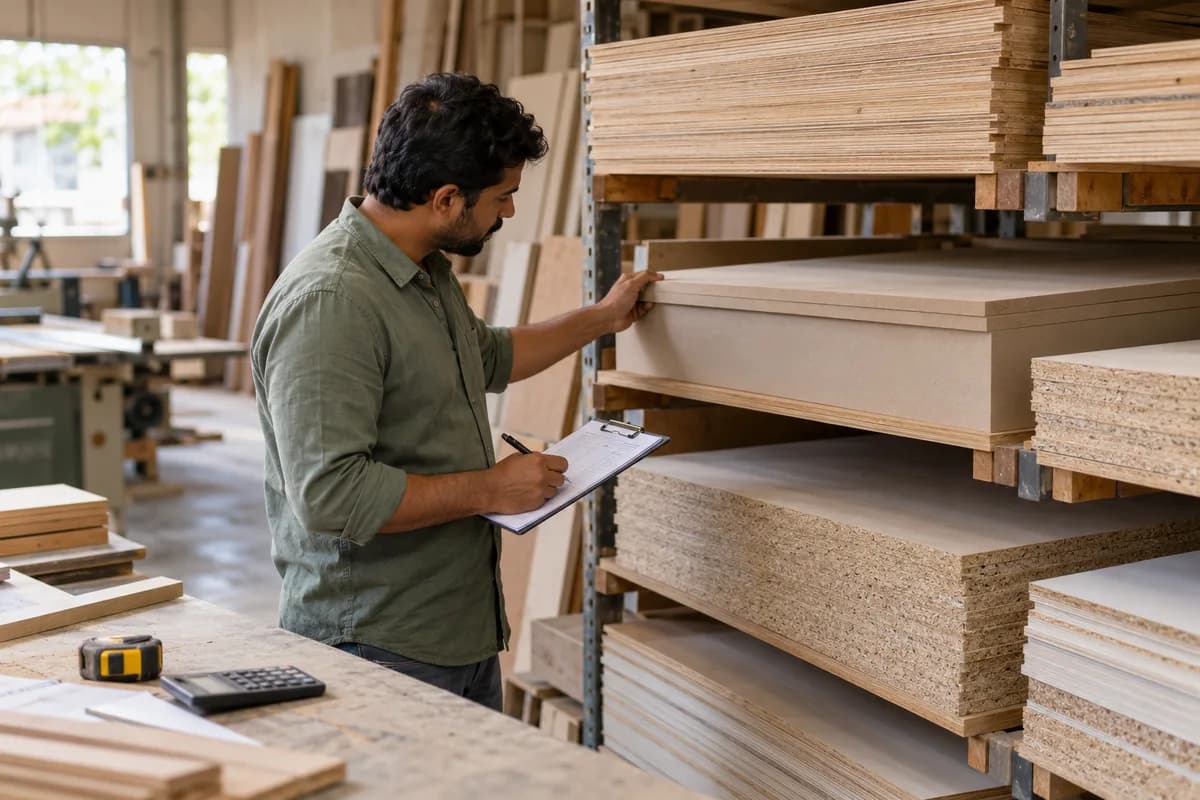
Three boards need three stock codes. They saw, screw and swell differently. Record the board type, thickness, face grade, sheet size and finish, and track wastage and offcuts separately, because a cabinet cut from each board yields a different area. Each board earns its own line.
Three boards, three different materials
Plywood is glued from thin veneers laid crosswise, so it holds screws well, resists splitting at the edge and takes a hinge cup without crumbling. Grades describe the face veneer and the glue line, so an interior sheet and a water-resistant sheet need different stock codes, even when both say 18 mm.
MDF is wood fibre pressed with resin. It is smooth, dense and clean to machine, which is why painted doors, routed fronts and curved shutters are usually cut from it. The catch is water. A cut edge standing on a damp kitchen floor swells, and the swelling stays even after the board has dried out and the leak has been mended.
Particle board is chips and resin. It is lighter and cheaper than the other two, yet it crumbles at screw points, so hinges, cam fittings and edge banding matter more here than on plywood.
- Plywood: veneer layers, glue grade, face species
- MDF: density, plain or prelaminated, moisture resistant
- Particle board: plain or laminated, edge quality
Why a single board code fails
Many shops list one line, 18 mm board. The store keeper issues whatever sits on the rack, the estimator quotes for MDF while the cutter picks up plywood, and nobody notices until someone checks the margin.
Each board has its own rate, weight and supplier, and offcuts are not interchangeable, since a scrap of particle board cannot stand in for a plywood back panel.
Separate codes make a stock count honest. They show which board moves. Slow movers stand out.
What a stock line should carry
Codes must say more. Add thickness in millimetres, sheet size, face finish and grade, because two sheets of one board, one 2440 by 1220 and the other 2745 by 1830, are different items.
Add the supplier and lot where you have one, because lots vary in thickness and colour, and a lot field lets you hold back an odd pallet early.
Keep the unit of measure clear. Buy and issue by the sheet. Cost it by square foot or square metre, whichever the shop already uses when it prices a wardrobe, a kitchen or a school bench.
- Board type and grade
- Thickness and sheet size
- Face finish or laminate code
- Supplier and lot
- Storage rack or bay
Wastage depends on the board and the job
Wastage is not one number. Plain MDF nests tightly because it has no grain direction, whereas a veneered plywood sheet must follow the grain, so more of it ends up as waste.
Kerf and defects differ by board. Particle board corners arrive damaged. Plywood may carry patches or voids on the face, which push a panel to the back of a unit where nobody sees it.
Record cutting losses by board type for a few weeks, and the averages you collect will make better quotes than any rule of thumb borrowed from another shop.
Offcuts, remnants and the first step
A usable offcut is stock. Record its board code, length and width, then store it on a labelled shelf so the next job can find it before someone cuts a fresh sheet.
Start with a physical count. Walk the racks, sort sheets by type and size, and write what you find against the new codes, then compare the grand total with the old ledger.
Fix the codes before ordering.
Board stock code sheet
One line per board. Columns are code, board type, thickness, sheet size, face finish, grade, supplier, rack position, sheets on hand and usable offcuts, giving one glance at what exists. Count against it first. It then stays as the master list.
Open a blank worksheet to printQuestions owners ask
Should thickness be part of the stock code?
Yes, because an 18 mm sheet and a 12 mm sheet are different items with different prices and uses, and thickness in the code prevents wrong issues.
Is plywood always better than MDF?
No. Plywood suits structural parts and screws. MDF suits painted and routed parts. The part decides the board, and the stock code should make that choice visible to the estimator, the store keeper and the cutter.
How do I record a half sheet?
Create it as an offcut under the parent code with its length and width, so the system counts it and offers it before a full sheet is opened.
Do moisture resistant boards need separate codes?
Yes. They go into kitchens and bathrooms. They also cost more. If they share a code with standard board, the wrong sheet can reach a wet area job, and a swollen carcass there is hard to replace.