In this guide 6 sections
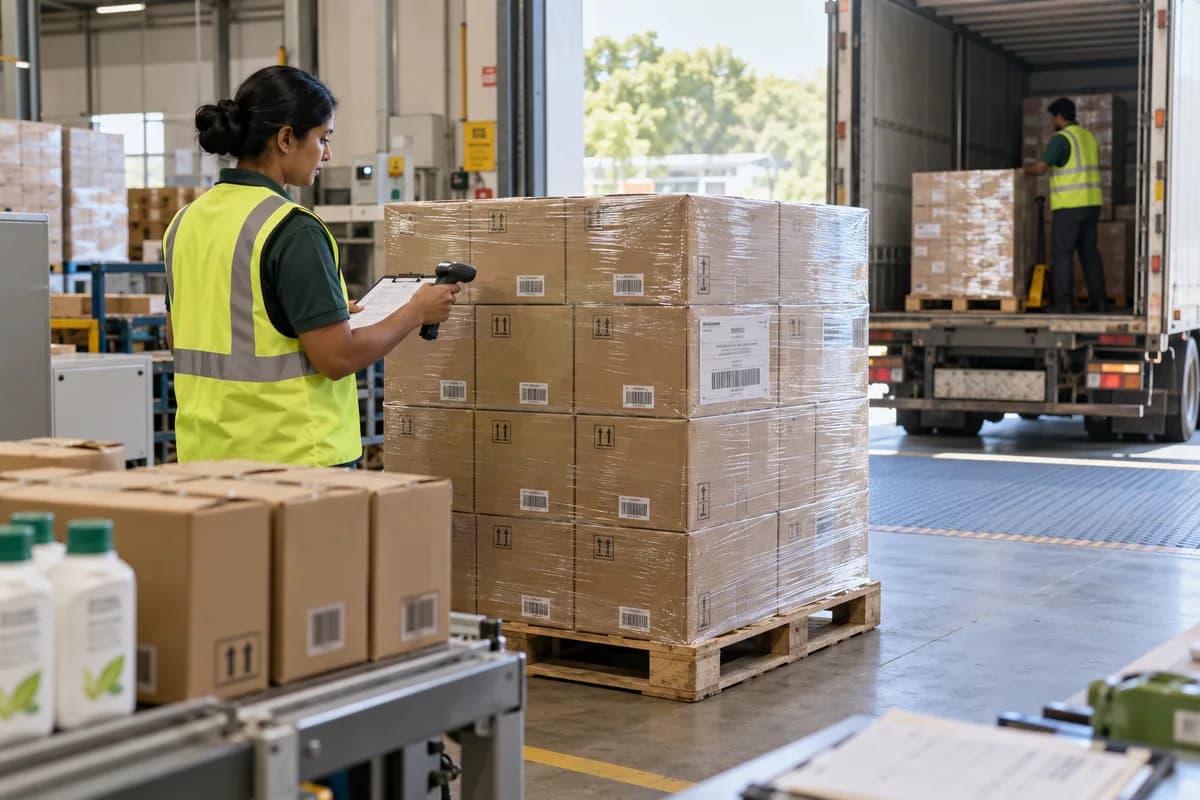
A pallet record must carry its own code, the carton codes inside, product, pack size and batch. Add manufacturing and expiry dates where they apply, plus the dealer order it was loaded against. A scan at loading links these, so recalls and short deliveries trace quickly.
Three levels of code
Consumer goods move in layers. An inner pack holds a few units, a carton holds several inners, and a pallet holds many cartons. Each layer needs a code that points to the layer below.
Without this nesting, a scan of the pallet label tells you nothing about what is inside. With it, one scan can confirm every carton, and one missing carton can be named.
Keep the codes short and unique. Printing a long text string as a barcode invites misreads, while a compact serial that the software expands works better.
What goes on the carton label
A carton label should answer four questions at a glance. What is it, how many, which batch, and until when. Staff on a dock read these in seconds, with gloves on.
Print the human readable text beside the barcode. When a scanner fails, the loader still reads the batch and keeps moving.
Check that label text matches the pack artwork. A carton that says one fragrance and a shrink pack that says another is a quality complaint waiting to happen.
- Product name and variant
- Units per carton and unit size
- Batch number
- Manufacturing and expiry date
- Carton barcode and serial
Batch and expiry marking on a pack run
Cleaning liquids, creams, detergents and some stationery inks carry batch codes, and many carry an expiry or best before date. The codes are usually printed by an inkjet or laser coder at the end of the filling line.
The risk is a coder left on yesterday’s date. Make the first carton of every run a check item, photographed or scanned, and compared against the batch plan before the run continues.
Record the filled quantity, rejects and the line clearance at changeover. A mixed batch on one pallet is a headache for both dispatch and recalls.
- Coder settings checked at start
- First carton scan against batch plan
- Line clearance at changeover
- Filled and rejected counts
- Hold status for unreleased batches
Building the pallet record
Pallet building is where the record is made. The operator scans cartons onto a pallet, the system checks that they share a product and sensible dates, and then prints one pallet label.
The record should also say the pallet’s status. A pallet from a batch still awaiting quality release must not be loadable. Software can enforce this where a notice board cannot.
Where cartons of two batches share a pallet, record both. Mixed pallets are common in busy weeks, and tracing needs the truth.
The scan at loading
At the truck, the loader scans each pallet against the dealer order. The system confirms the product and quantity, rejects a pallet that is on hold, and prefers older stock first where expiry matters.
The loading record then becomes the dispatch proof. It ties the vehicle, the dealer, the invoice and the pallet codes together, and a short delivery claim can be checked against it.
Walk your dock for one shift this week. Note where a pallet loses its identity between packing and the truck, and fix that gap first.
Pallet record field sheet
Label fields at inner, carton and pallet level fill the top of the sheet. Under them sits a pack run start check with coder date, first carton scan and line clearance ticks. A loading log closes the sheet, with columns for pallet code, dealer order, vehicle, scanner and time.
Open a blank worksheet to printQuestions owners ask
Do all products need an expiry date on the carton?
No. Rules depend on the product and the market. Where an expiry or batch is required, print it on the carton as well as the unit, and check local labelling rules with your compliance adviser.
What happens when a pallet is built from two batches?
Record both batches on the pallet record with their quantities. The loading scan then knows which carton belongs to which batch, and a recall can target the right dealers.
Is a scan at loading worth the extra minute?
Usually yes. It catches wrong products and shortages at the dock, where they are cheap to fix, and it gives you a record when a dealer disputes the delivery.
Can we start with carton labels only?
Yes. Carton codes with batch and date are a sound first step. Add pallet codes and loading scans once the carton labels are printed correctly and read reliably.