In this guide 7 sections
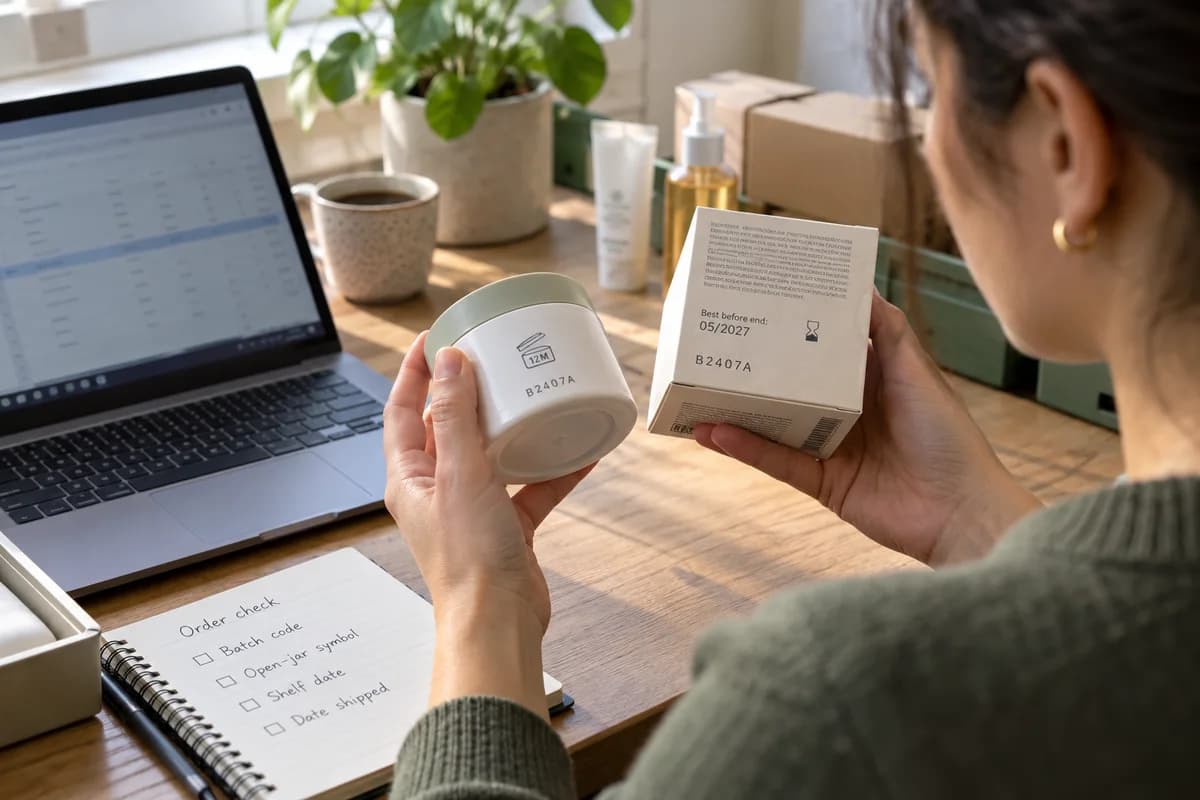
The open-jar symbol gives the months a product stays good after first opening. Shelf life is the time an unopened product keeps its quality. The batch code names the production run. Show the first two on the product page. Log the batch on every order line.
Three marks on one jar, three different questions
Customers mix these up, and so do staff. Each mark answers one question. The batch code says where the jar came from, the date says how long it keeps unopened, and the symbol says how long it lasts after opening.
A batch code is not a date, although some brands hide a production month inside it, and only the brand can tell you how its codes are built. Never guess from the digits.
The shelf date has its own trap. Some packs print a manufacture date instead of a best-before date, so read the words beside the numbers before you do any sums.
How to read the open-jar symbol
It is a small drawing of an open tub, followed by a number and the letter M, printed on the base, the tube crimp or the carton. The number is months. A tub marked 12M lasts twelve months from first opening. The clock starts when the customer breaks the seal. It does not start at checkout.
Products that keep for a long time may carry only the symbol. Products that spoil sooner show a date, often beside an hourglass drawing or the words best before end of, and many packs carry both marks. Under the EU Cosmetics Regulation, the label also shows the batch number, but other markets differ, so check the regulator for each country you ship to.
How a jar can be in date and still too old
Take an unopened vitamin C serum with a shelf date a year away. The buyer opens it in March and the box carries a 6M symbol, so the serum should be used by September, whatever the printed date says. The earlier of the two always wins.
Storage matters too. A bathroom shelf beside a hot shower, a car glovebox in summer or a sunny windowsill can shorten a product’s life well before either printed date arrives. Ask where the jar has lived.
- What batch code is on the base, tube crimp or carton?
- Which number of months sits beside the open-jar symbol?
- On what date was the product first opened?
- Where has it been stored since?
- Has the colour, smell or texture changed?
Where each mark belongs on the page and in the record
On the product page, show the open-jar months in the details tab beside the ingredient list, and write the symbol out in words for screen readers. State the minimum shelf life you ship with once, in your delivery policy, because a promise repeated on every product page goes stale the day the stock changes.
Keep the batch code off the page. It changes with every production run. Record it in the order instead. When the packer takes the jar, the batch lands on the order line, and support can open the order and see what was sent.
Returns need the same care. Read the code from the jar being returned, not from the order, and log it next to the reason, because the two can differ. Complaints then group by batch.
- Batch code shipped, per order line
- Open-jar months or shelf date for that product
- Date shipped and carrier
- Batch code read from a returned jar, with the reason
Give support a short script and a card
A customer writes, is this expired? A good reply asks for three photos: the batch code, the open-jar symbol and the date, taken in daylight so the print is legible. The agent then opens the order, compares the batch with what was shipped, asks when the product was first opened and works out the use-by date from that day.
Reactions are a different matter. If a customer reports redness or a rash, record the product, batch, date opened and what happened, then pass it to whoever handles product safety. Agents should not give medical advice.
Print the jar-reading card for every desk. This week, photograph the three marks on five of your own products and use the photos as the first page of the support guide.
Jar label reading card
A one-page card with three boxes, one each for batch code, shelf date and open-jar symbol. Each box shows a photo, the question it answers, where to find it on a tub, a tube or a pump, and what to log in the order. Below sits a table with a row per product and columns for open-jar months, date format and where the code is printed.
Open a blank worksheet to printQuestions owners ask
Is the batch code the same as the expiry date?
No, they differ. The code names the production run. The date shows how long the unopened product keeps its quality. Some brands encode a production month in the batch code, but only the brand can confirm how, so ask before you rely on it.
Can we sell a product close to its best-before date?
That is your policy, and marketplaces set their own limits. State the minimum remaining life you ship with, send the earliest dates first, and tell buyers in the delivery policy what to expect.
Why might the carton and the jar show different batch codes?
A carton can be printed in a different run from the jar inside it, especially when packaging is ordered in bulk and filled over several months. Log both codes, ask the manufacturer to explain the mismatch and make sure recall notices quote the right one.
Does the open-jar symbol appear on tubes and pumps too?
Yes, it sits on tubs, tubes and pumps alike. Where a pack shows neither a symbol nor a date, ask the manufacturer before you stock it, because the missing mark may be an error.
Sources
- Regulation (EC) No 1223/2009 on cosmetic products, EUR-Lex — verified 17 Oct 2026