In this guide 6 sections
Ask a chemical software vendor to show, not describe. Have them author a safety data sheet from your formula and print a GHS label for a real pack. Then trace one finished lot back to raw material lots, block an expired drum and assemble a tanker dispatch pack. Anything they cannot show is a gap.
Ask them to build a safety data sheet from your formula
Hand the vendor one of your own formulas, with CAS numbers and ingredient concentration ranges. Ask for the safety data sheet live. Watch where the hazard classification comes from: a raw material library, a calculation rule, or a person typing it in.
Then change one ingredient. A sound system creates a new revision, keeps the old one and lists the customers who received it. A weak one overwrites the file.
Ask about languages as well. A sheet for a buyer in Germany reads differently from one for a buyer in Texas, and every translation must follow the master revision, not drift from it.
- Where the hazard classification is calculated or entered
- Revision history with the approver’s name on each version
- Translations tied to the master revision
- A link from each sheet to the customers who received it
Check GHS labels against the actual container
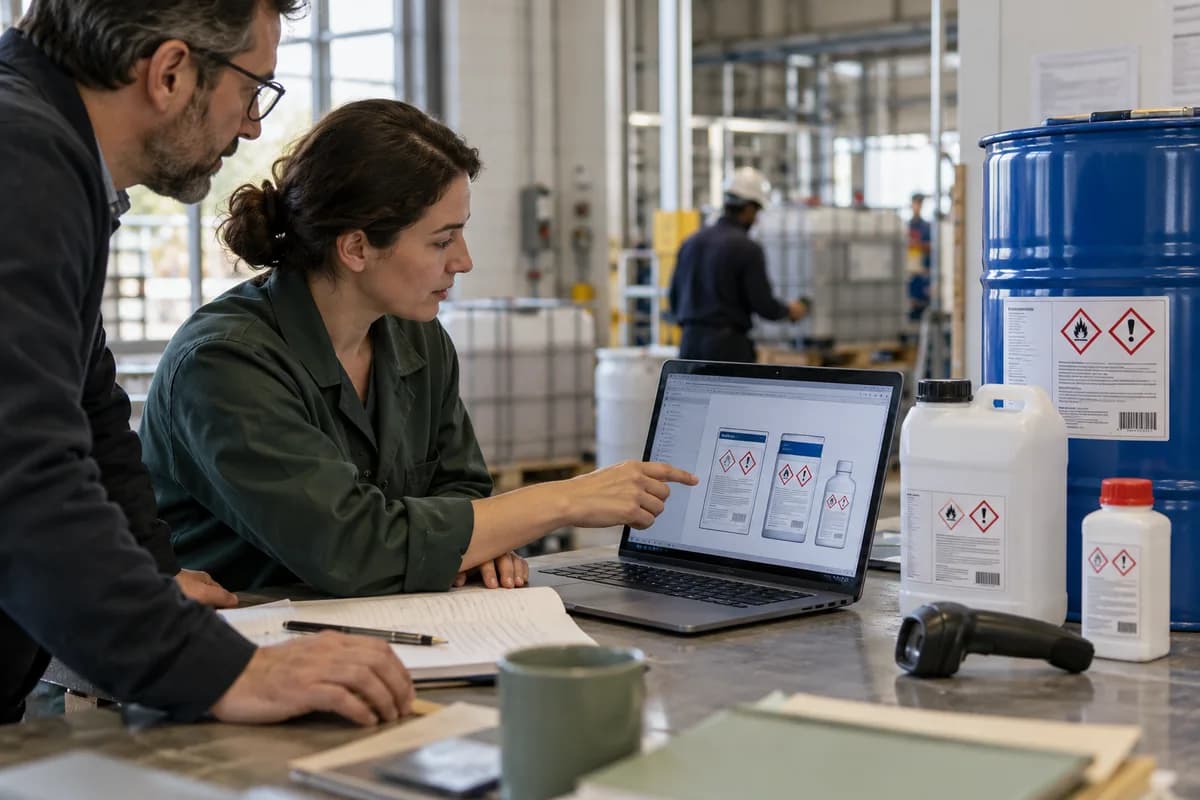
Request a label print for the same product in a 200 litre drum, a 25 litre jerrycan and a one litre bottle. Pictograms, signal word, hazard statements and precautionary statements must fit each size. Small packs usually need a reduced layout, and many tools cannot do that.
Ask which printers and label stock the software supports. A thermal transfer printer on a filling line behaves nothing like an office laser. The label should carry the batch number and a barcode that scans back to the lot record.
Transport marks are a separate matter. A drum leaving by road may need a UN number panel and a class diamond beside the GHS label. Does one print job cover both?
- Label sizes and layouts supported for small packs
- Printer models and label stock tested
- Batch number and barcode printed on the label
- Transport marks produced alongside the hazard label
- What happens to old label templates when a sheet is revised
Follow one lot from raw material to customer
Pick a finished batch and ask for its genealogy in both directions. Forward from a raw material lot to every batch that used it. Back from a customer complaint to the supplier’s certificate of analysis. Time the demo with a watch. Slow answers tell you something.
Ask how the batch record captures charge weights against the recipe, hold times, reactor temperatures, in-process checks and operator sign-off. Look for a deviation entry and see what the system does when a weight falls outside tolerance. Scanned paper binders are storage, not traceability.
Ask about reworked and blended batches. That is where lineage most often breaks.
- Forward and backward trace shown on screen
- Charge weights compared with the recipe
- Deviation entry with a named approver
- Lineage kept through rework and blending
- Supplier certificate attached to the receiving lot
Test expiry and quarantine rules with a drum
Ask the vendor to receive a drum into quarantine, release it after a QC check and then let it pass its retest date. What does the screen do on the day? A sound system blocks the issue to production or warns loudly, and offers a retest with a new date.
Check first-expiry-first-out picking. Ask how stock in tanks, totes and part-used drums receives a date. Part-used containers are the usual blind spot. Press on it.
Storage rules matter too. Some systems warn when incompatible hazard classes are put into the same bay, or when a flammable lot is moved to an unrated room.
Look at dispatch papers, then call two references
Ask for a dispatch pack for a tanker or a mixed pallet load. It should hold the invoice, packing list, certificate of analysis tied to the lot, the safety data sheet at its current revision and the transport documents. If staff must gather these by hand, the gain is small.
Then ask for two reference calls with chemical makers close to your size, not a general manufacturer. Ask what the system could not do on day one and how long the first customer audit took.
Take this list to every demo and score each question yes, partly or no. Compare the scores side by side the same evening, while memory is fresh.
Chemical software vendor scorecard
Twenty rows fill a single page, grouped in five blocks: safety data sheets, labels, lot genealogy, expiry and storage, dispatch papers. Columns are the question, whether it was shown live or only described, a yes, partly or no mark, the evidence seen and a notes cell. A total row at the foot compares vendors.
Open a blank worksheet to printQuestions owners ask
Should the vendor already know our regulations?
They should know the rules of your market and show how the product handles them. Your regulatory officer still owns the decision. Ask which rule changes the vendor has released updates for.
Is a demo with sample data enough?
No. Use your own formula, your own label sizes and one real batch history. Sample data is built to look good.
Who should sit in the demo?
The QC lead, the person who writes the safety data sheets, a stores supervisor and the dispatch clerk. Each will spot a different gap.
What if the software does not print GHS labels at all?
Ask whether it connects to a separate label tool and how the batch number reaches it. A manual retype between the two is a risk you should price in.