In this guide 6 sections
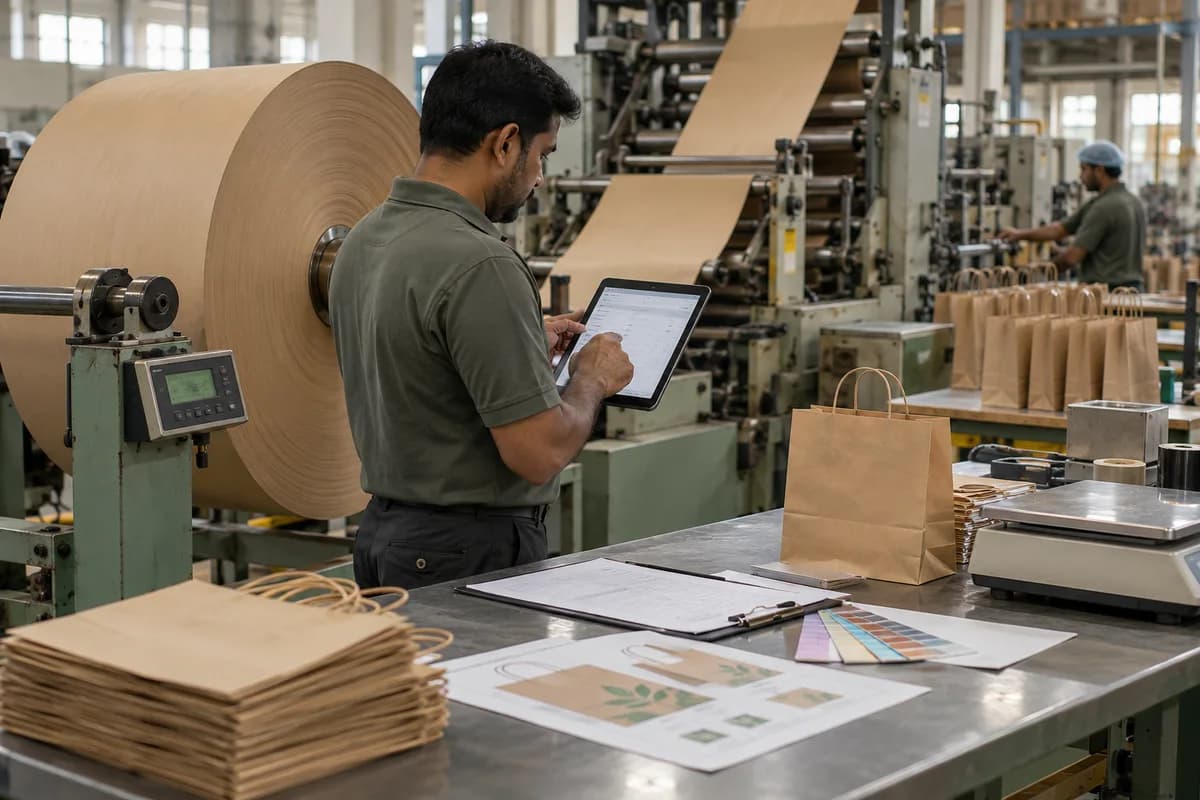
A paper bag maker needs software that holds a full bag spec per order. It should deduct reel weight against each machine run, record wastage, and keep the customer’s signed print approval attached to the job. A package that misses any of these will not replace your registers.
Can the system describe a bag exactly?
A bag is not just a piece rate. Width, gusset, height, paper grade, handle type, handle length and bottom pasting all change the cost, so two bags that look alike on a quotation can need different reels.
Look for a spec sheet that saves each of those fields against the customer’s item code, so reorders start from a known bag with no phone call needed.
Enter your trickiest bag in the demo. Try a twisted paper handle with a patch reinforcement at the mouth, since that combination exposes weak spec fields fast, long before any contract is signed.
- Flat width, gusset and finished height
- Paper grade, GSM and reel width
- Handle type: twisted, flat or die-cut
- Patch or card reinforcement at the mouth
- Bottom style and pasting pattern
Reel consumption should post itself
Reels are your biggest material cost. They arrive in different weights, and a bag order consumes part of a reel, so the system has to deduct by weight or running metres, not by whole reels.
The operator should log reel number, start weight and end weight when the machine stops, and the leftover core goes back to stock with a fresh weight.
A month of entries shows which bag sizes waste paper at the cutter and which supplier’s reels split at the splice, evidence that settles price talks.
Machine runs need more than a start time
Machine speed is fixed, yet jobs overrun. Reel changes, paste trouble at the bottom folder and handle-attaching jams eat the shift, so software should record each run with its operator, reel and stoppage reason.
Short entries beat long forms here. A supervisor with a tablet at the machine will tap a reason code, but he will not type a paragraph about why the folder jammed.
Compare planned pieces against counted pieces at the end of each run, because the gap is your wastage and it belongs on the job. Without it on record, the owner learns about overruns only when the invoice is late and the customer has stopped answering.
- Operator, machine and shift
- Reel numbers loaded
- Pieces counted at the packing table
- Stoppage reasons chosen from a short list
Print approval has to stay with the job
Printed bags fail in one way above all. The customer disputes the colour or the logo position after delivery, and a signed artwork proof is your only defence against a rejected pallet.
Store the approved PDF, its date, the approver’s name and the Pantone references against the order, along with the plate or flexo block details. A reorder then finds everything together.
Plain unprinted bags need none of this. A good system lets you switch the print block off for those orders, so the operator never scrolls past empty colour fields on a busy shift.
What to ask before you buy
Bring three real orders to every demo and watch each one travel from enquiry to dispatch: a plain bag, a printed bag and a rush reorder.
Ask how deliveries are packed, since bundles of fifty, cartons of five hundred and mixed pallets should all print on one delivery note.
Ask who can add a field. Your factory will add a bag type next year, and waiting on the vendor for a new field would stall the order desk.
- Does it track reel weight, not just reel count?
- Can artwork approval be attached and searched?
- Can you add custom fields without the vendor?
Bag order spec sheet
Three blocks fill this single-page template. The first lists the bag: dimensions, paper grade, GSM, handle type and bottom style. The second lists the print: colours, Pantone references, block or plate number and the approved proof date. The last covers the run: reel numbers, start and end weights, pieces counted and wastage.
Open a blank worksheet to printQuestions owners ask
Do small bag makers need dedicated software?
If you run a few machines and a handful of bag types, a well-built spreadsheet can hold. Once print approvals and reel tracking start causing disputes, dedicated software pays for itself in saved arguments.
How should reel stock be counted?
By weight, with each reel carrying its own number. Partly used reels go back with a fresh weight so the next job knows what is left.
Can software cost a bag with a handle?
Yes, if handle material, length and attaching time are separate cost lines. Then a flat handle and a twisted handle are priced from real inputs.