In this guide 6 sections
Raw nut from several suppliers is often tipped into one roasting batch, so the paper trail ends at the weighbridge. Tracing needs a lot register that records which purchases fed each roast, then carries that link through shelling, peeling, grading and the export batch.
Where the trail breaks first
A cashew factory buys raw nut from farmers, traders and agents, often on the same morning. Each truck gets a weighbridge slip and a purchase entry. That part is usually fine.
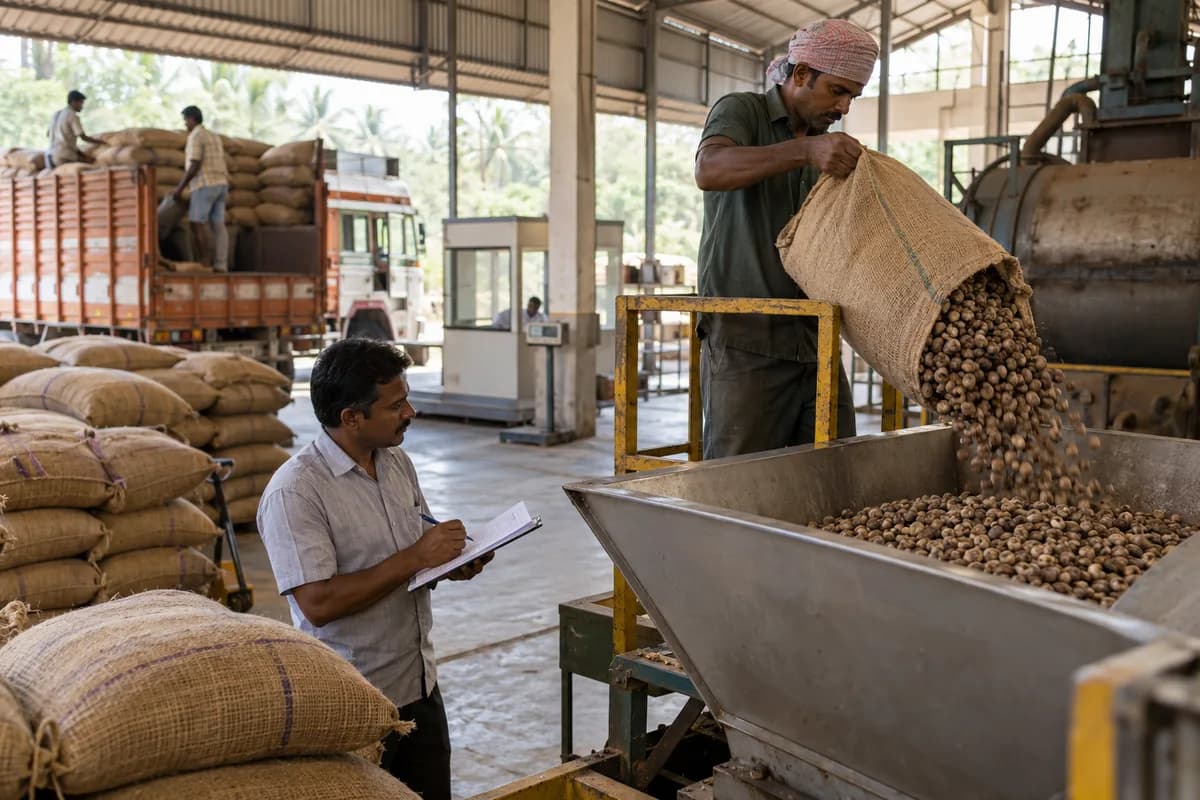
The break comes at the store. Bags from different suppliers are stacked together, drawn down in whatever order the loader finds convenient, and emptied into the roaster hopper. The slip never travels with the bag.
After that the factory knows how much raw nut went in. It does not know whose nut was in a given roast. That single gap makes every later question hard.
- Weighbridge slips that stay in the office
- Bags stacked without a supplier tag
- Mixed hopper loads
- Stock counted as one raw nut pile
Why mixing is a normal part of the process
Mixing is not carelessness. It is routine, and in a busy season it happens every shift. Raw nut arrives in uneven sizes and moisture, and a roaster runs best with steady batches. Plants blend to keep output steady and to use up older stock first.
The answer is not to ban blending. It is to record it. A roast batch can draw from three purchase lots, as long as the register shows which three and how many kilograms from each.
Origin, outturn and moisture differ by supplier. Those figures help only if they stay attached to the nut they describe. Most plants lose them within a day.
What a lot register records at each step
Think of the register as a chain of linked rows. Every step creates a new lot number and lists the lots that fed it. Nothing is overwritten.
At intake, a raw lot holds supplier, date, truck, gross and net weight, moisture and the outturn from a cutting test. At roasting, a roast batch lists its raw lots and weights. Shelling then yields kernels, shell and testa, each with a recorded weight.
Peeling, grading and drying follow the same rule, with the borma or drying chamber load recorded as a lot of its own. By packing, a kernel grade such as whole white, splits or pieces points back through the chain to the purchases behind it.
- Raw lot: supplier, truck, net weight, moisture, cutting test result
- Roast batch: raw lots drawn and kilograms from each
- Shelling output: kernel, shell and broken weights
- Grade lot: grade, packing date and carton count
- Export batch: grade lots in the container
Using the register when a buyer complains
A buyer reports rancid or insect-damaged kernels in a carton. Without a register, the factory pulls samples and guesses. With one, you read the carton number, find its grade lot, and list the raw lots behind it.
You may find two of the four suppliers share a village, a trader or a damp storage habit. That is a real finding, and you can raise it with them. It also lets you recall only the affected cartons, not the whole container.
The same chain answers cost questions without a separate study. Which supplier gave the best kernel recovery from raw nut? A register answers it from facts rather than memory.
Starting without stopping the plant
You do not need to rebuild the plant. Begin by tagging each raw bag or stack with a lot number at intake, using a printed label or a painted code.
Next, have the loader at the roaster write the lot numbers drawn for each roast on a simple slip at the hopper. Enter it into the register at the end of the shift. The tablet or screen can come later.
Run it for two weeks on one roasting line, with one loader and one supervisor who both know why it matters. Then trace a kernel carton back to its purchases as a drill, using only the register and the weighbridge slips. If you can do it in ten minutes, extend the habit to the other lines.
Cashew lot register template
A worksheet with four linked tables: raw nut intake, roast batches, shelling and grading output, and export batches. Each table has a lot number column and a feeder-lots column, so a carton can be traced back to supplier, truck, moisture reading and cutting test.
Open a blank worksheet to printQuestions owners ask
Do we have to stop blending raw nut?
No. Blending is fine when each roast batch records the raw lots and weights it drew. The register keeps the link, so you can still trace the result.
Is a paper register enough to start?
Yes, for a pilot. A bound book at the roaster with lot numbers and weights proves the habit, and it costs nothing to try this week. Software becomes useful once the volume of lots makes searching slow.
Why record the cutting test per lot?
It gives you a measure of nut quality at intake, taken from a sample cut open on the spot. Later you can compare it with kernel recovery, and judge each supplier by what their nut actually delivered.
Can this help with export documents?
It can supply the batch and origin facts a buyer asks for. Check each importing country’s own rules, and keep the certificates and test reports with the export batch.