In this guide 6 sections
Carriers hold cleaning products when a parcel contains an aerosol, a flammable liquid or a corrosive such as bleach without the right class, marking or quantity limit. Tag each product with a shipping class from its safety data sheet, restrict it to ground service, cap units per parcel and pack refills upright with absorbent.
What the carrier sees when it holds your parcel
Sorting hubs do not open parcels. They read the label, the declared contents and the manifest your system sent, then scan for leaks, smells and damp patches on the outer carton. A parcel gets held when those three disagree, or when a product class is not accepted on the service you chose.
A few product types cause most of the trouble. Aerosols hold gas under pressure, and the propellant is often flammable, so a can left in a hot van or a warm hub becomes a risk. Bleach is corrosive. Mixed with acids or ammonia it gives off harmful fumes. Solvent degreasers and some floor polishes have a low flash point.
Air service is the strictest. Cabin pressure and temperature swings make pressurised cans and loose caps riskier, so many carriers refuse these goods by air or accept them only under a separate agreement.
- Aerosol room sprays, air fresheners and spray polishes
- Bleach and chlorine-based disinfectants
- Solvent degreasers, thinners and some floor polishes
- Acid toilet and descaling cleaners
- Caustic drain openers and pool chemicals
Read the safety data sheet once and store the answer
Each hazardous cleaning product has a safety data sheet, and its transport section lists a UN number, a proper shipping name, a hazard class and a packing group. Copy those values into the product record. Do it once.
Add fields for flash point, net volume per unit and whether the carrier accepts the product as a limited quantity. A new fragrance or a changed formula can change the sheet, so tie the data to the exact variant, not to the brand line.
Then read each carrier’s own dangerous goods page. Their rules can be stricter than the legal minimum, and they differ by service level and by country. When a product sits near the edge, ask your account manager. Get the answer in writing.
Let a shipping class decide what checkout offers
Once the class lives on the product, checkout can act on it. Aerosols mean ground services only. An address on an island, or in a remote region that is served by air alone, should be refused for that line with a clear message.
Cap the units per parcel at the carrier’s limit for that class. When a basket goes over, split the order into two parcels instead of failing it, and let label printing add the correct hazard mark and declaration automatically.
Mixed baskets need one more rule. Bleach should never ride in the same parcel as an acid cleaner, because a single leak turns two ordinary products into a fume hazard. Keep incompatible classes apart.
- Shipping class field on every product variant
- Ground-only flag that hides air and express services
- Units-per-parcel cap by class
- Excluded destinations such as islands and remote postcodes
- Incompatible-pair list covering bleach, acids and ammonia
Pack so the bottle arrives dry
Leaks do as much damage as misclassification. A weeping bottle taints the parcel beside it, and a sorting hub will pull it off the belt. Most leaks start at the cap, at the trigger head, or in a bottle squeezed by the parcel above it in the cage.
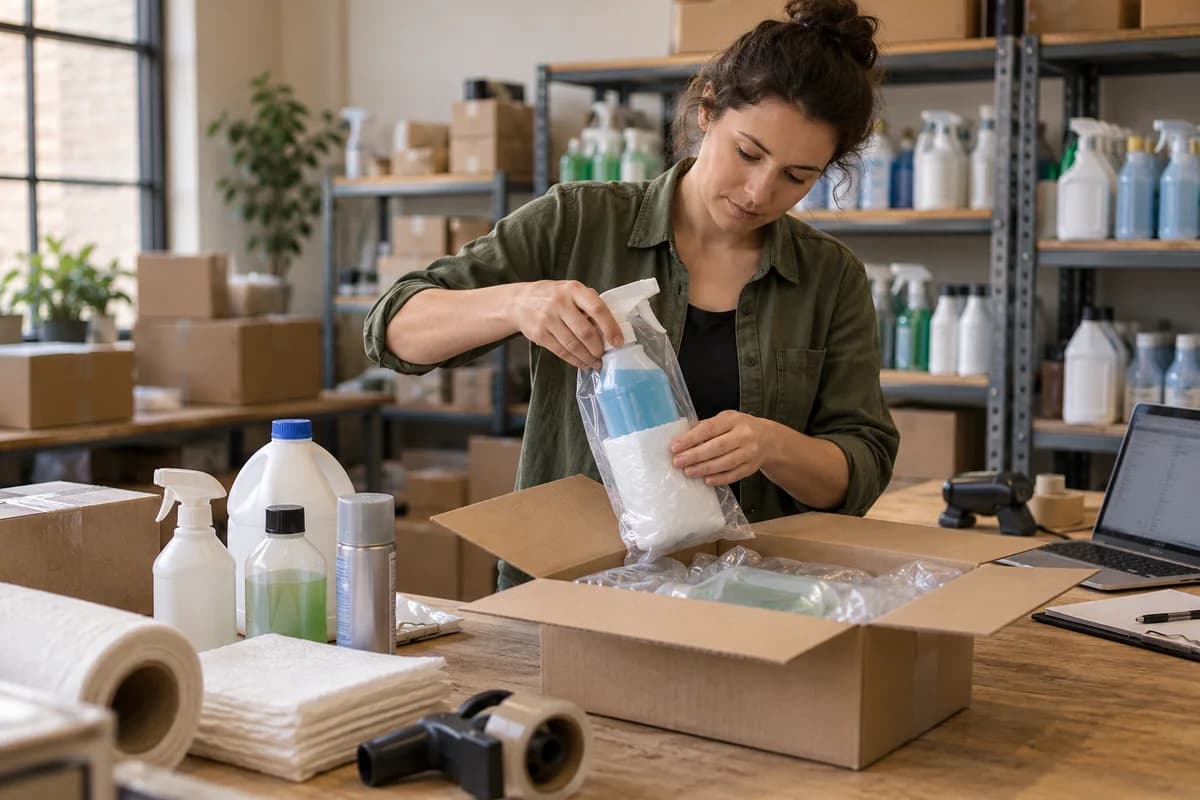
Use caps with a liner and tape trigger heads in the locked position. Place each bottle upright in a sealed inner bag with an absorbent sheet, then surround it with void fill so nothing presses on the cap or nozzle. Drop-test a packed sample first.
Refill pouches suit online selling because they weigh little and crush softly, but a pinhole in the seam can soak a whole carton. Use a stiff outer carton and a spout protector. Write the pack method on the product.
What to do with a parcel that is already held
Ask for the reason code first. A missing marking is fixable, a refused class is not, and a leak report needs photos taken before anyone repacks the parcel. Release, return and destruction run on different timelines. Ask which one applies.
Tell the customer the same day, and offer a ground reship where the carrier allows one. Log the held parcel against the product, not only the order, because three holds on one product point to a data gap rather than bad luck.
Open your last held parcel, find the missing field on the product record and fill it in before tomorrow’s orders go out. Start there. The rest of the catalogue follows.
Hazardous goods shipping sheet
A single page with one line per product variant. The columns are variant code, hazard class, UN number, packing group, flash point and net volume. Further columns mark ground-only, units per parcel and carrier acceptance by service, then record the pack method and the date the data sheet was last checked. A footer lists incompatible pairs and the person to call at each carrier.
Open a blank worksheet to printQuestions owners ask
Can I ship bleach by air?
Usually not. Most carriers restrict corrosives by air or accept them only under a dangerous goods agreement. Check the carrier’s page for your exact product and route, and default to ground.
Do I need a safety data sheet for every product?
Ask the maker for one per variant. It gives the transport classification, and a carrier may ask to see it after a hold.
Are refill pouches treated differently from bottles?
The classification follows the contents, but pouches face less pressure and less breakage. Limits and marks still apply, so declare and pack them as you would the bottle.
What if a marketplace blocks the listing?
Marketplaces keep their own restricted lists. Read the category policy, supply the data sheet when asked, and sell through your own store if the listing stays blocked.