In this guide 6 sections
Furniture damage claims repeat a few causes. One carton of a multi-carton order is crushed or missing, packing was never matched to each carton, and nobody photographed the delivery. Track every carton on its own barcode, set a fixed photo routine for claims and let customers order a single replacement part instead of a new piece.
Sort last month’s claims by cause before changing anything
Open the last thirty damage claims and read them in one sitting. The same few causes repeat. Tag each claim with one cause only, so a crushed carton is never also counted as a missing one, and let the tally show which fix comes first.
Use causes that point to a fix. Crushed carton, missing carton, edge or corner knock, scratched finish, broken glass, wrong part supplied and damage found only at assembly each lead somewhere different. A tag reading damaged in transit leads nowhere.
Also record where the carton was last scanned in good condition and which carrier leg followed, because that one field separates warehouse faults from road faults. It settles most arguments with a carrier.
- Order number and carton number, such as 2 of 3
- Cause tag from a fixed list of eight or fewer
- Last good scan and the carrier leg after it
- Where the damage was found: delivery, unpacking or assembly
- Photo set received, yes or no
A multi-carton order fails one carton at a time
A wardrobe ships as four cartons. A bed frame ships as three. They rarely travel together. One carton arrives on Tuesday, another on Friday, and a third sits in a depot with a torn label and no scan since the weekend.
The customer sees a broken promise. They open the first carton, find no legs and report the item missing, while your agent sees one order number and one tracking line that says delivered.
Give every carton its own barcode, scanned at packing, at hand-over and at delivery, and show the customer 1 of 4 delivered, 3 on the way. A missing carton becomes one trace, not a long call about a whole wardrobe.
Match the packing to the carton, not the product
A product page sells one bookcase. The warehouse packs cartons, and the glass shelves, the back panel and the side panels each need different protection even when they share a box.
Store a pack method on each carton record: corner guards, edge protectors, honeycomb board, foam, strapping, a crate for mirrors and stone tops. Add orientation arrows and a heavy label. Pickers pack to the record, not memory.
Test the carton that fails most. Drop it from table height onto a corner, strap it to a pallet, wheel the pallet across the yard and stack two more cartons on top. Alter a single variable per run, then compare the damage.
- Corner guards and edge protectors for panels
- Honeycomb board or foam sleeves for glass and mirrors
- Crate or full wrap for stone and marble tops
- Strapping and stretch film for pallet loads
- Orientation arrows and a weight label on every side
Make the delivery photo part of the delivery
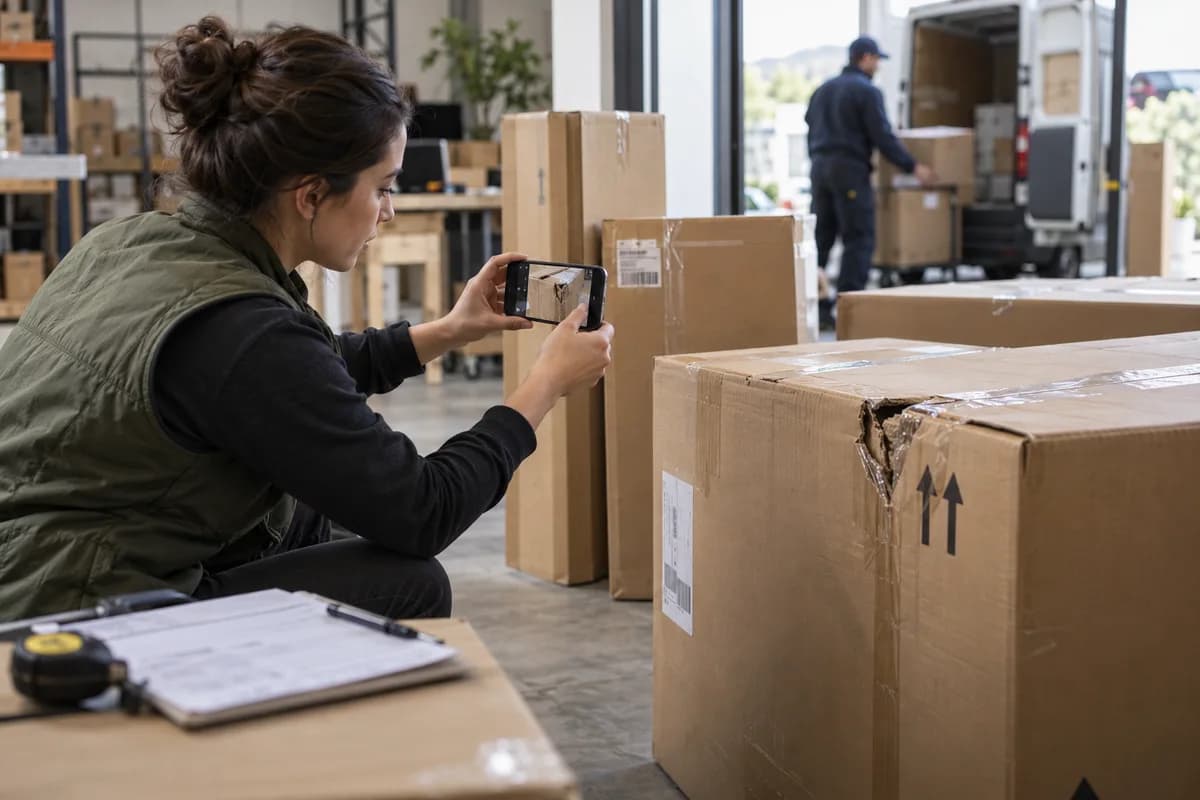
Photos settle claims, but only the right ones. A picture of a broken leg in the living room tells the carrier nothing about where the damage began or what the carton looked like at the door.
Ask for a fixed sequence. First all cartons together on the doorstep, then the shipping label, then the damaged corner with a coin or tape beside it, then the inside. Packing stays until the claim closes.
Give drivers a handheld that photographs each carton at the door, and build the same sequence into the claim form with one photo field per step. Compare the two sets when a claim arrives.
- All cartons together, before opening
- The shipping label and carton number
- The damaged area, with a coin or tape for scale
- The inside packing, if the carton is opened
- A note on any stained or wet packaging
Order the missing part, not a new wardrobe
Most damage hits one panel or one leg. Replacing the whole piece pays for freight twice and leaves a mostly good wardrobe in the customer’s hall waiting for a second collection.
Give every part a code from the assembly guide, with a size, a weight and a photograph for each panel, shelf, leg, hinge and fittings bag. Customers pick the part from the exploded diagram. An agent confirms the pick.
Parts usually travel by parcel, which is simpler than a second freight run, and linking each part to its claim shows which products need parts most. Start by giving a code and a shelf location to the five parts requested most often last month, then add the rest as claims come in.
Damage claim log
Rule a table across one sheet. Columns run from order number and carton number (n of N) through product and finish code, cause tag and where the damage was found. Later columns hold the last good scan, the carrier and service, the photo set received, the part code needed and the resolution. Resolution is a replacement part, a panel swap, a partial refund or a full refund. A strip beneath tallies causes for the month.
Open a blank worksheet to printQuestions owners ask
Who pays when furniture is damaged in transit?
Check both your carrier contract and the consumer rules where you sell. In practice stores usually fix the problem for the customer first and claim from the carrier later, which is why scans and photos at hand-over matter.
Which photos should a customer send?
Four photos cover most claims: every carton together, the label, the damage with a coin for scale, and the packing inside.
How do I tell warehouse damage from carrier damage?
Compare the packing photo and the last good scan with the delivery photo. A carton scanned out in good order and photographed damaged at the door points to the carrier leg.
Is heavier packaging always the answer?
No. Extra board and foam add weight and volume, and freight is priced on both. Test stronger packing on the carton that fails most before you apply it across the range.