In this guide 6 sections
Serial numbers drift because stores, crew and office each write them down at different points, and nobody links them to the customer record a warranty claim depends on. The hunt takes days. Meanwhile the customer waits for power, and the manufacturer waits for a serial that nobody can read off the roof without sending an engineer out.
Where the serial numbers come from
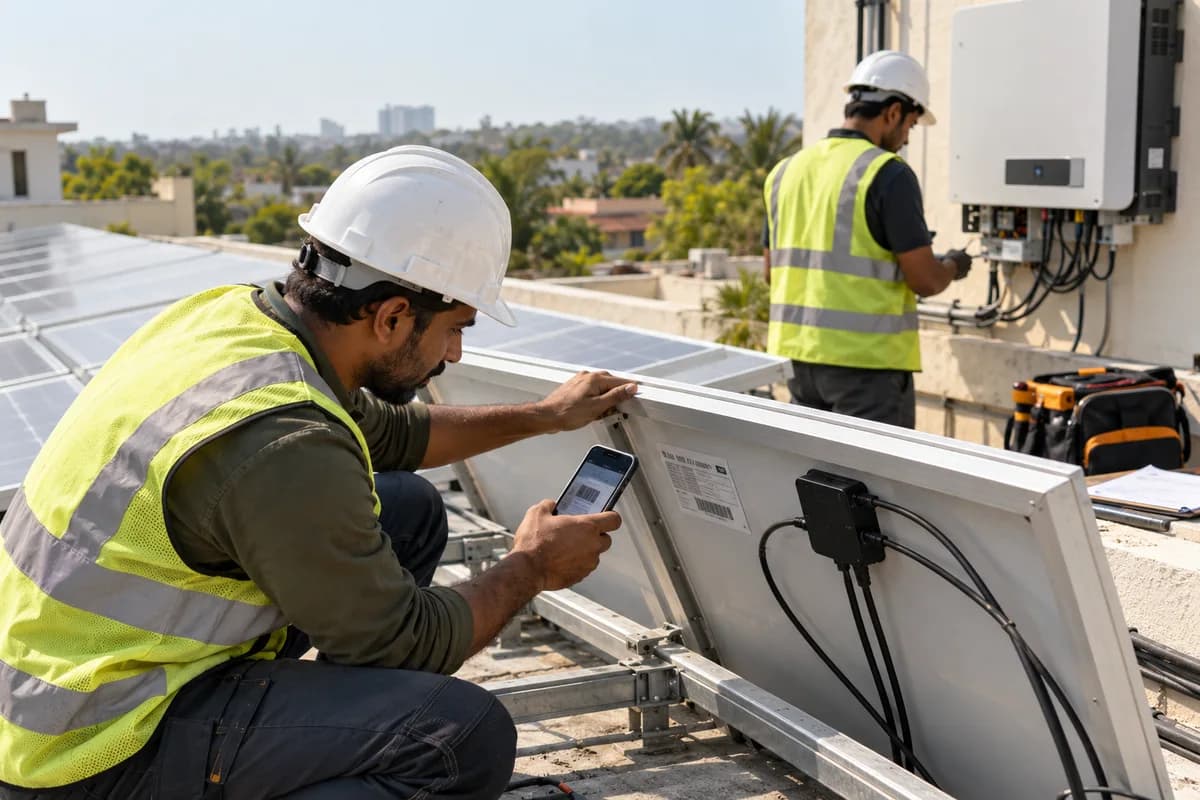
A solar panel carries a serial on its rear label, the inverter has its own rating plate, and a monitoring stick or datalogger adds one more number. One rooftop site can easily hold forty panels, one inverter and a monitoring stick, which means forty-two numbers to copy by hand.
The manufacturer prints every one of these numbers, so your records match only if someone copies them with care on a hot roof at four in the afternoon. Digits swap. An eight becomes a three. A B turns into an 8. Two crew members read one label differently, and both entries look perfectly fine in a spreadsheet once they are typed up later that evening.
The distributor’s pack list sometimes carries serials too, but a distributor packs from whatever stock sits nearest, and the paper follows the order rather than the pallet. Treat that list as a hint. It is never the record.
Three places the chain breaks
The first break is goods receipt, where pallets arrive from the distributor and the storekeeper signs the delivery note because the stack looks complete. No serial is scanned. The batch record starts empty before a single panel leaves the shed, and nothing downstream ever fills the gap, however carefully the crew works.
The second break is dispatch, when panels from two pallets go onto one van for two different sites and the crew mixes them up without noticing. Site records now describe the wrong panels.
The third break is commissioning, where the crew photographs the labels and the photos land in a phone gallery that nobody has time to read against the right customer. The images stay unread.
- Goods receipt signed without scanning
- Pallets split across vans for different sites
- Label photos left in a phone gallery
- Replaced part, old serial kept
- Datalogger or stick serial missed
What it does to a warranty claim
A customer reports that the inverter has tripped and will not restart, and the manufacturer asks for three things: the serial, the purchase invoice and the commissioning date. You hold the invoice. You do not hold the serial.
So an engineer drives out to read the plate, losing a day while the customer sits without power and the plate may have faded in the afternoon sun. Peeling stickers stall claims for weeks.
Panel claims are worse, since a hotspot or cracked cell needs a serial for the supplier to trace the production batch, and without one it may be declined. Meanwhile the customer sees only an installer who cannot prove what was fitted, so trust drops and the next quote becomes harder to win.
Fix the chain one scan at a time
Capture serials at the earliest point by scanning the barcode at goods receipt, assigning each panel to a job at dispatch, and confirming it on the roof. Three scans catch mismatches early. A panel seen at dispatch but never on the roof is easy to trace within the week while the crew remembers, yet close to impossible a year later.
A phone camera reads a barcode, so pair it with a form that refuses to close the job until panel serials equal the bill of materials count.
When a part is replaced, the new serial goes onto the site record and the old one is marked returned, with the supplier claim number beside it.
- Scan at goods receipt
- Assign serials to a job at dispatch
- Confirm on the roof against the job
- Block job closure when counts differ
- Log old and new serial
Check your records this week
Pick five sites from last year and try to name the inverter serial and panel serial range for each within two minutes, then count how many you managed. Be honest about it.
If three or more fail, start capturing serials on every new job from Monday morning, with no exceptions for small rooftops or rushed installs. Back-fill older sites whenever a service visit takes an engineer to the roof, and add a serial line to that visit checklist. Keep a simple tally. It moves every week. The tally also shows your crews, in plain numbers, whether scanning at the roof is becoming a habit or fading once the first week of enthusiasm has passed.
Serial register template
Register on one sheet. Columns: site name, item type, serial number, scanned at receipt, assigned at dispatch, confirmed on roof, commissioning date, warranty end and replacement note. A second block lists replaced parts with old serial, new serial, reason, supplier claim number and the date the supplier agreed to replace or credit the unit.
Open a blank worksheet to printQuestions owners ask
Do we need to record every panel serial?
Yes, for any panel the manufacturer will ask about in a claim, since panel warranties are traced by production batch and a missing serial can weaken a claim. Record all of them.
Can the crew photograph labels instead of scanning?
Photos are a useful backup but slow to read later, whereas a scan gives searchable text while the photo stays attached to the record as proof. Scan first, photograph second.
What if serials were never recorded on old sites?
Collect them during the next service visit by adding a line to the checklist, so the engineer reads the inverter plate and a sample of panel labels. Do not chase everything at once.
Who should own the serial register?
The stores lead owns it, with the site engineer confirming each serial on the roof, so one person keeps the register consistent and answers every supplier query. One owner, one register.