Purchase Order Management for Personal care product manufacturers
Record authorised supplier orders and track what remains due.
Does this function belong in your operation?
Use when purchasing commitments need control before delivery and billing.
The business agrees to purchase goods or services.
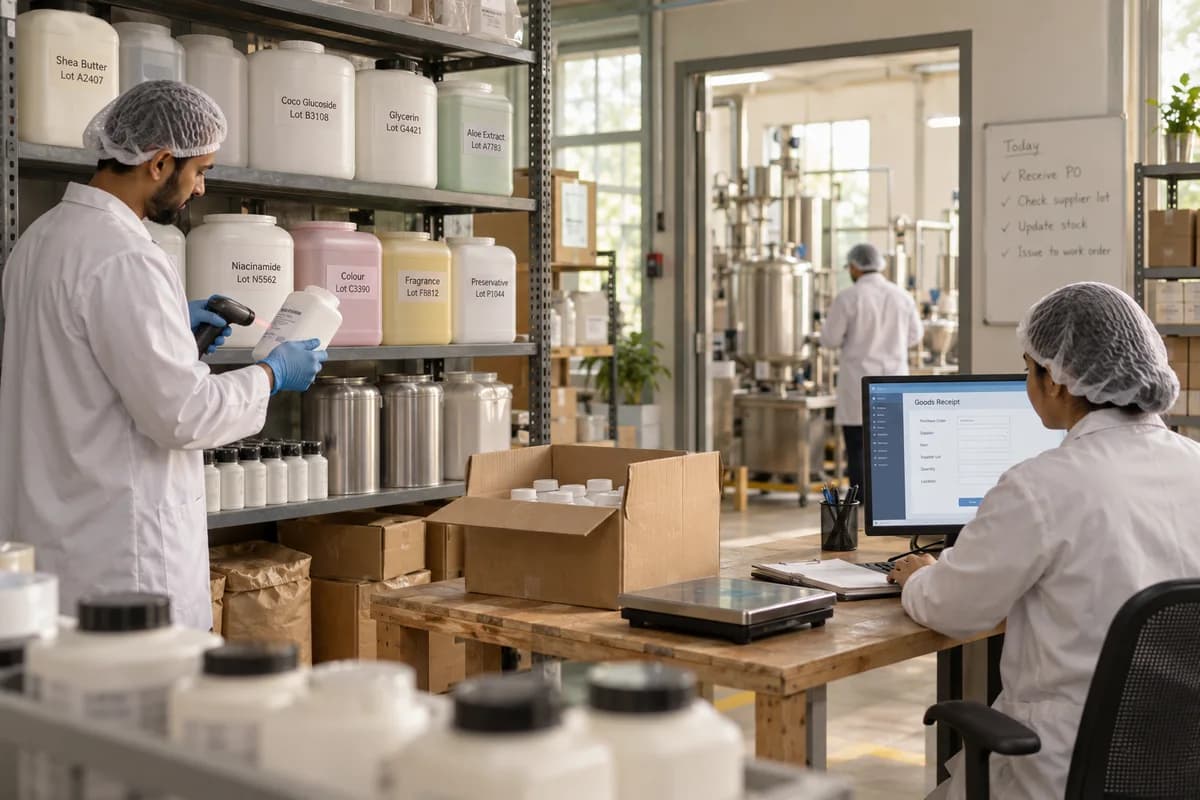
Purchasing must preserve the grade of an ingredient and the exact bottle, pump or tube specification needed for a personal-care batch. A supplier’s delivery includes evidence required by the plant’s receiving process, such as an agreed certificate of analysis. The PO links that requirement to supply; quality acceptance and supplier payment remain separate decisions.
Bring the records the workflow depends on.
- Approved batch shortage or replenishment request
- Ingredient grade or pack-component specification and unit
- Supplier quotation and accepted commercial terms
- Required receiving documents and purchase authority
Outputs to check
- Outstanding ingredient and packaging commitments
- Orders supporting bulk or filling requirements
- References for receipt checks and invoice reconciliation
Follow the purchase order management workflow.
Use this sequence to compare your current process with the proposed module. Agree the owner, permission and exception at each step.
Who uses the module, and who approves?
Keep responsibilities distinct even when one person holds more than one role.
Decide how exceptions are handled.
These business rules belong in configuration and testing. A normal transaction alone does not demonstrate that the workflow is ready.
Can this work independently?
Purchase orders can run as a controlled register with entered supplier and item data. Goods receipt owns physical acceptance, accounts payable owns invoice matching and posting, and the payment process owns settlement. Connecting those records provides closure evidence; issuing a PO performs none of those later actions.
Systems and records it connects with
- Goods receipt: Counted, accepted and rejected supplier-delivery quantities.
- Stock tracking and alerts: Item-location quantities and authorised stock movements.
- Vendor management: Approved supplier identities, terms and sensitive-change controls.
- Your accounting software: Posted financial entries and reconciliation references.
Configure, test and introduce the workflow.
- We follow how items are requested, ordered and received. You provide recent orders and supplier lists. A summary note comes back.
- Rates, credit periods and freight terms are entered for each supplier. The purchase assistant checks them. Stock levels that trigger an order are set item by item. The owner approves the list.
- New orders are raised on screen while the old method runs. Differences are explained and corrected. Storekeepers receive on phones and accounts match bills. Old order books are closed.
Check the result before rollout.
Apply these checks to a sample from the agreed workflow, then repeat with an exception. Keep the expected result beside the test record.
- Trace a purchased ingredient lot to the ordered grade and required receiving documents.
- Check that a short bottle shipment leaves its remaining quantity open.
- Retain original and amended prices with the reviewer who approved the change.
How the business operates.
You buy surfactants, emollients, preservatives, fragrance oils, laminated tubes, pump dispensers and printed mono cartons, make bulk in a kettle batch, and fill it into packs. You sell through distributors and marketplaces, and some brand owners hand you their own formulas.
The records that hold the operation together.
- Approved formulation and bulk-batch reference
- Ingredient lots and actual issues
- Container, closure, label and artwork revision
- Filling, packing, rejection and release records
Operational bottlenecks to check
Bulk yield and filled count disagree
Bulk made in the vessel, packs off the filling line and leftover bulk in the drum are measured on different sheets, so loss is guessed. The gap between kettle and carton is never explained.
Packing components run out mid-batch
Printed cartons, tubes and pumps carry artwork versions, and the wrong revision is found at the line with the shipper already half packed. Filling stops until the right stock is hunted down in the store.
How work flows across this business
This module sits within a wider operating process. Use the sequence to identify the other teams and records affected by a change.
1. Agree the product and pack
Record the formulation, pack size, artwork and brand-owner approval relevant to the order.
2. Make and identify the bulk batch
Issue accepted ingredient lots and record the plant observations and actual yield required by the process owner.
3. Release and fill
Quality authorises the bulk for filling. Record the containers, closures and artwork used, along with filled units, rejects and unused components.
4. Check the finished batch
Attach the finished-pack checks and retained-sample reference. Keep held stock separate until the responsible person releases it.
5. Dispatch and investigate returns
Identify the batch sent against each brand or customer order. Link returns and complaints to the batch and its original ingredients and pack materials.
Industry reports to connect with
- Bulk yield and filling reconciliation
- Packing-component shortages by artwork version
- Held and released finished batches
- Complaints and returns by batch and reason
Questions before implementation.
When should personal care product manufacturers consider purchase order management?
Use when purchasing commitments need control before delivery and billing. The business agrees to purchase goods or services.
What should we bring to the requirements discussion?
Bring anonymised examples of Approved batch shortage or replenishment request; Ingredient grade or pack-component specification and unit; Supplier quotation and accepted commercial terms; Required receiving documents and purchase authority. Show who creates, checks and changes each record. Use only records from an activity that meets the suitability conditions above.
Does this replace our existing business software?
The starting point is your current system and the gap you need to close. Record authorised supplier orders and track what remains due. Configuration, a connected module or a custom build are evaluated against that gap before a replacement is proposed.
What is outside this module?
A purchase order does not confirm supplier acceptance or physical receipt.
How are scope, price and rollout decided?
The proposal follows a review of your records, user roles, branches and existing software. Data migration, connections, training and support are scoped separately where needed. Trace a purchased ingredient lot to the ordered grade and required receiving documents. Use this check when reviewing the first working version.
Related functions for personal care product manufacturers.
Discuss purchase order management for your business.
Tell us which workflow needs attention and which systems your team uses. The next step is a requirements discussion and a written scope.
What happens after you share your requirements
- We review your brief and the systems you already use.
- We clarify the workflow, missing information and the work to consider first.
- The proposed scope sets out the deliverables, responsibilities and dependencies.
- Review the scope and commercial terms before deciding whether to proceed.
Start with your requirements
Describe your current process, the people involved and the change you need. Start with the details you know; we can clarify the rest together.
Share your requirements