In this guide 7 sections
ECE R129 and ECE R44 are United Nations rules used across Europe and other markets, and FMVSS 213 is the United States federal standard. R129 groups seats by child height and R44 by weight. Store the standard, the label details and the height and weight range on each record. This is software help, not legal advice.
Three standards, two sets of rules
ECE R44 and ECE R129 are regulations under the United Nations vehicle rules, and each market decides which of them it still accepts for sale. R44 is the older rule. R129, often sold as i-Size, is the newer one.
FMVSS 213 is the Federal Motor Vehicle Safety Standard for child restraint systems in the United States, and no government stamp is applied before a seat is sold. The maker certifies the seat. The regulator tests samples afterwards.
Never assume the two swap freely. A seat made for one set of rules is not automatically allowed under the other, so check with the regulator of each country you ship to.
Height based and weight based seats
R129 groups children by height, which a parent can measure at home without a scale, and the shopper compares that figure with the range on the seat. R44 sorts seats into weight groups instead, named zero, zero plus, one, two and three, and some seats span several groups.
R129 also adds a side impact test and asks for rearward facing travel for longer, and seats approved to R44 may still be on sale in some markets. So a catalogue can hold both.
Under FMVSS 213 the label states the weight and height limits for the child, so the shopper reads limits off the seat, not a group code. Store both limits, because parents rarely know both.
Reading the approval label on a seat
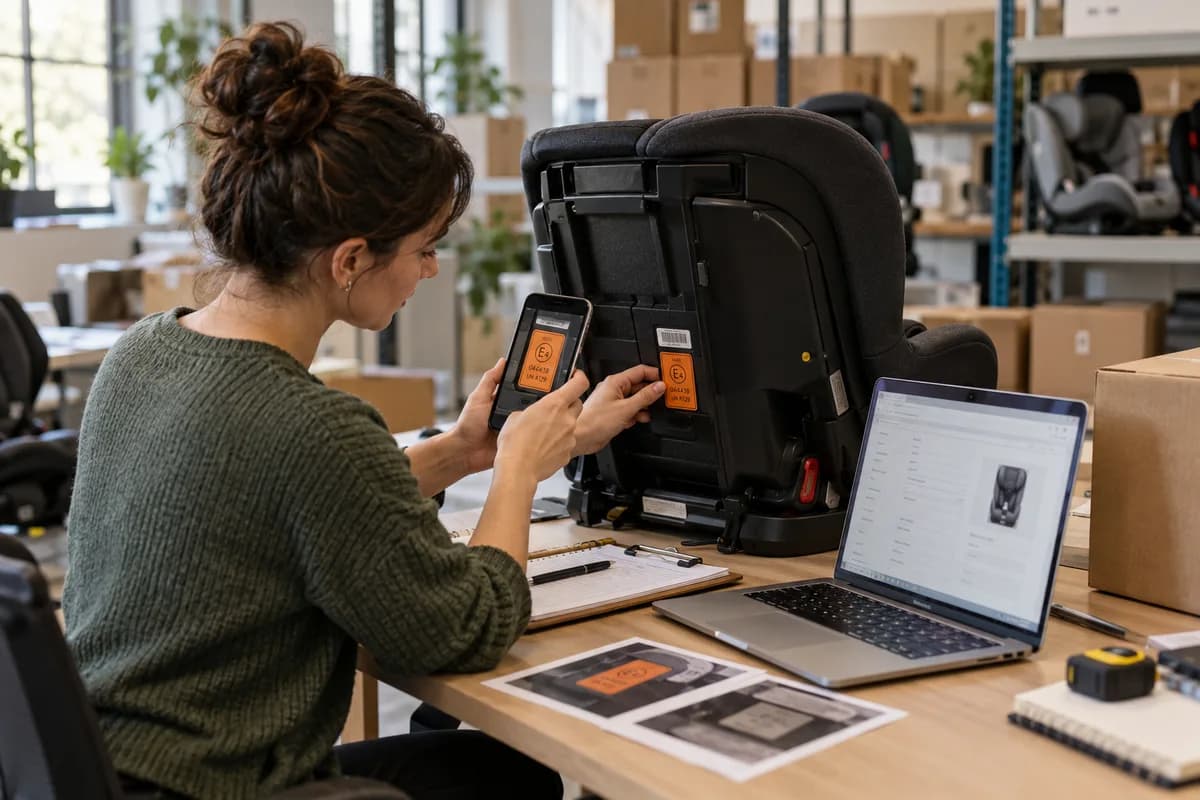
The label is the proof. An R44 or R129 label shows a capital E inside a circle, followed by the number of the approving country and an approval number. R129 labels also state a height range.
A US seat reads differently. It carries no circled E. It says the seat conforms to all applicable federal motor vehicle safety standards, and it names the maker, the model and the date of manufacture.
Ask the supplier for a photograph of the label and a copy of the test report, and check that the label model matches your SKU.
What to store on each car seat record
Software cannot decide whether a seat may be sold, but it can put the facts on the record and carry them to the buyer. Give every seat a standard field that offers a short pick list, ECE R129, ECE R44 or FMVSS 213, and never free text. Free text lets “R 129”, “R129” and “i-Size only” sit as three values, and a filter then misses two of them.
Add the label photograph, the approval number and the manufacture date. Makers print a use by date because plastics age, so store it as a real date field and let old stock be flagged before anyone picks it.
- Standard, chosen from a short list
- Approval number or certification statement
- Height range and weight range
- Fitting method: ISOFIX, belt or LATCH
- Travel direction: rearward, forward or both
- Date of manufacture and maker’s use by date
Keep each seat to the markets it suits
Link every seat to its markets. A seat marked FMVSS 213 only should not be offered at checkout in a country that asks for R129 or R44, and the reverse also holds. Block the order with a clear message. Some sellers keep a separate store view for each country, and the standard field then decides which seats each view may show.
Makers and regulators publish recalls by model and manufacture date, and the dates you stored let you find affected stock in minutes. Skip used seats altogether, because nobody can check their crash history.
Start with your ten best selling seats. Photograph each label, key in the fields above, and chase the supplier for the test report wherever the folder is empty.
Car seat compliance record
A one page template kept for each seat model. The top block holds SKU, maker, model, standard and approval number, and the middle block holds height range, weight range, fitting method and travel direction. The bottom block holds allowed markets, date of manufacture, use by date, label photograph reference and the date someone last checked the record.
Open a blank worksheet to printQuestions owners ask
Is ECE R129 the same as i-Size?
Nearly. R129 is the regulation, and i-Size is the name usually used for seats approved under it, so store the regulation and keep the brand name in the title.
Can I sell an R44 seat in a country that prefers R129?
It depends on the country. Rules and phase-out dates change, so ask the regulator before you list the seat, and let the market field block any seat that does not fit.
Does an FMVSS 213 seat have an approval number?
No. The maker prints a certification statement with the model and manufacture date instead of an approval number, so store that wording and the date.
Does software make a seat compliant?
No. The maker and the seller are responsible for compliance, while software keeps the facts in one place, shows them to buyers and blocks mismatched orders.
Sources
- UNECE: Vehicle regulations (UN Regulations No. 44 and No. 129) — verified 17 Oct 2026
- NHTSA: Car seats and booster seats — verified 17 Oct 2026
- eCFR: 49 CFR 571.213, Standard No. 213, Child restraint systems — verified 17 Oct 2026