In this guide 6 sections
Hand issued certificates depend on the clerk, the printer and a register that only your office can read. A system stores the result, the serial number and the issue date once, prints from that record and lets employers check a certificate online. Forgery and reprint requests both drop.
How manual issue works and where it leaks
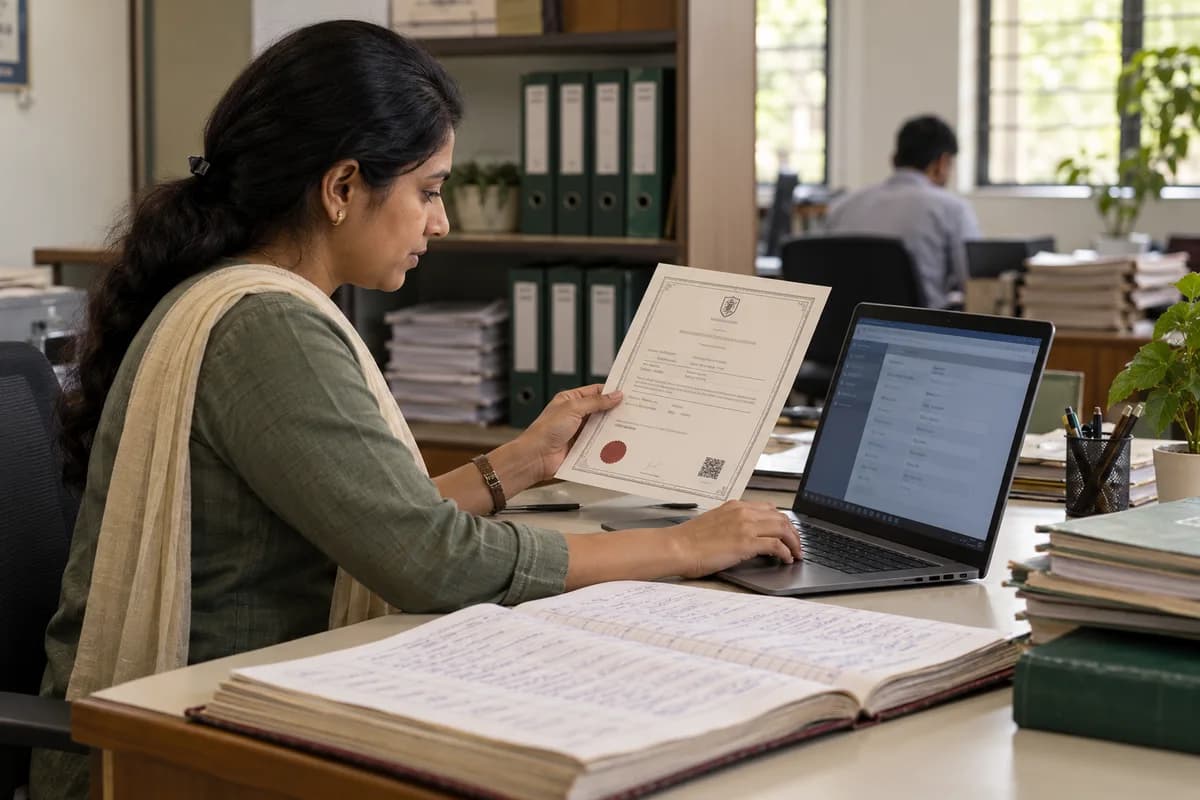
A typical office keeps results in a mark sheet, serial numbers in a bound register and the certificate template in a Word file. A clerk types the name, the course and the date, prints the page and chases a signature.
Each step is a place for error: a misspelt name, a wrong grade, a duplicate serial number, a certificate printed from last year’s template. Fixing it means a reprint and a note in the margin of the register.
The register is also the only proof. If it is damaged, or the clerk who knew it has left, you cannot confirm an old certificate.
What a system stores for each certificate
The record holds the candidate’s legal name, the exam or course, the result, the batch, the issue date, the signing authority and a unique serial number. The system makes the serial, so no two match.
The certificate comes out as a PDF generated from the record. The name on the page is the name in the database, not a retyped copy. A change needs a reason and is logged against the user.
Revocation matters too. A certificate withdrawn after a malpractice case should show as withdrawn when anyone checks.
- Candidate name as on the ID
- Course, level and result
- Unique serial number
- Issue date and signing authority
- Status: valid, reissued or withdrawn
- Change log with user and reason
How verification works for outsiders
An employer, a university or an immigration office wants to know if a certificate is real. Today they email the registrar, wait several days and receive a letter. Many give up and accept the paper.
With a system, a QR code or a short link on the certificate opens a page showing the name, the course, the date and the status. Typing the serial number gives the same answer. The employer has it in seconds.
Decide how much the public page shows. Name, course and status are enough. Marks and addresses stay private unless the candidate agrees.
- QR code or link printed on the certificate
- Search by serial number
- Public page shows name, course, date and status
- Bulk check for employers with many hires
- Log of each check made
Side by side on the points a registrar cares about
On speed, manual issue takes a clerk’s time for each paper, while a system prints a whole batch from approved results. On accuracy, retyping is where mistakes enter, and a database that feeds the template removes it.
On proof, a register can be altered quietly and a system keeps a trail. Manual work has no software fee but carries a steady staff cost and a risk of fraud. A system has a set-up effort and a monthly fee.
Manual still makes sense for a small institute that issues a handful of certificates a year. The case for a system grows with volume, with exams run in many centres and with employers who ask for checks.
Moving from files to a system without losing old records
Start by listing every certificate issued in the last five years from the bound register. Enter serial, name, course and date. Do not try to enter everything at once.
Check a sample against paper. Pick fifty entries, compare them to the original mark sheet and fix errors before launch. Then open public verification for new certificates first and older ones as they are entered.
Ask your regulator or accrediting body whether it prescribes a format or retention period. Then book a day this month to enter one batch and test the check page yourself.
Certificate record template
A one page template listing each field of a certificate record: legal name, ID type, course, level, result, batch, serial number, issue date, signer, status and change reason. A second block lists what the public verification page shows. A third block is a migration log with columns for year, entries made, entries checked and errors found.
Open a blank worksheet to printQuestions owners ask
Is an online check legally accepted?
That depends on the country and the body that accredits you. Ask your regulator whether an online record counts as proof, and keep paper copies where the rules require them.
What happens to certificates lost by the candidate?
The system lets you issue a duplicate from the same record, marked as a duplicate with its own date. The original serial stays on file so the two can be linked.
How do we stop forged certificates?
Forgery cannot be stopped entirely, but a serial number and a public check make fake paper easy to expose. Employers who check will find a mismatch within seconds.
Can older certificates be added later?
Yes. Enter them in batches, starting with the most requested years. Until a record is entered, verification for those certificates stays by email or letter.