In this guide 6 sections
A field failure becomes a scramble when the maker cannot link a drone’s serial number to the motor winding lot, carbon sheet roll or controller board batch inside it. Fix it by recording lot numbers at the moment each part is issued to a build, and by keeping one genealogy per finished unit.
Why a failed batch turns into a guessing game
A customer reports that three quadcopters lost thrust in flight. The motors all came from your shop. Which winding lot did they use? Which magnet batch? Nobody can say without opening four spreadsheets and a stack of traveller sheets.
Most drone parts makers record the finished serial well enough. The trouble sits one level down. The stator was wound on a Tuesday shift, the bell was machined on another lot of aluminium bar, and the bearings came from two purchase orders. None of that was tied to the serial.
So the recall becomes a wide net. You pull every unit shipped in a quarter, because you cannot prove which ones are clean. Customers lose flying time. You lose trust.
- Winding lot not tied to the motor serial
- Magnet or bearing batch missing from the build record
- Carbon sheet roll number lost after cutting
- Firmware version on the flight controller not logged
The records that must exist before anything fails
Start with the genealogy for each serial. It lists every lot of every critical input that went into that unit: copper wire spool, magnet batch, bearing PO, carbon prepreg roll, PCB panel, MCU reel. One line per input, one parent serial.
Add the process records beside it. Cure oven profile for the frame, balance test result for the rotor, bench thrust curve for the motor, calibration file for the flight controller. These are the proof that a unit passed, not just that it shipped.
Keep supplier lot numbers as the supplier printed them. Do not retype them into a house format. When a vendor sends a notice about a bad reel, you need to search their number, not yours.
Where the chain usually breaks
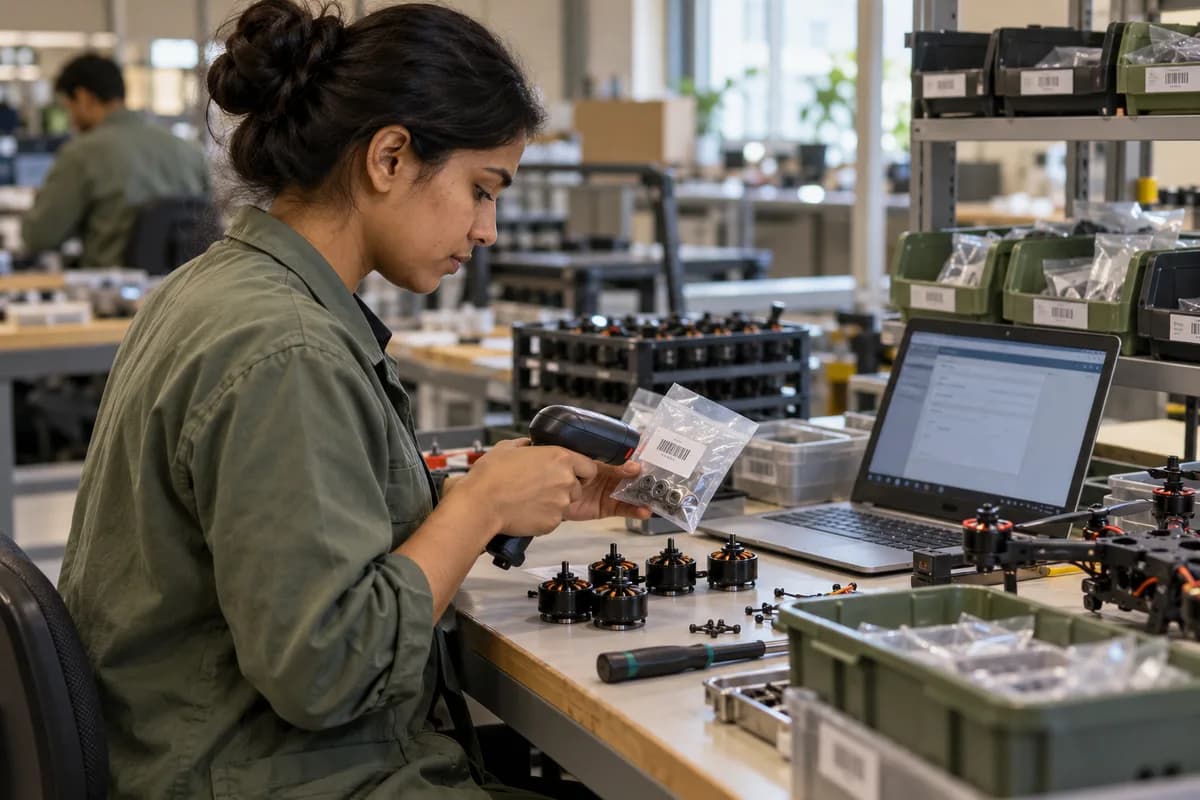
Kitting is the first weak point. A tray of parts goes to the bench, and the technician takes what is on top. If the lot is not scanned when the part leaves the store, the build record is a guess.
Rework is the second. A rotor comes back for rebalancing, a wire is resoldered, a board gets a new connector. The serial stays put. The history changes. If rework is not logged against that serial, the next failure looks inexplicable.
Mixed lots inside one bin are the third. Two reels of the same resistor sit in one drawer. Only one was bad. Without a rule to finish a reel before opening another, you cannot narrow the recall.
- Scan lots at issue from stores, not at the bench afterwards
- Log every rework step against the original serial
- One open reel or spool per part number at a time
- Quarantine tag and a hold flag on suspect lots
Running a recall in hours, not weeks
With a genealogy in place, the recall is a query. Enter the suspect magnet batch and get back every motor serial that used it. Then match those motors to the drone serials they shipped in, and to the customer and delivery date.
Test the logic before you need it. Pick one lot at random and trace forward to customers, then pick one customer unit and trace back to its raw inputs. If either takes more than an afternoon, the records have a gap.
Prepare the customer notice in advance too. Keep it plain. It needs the serial range, the symptom, the action asked of them and a return address. Writing it under pressure is how errors reach the field.
- Forward trace: lot to units to customers
- Backward trace: unit to every input lot
- Quarantine count of stock still on your shelves
- Customer list with shipment dates and contacts
Start small with one product line
Do not try to trace everything at once. Choose the part that has failed most often or the one that sits on the most expensive airframes. Define five or six inputs that matter and record those first.
Run it for a month alongside your current method. Compare what the new genealogy tells you with what the old records tell you. Differences show where the habit needs fixing, usually at issue from stores.
Then add the next product. Ask your production head to pick one live order this week and write down, from memory, which lots went into it. The gaps in that list are your first job.
Serial genealogy sheet
Single printed page. The header holds finished serial, product, build date and customer. Beneath sits a table of input part, supplier, supplier lot, quantity, issued by and issue date. A second block lists tests with result and tester. A final strip holds rework entries and quarantine decisions.
Open a blank worksheet to printQuestions owners ask
What is a genealogy record for a drone part?
It is the list of every input lot and process step behind one serial number. It lets you trace a failed unit back to its materials and trace a suspect material forward to every unit.
Do small drone makers need lot tracking?
If you sell flight-critical parts such as motors, ESCs or frames, yes. Even a modest volume can hide one bad reel across many units, and customers will ask which ones.
Can a spreadsheet hold serial and lot records?
For a handful of units, yes. Once several people build in parallel, shared sheets drift, lots go unscanned and rework gets missed. A system that scans at issue keeps the chain intact.
What should we record when a part is reworked?
Record the serial, the reason, the step performed, who did it, the retest result and the date. Without this, a later failure cannot be tied to the repair.