In this guide 6 sections
Record the heat number when wire rod or bar arrives, then carry it as a lot number through heading, threading, heat treatment and plating. Each step links its output lot to its input lot. At packing, the carton label shows the final lot, which opens the whole chain back to the mill certificate.
Start at goods receipt with the mill certificate
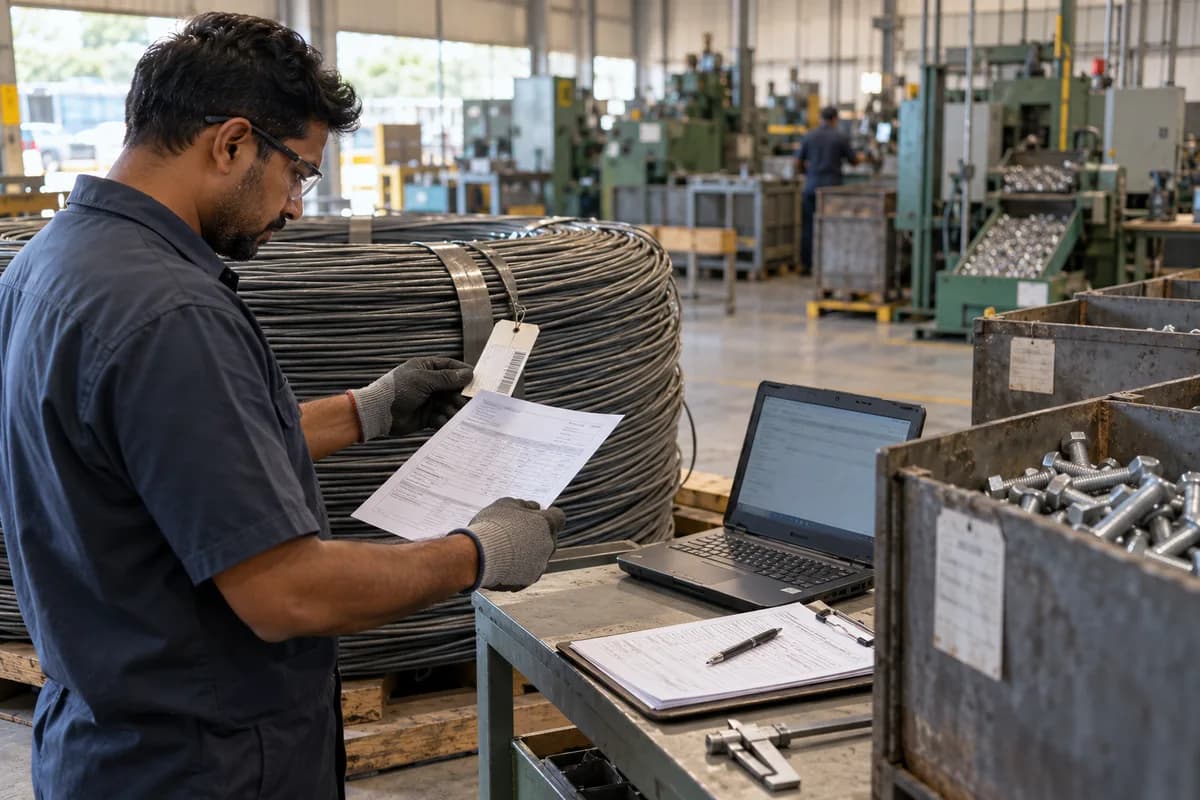
A coil of wire rod arrives with a mill test certificate that lists the heat number, grade, chemistry and mechanical results. Capture the heat number, coil tag and certificate file at the gate, before the coil reaches the store.
Check the certificate against your purchase order. The grade on paper must match the grade ordered, and the heat number on the coil tag must match the heat on the certificate.
Quarantine every mismatch. A coil with the wrong tag starts every later argument.
- Heat number and coil or bundle tag
- Grade and diameter against the order
- Certificate scanned and linked to the receipt
- Supplier name and mill of origin
- Quarantine flag for any mismatch
Carry the heat through heading and threading
Cold heading turns wire into blanks. The work order must name which heat went into which header machine, and record the changeover time whenever two coils feed one shift.
Thread rolling comes next. Blanks from one heading lot go into bins, and bins get a lot tag that names the heat, the heading lot and the thread roller used.
Mixing is the usual failure, because two part-filled bins combined at the thread roller silently merge two heats into one batch. Forbid it, or record both heats on the merged lot.
Heat treatment and plating are where lots get lost
A furnace basket holds many bins, so the load chart should list each bin tag, the furnace, the temperature set points and the quench. Hardness and tensile results then attach to those heats, not to a vague basket.
Plating is often subcontracted. Send a dispatch note listing lots, receive them back on a goods receipt that keeps the same lot numbers, and keep the plater’s process certificate on file.
Watch for hydrogen embrittlement relief baking on plated high strength bolts. Record the bake start and finish against the lot, or you cannot show it was done.
- Furnace load chart listing bin tags
- Hardness and proof load results per lot
- Plater dispatch note and return receipt
- Plating thickness check and certificate
- Baking time where the grade needs it
At packing, print the lot on the carton
Final inspection samples the lot against the customer’s drawing before the packer fills cartons. The label should carry part number, size, grade marking, quantity and the final lot number.
Test the chain with a mock recall. Pick a carton label and ask for the heat number, the heading machine, the furnace load and the plater within a few minutes. A phone call means a gap.
A customer complaint about a snapped bolt then becomes a short list of affected cartons, not a whole month of stock.
Choose where the chain is weakest and fix that first
Do not rebuild every record at once. Run the mock recall on three recent lots and mark the step where you lost the trail, since most shops lose it at bin merging or at the plater.
Fix that single step with a tag, a form or a software field. Then rerun the test next month.
Heat to carton trace sheet
Each stage gets its own row: receipt, heading, threading, heat treatment, plating, final inspection and packing. Columns are input lot, output lot, machine or furnace, date, operator, certificate reference and result. The top of the sheet carries the heat number, grade and customer order.
Open a blank worksheet to printQuestions owners ask
Do we need a separate lot number at every stage?
Not always, but every stage must link its output to its input. Many plants keep the heat number as a prefix and add a suffix for each new lot, which keeps the chain readable.
What if two heats are mixed in one bin?
Record both heats on the merged lot, or segregate and rework the bin. Silent mixing destroys the trace and should be treated as a nonconformance.
How long should mill certificates be kept?
Follow your customer contract and quality standard, since requirements differ by sector. Store the scanned certificate with the receipt so retention is a single decision.
Can a spreadsheet do this?
For a small range, yes, if one person owns it. It struggles once lots split, merge and travel to subcontractors, because linking rows by hand invites errors.