In this guide 6 sections
Pick one finished lot, then trace it backward to every ingredient lot and supplier, and forward to every buyer and pallet. Time the exercise, count what you can account for, and list each missing record. Run it again after fixing the gaps, using software where paper slows you down.
Set the rules of the exercise before you start
A mock recall is a drill. Choose a finished lot that left the plant weeks ago, since older lots hide far more gaps than yesterday’s output, and nobody remembers how they were made. Pick a product with several inputs, such as a spice blend with chilli, coriander, salt and an anticaking agent, since single-ingredient lots reveal very little.
Name a team leader and a timekeeper. The leader’s one question is where every unit of this lot sits, and every answer needs a goods receipt, batch card or invoice that a stranger could follow. Nobody answers from memory.
Decide what counts as success. A common test is to account for the full quantity produced against the quantity found in stock, in transit and with buyers.
- The lot code and pack date chosen
- Start time and end time
- People on the drill and their roles
- Target for the share of quantity accounted for
- Place where findings are written
Trace backward from the pack to the supplier
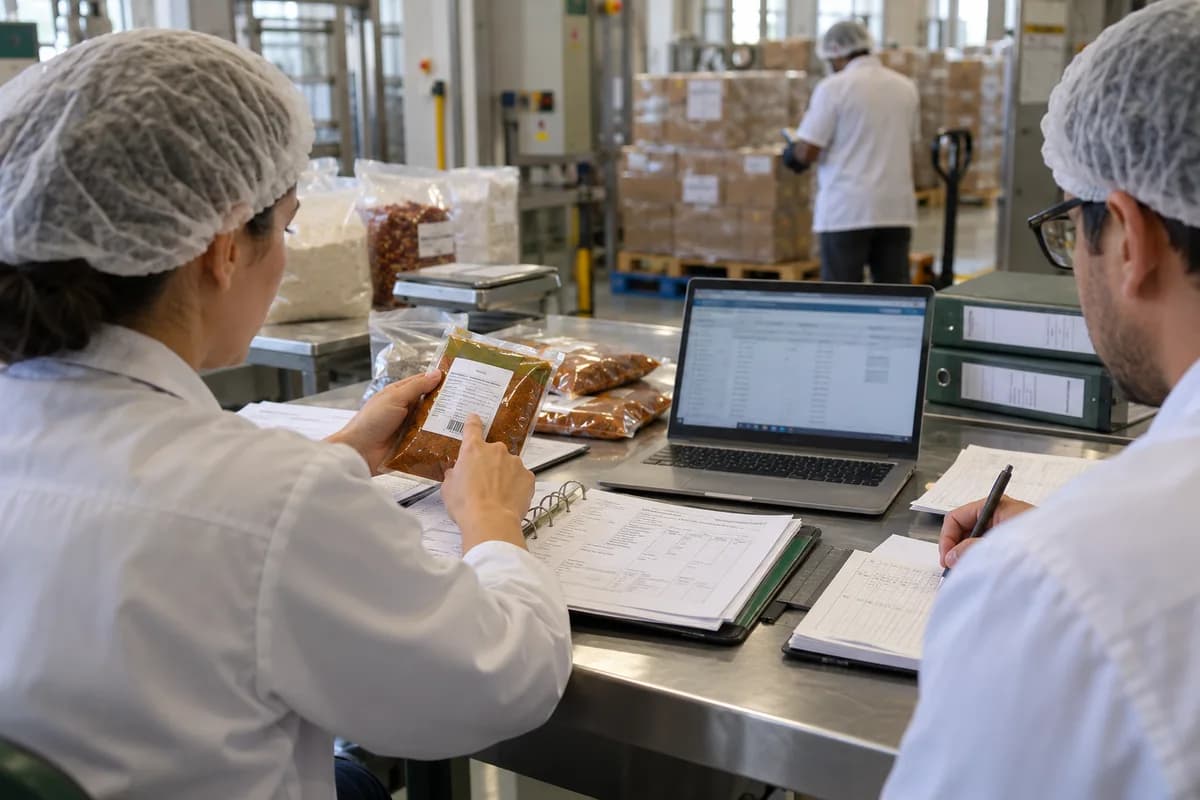
Start at the label. The batch code on the pack should lead to the production record for that shift, and from there to every ingredient lot used, including packaging film, cartons and additives. Retention samples, metal detector logs and the allergen changeover sheet for that shift belong in the same folder, and the drill should pull them out as well.
Each ingredient lot should lead to a goods receipt, a supplier name and the supplier’s own lot or invoice, so check for certificates of analysis and weighbridge slips too.
Gaps show up fast. A hand-written register line reading flour, two bags does not identify a lot, so mark it as a failed trace and move to the next ingredient.
Trace forward from the plant to the buyer
Now work the other way. Find every pallet and carton produced in that batch, then check how many sit in your store, which invoice carried the rest and which vehicle took them.
Each invoice should name the lot. If it names only the product, you are guessing which batch went to which buyer, and in practice that means phoning every customer who bought the item. Pallet labels, cold chain logs and the transporter’s lorry receipt show where the product went after it left the gate, and they often disagree with the invoice.
Distributors add a layer. Ask each distributor whether they still hold the lot, resold it or returned it, because your forward trace stops where your last record stops. Push that point down the chain.
- Quantity produced, in store and shipped
- Invoice and delivery note numbers matched to lot
- Distributor and retailer names
- Returns, damaged goods and samples
- Product held back by quality
Score the result and find the gaps
Write the time taken and the quantity accounted for, because a complete answer that arrives after two days is still slow when a buyer is waiting on the phone. A quality manager who can account for nearly every carton within two hours holds a stronger position with a retail buyer. A promise to check later does not.
Sort each gap by cause. Some are missing fields, like a blank supplier lot, some are habits, like merged batches on the line, and others are separate stock and billing spreadsheets that never meet.
Rank the gaps by how often they would hurt in a real recall, fix the top three, then drill again on the same lot to prove the fix worked.
Where software shortens the answer
Software helps when every record carries a lot number, so one search on a finished lot lists ingredients, suppliers, shifts, pallets and buyers on a single screen.
It also forces the discipline. A goods receipt cannot be saved without a supplier lot and a dispatch note cannot be printed without a batch, whereas paper never refuses an entry. Mandatory fields help most at three points: the goods receipt, the batch record and the dispatch note, because those three records join the whole chain together.
Repeat the drill every quarter with a different product, and keep each run’s drill sheet in one folder so the next auditor sees how the answers improved.
Mock recall drill sheet
One page holds three blocks. Block one: lot code, start time, end time, team roles. Block two is a trace table with columns for ingredient lot, supplier, receipt document, pallet, invoice and buyer. Block three records quantity accounted for, time taken and the top three gaps with an owner for each.
Open a blank worksheet to printQuestions owners ask
How often should a food plant run a mock recall?
Twice a year at minimum is common. Run an extra one after any change to suppliers, labelling or packaging film, because customers and auditors often ask to see the latest result and its date. Keep the sheet ready. Dated and signed.
Which product should we pick for the drill?
Pick a multi-ingredient product with many buyers. A complex product exposes more gaps than a single-ingredient bulk item, since every extra input adds a supplier lot, a goods receipt and a chance of a blank field. Avoid simple bulk items. They teach little. Start hard.
What if we cannot trace the whole lot?
That is a useful result. Record each gap, fix it and repeat the exercise, because the drill exists to find weaknesses in your records before a real incident finds them for you. Failure here is cheap. Do not hide it. Share the result.
Do we need software before we can run a drill?
No, paper works today. You can run the drill with registers, files and a stopwatch, and software becomes valuable only once the exercise shows how long manual searching takes your team. Time the search. That number makes the case. Write it down.