In this guide 6 sections
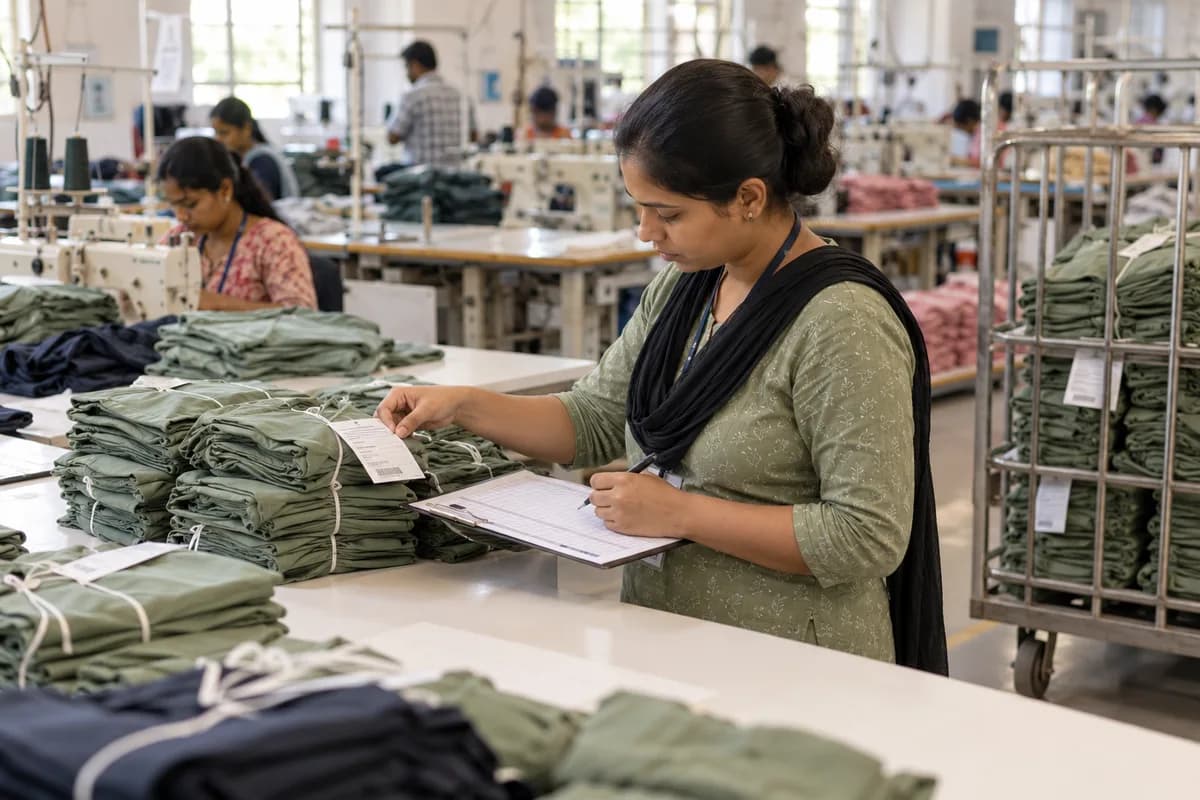
Give every bundle a ticket at the cutting table carrying style, size, colour, lay number and quantity, so each bundle can be traced through later steps. Scan or tick it at four points. Compare counts at each checkpoint, and the step where cut and packed quantities part ways will show itself as a pile of bundles on a trolley.
Make the ticket at the cutting table
The cut order tells the cutter what to lay, and the cut pieces are tied into bundles of a fixed count by size and colour. Each bundle gets a ticket first.
The ticket carries style, buyer order, size, colour, lay number, bundle number and piece count, plus a shade lot number if the fabric came from more than one lot. Print it or write it in ink. Pencil smudges at the sewing line.
- Style, order and size
- Colour and fabric lot
- Lay number and bundle number
- Piece count and cutter initials
Set a checkpoint at each move
A checkpoint is where a bundle changes hands and someone counts it, as at cutting out, sewing in, sewing out, finishing out and packing, each with a named counter.
At each point, record the bundle number, the count and the time, using a scan or a tick on a sheet, whichever the line will actually keep up. The recorder must not be the person who made the bundle, so the count stays independent of the hands that sewed it.
Keep the checkpoints few, because too many get skipped when the line is busy before a shipment, and a skipped checkpoint is worse than none.
Compare counts to find the gap
Add the pieces at each checkpoint for one order, size and colour: cut quantity is the start, and sewing out should be lower only by known defects. Packing should match what ships.
When the totals differ, look at the checkpoint just before the drop, since a gap between sewing out and finishing in often means bundles sitting on a trolley. A gap after finishing means pieces lost to rework or rejection, which is a different problem that needs the quality checker rather than the trolley handler.
Small losses are normal. Unexplained ones are a signal.
- Cut to sewing in: missing pieces
- Sewing out to finishing in: stuck bundles
- Finishing to packing: rework not returned
- Packing to dispatch: short cartons
Keep defects and rework on the ticket
A defective piece must not vanish, so record it as rejected, reworked or replaced, and for a replacement cut issue a new small bundle linked to the parent ticket.
Rework needs a return checkpoint, because without one the piece goes to the repair table and never reappears in the count, so the order ends short without a cause. Use a red tag. Log pieces in and out.
At the end of the order, a short reconciliation shows cut, sewn, rejected, reworked and packed quantities on one line, ready for the buyer’s query.
Start with one line and one order
Pick one sewing line and one order for a week, use bundle tickets and three checkpoints only, and review the totals each evening with the line supervisor.
After the week, list the gaps found and what caused them, then add the remaining checkpoints or move the system to the next line.
Show the supervisors their own data. People protect numbers they can see.
Bundle checkpoint sheet
A tracker gives each bundle a line, with columns for bundle number, style, size, colour and cut count, then a count and time at each checkpoint. A last column records rejects and rework. The foot of the page totals each checkpoint for the order, which lets the supervisor see the drop between any two steps.
Open a blank worksheet to printQuestions owners ask
What is a normal bundle size?
It depends on the garment and the line, but many units use a fixed count so that every operator handles the same load. Choose one that suits your line balance.
Do we need barcodes for bundle tracking?
No, because a ticket with a printed number and a tick sheet is a start, and barcodes help only when volumes are high and manual entry slows the line.
What about mixed sizes in one bundle?
Avoid mixed bundles, but if one must mix sizes, split it into separate tickets at the first checkpoint so each size has its own count.
Who should record the checkpoints?
A person who does not sew the bundle, such as a line checker or a trolley handler, because independent counts are more reliable than self-reported ones.