In this guide 6 sections
Give every cell or tray a lot code on receipt. Record capacity and internal resistance at grading, assign a grade, and match cells of one grade into each module. Then store the cell to module to pack link by serial, so service calls and recalls can be traced.
Receive cells against a lot code
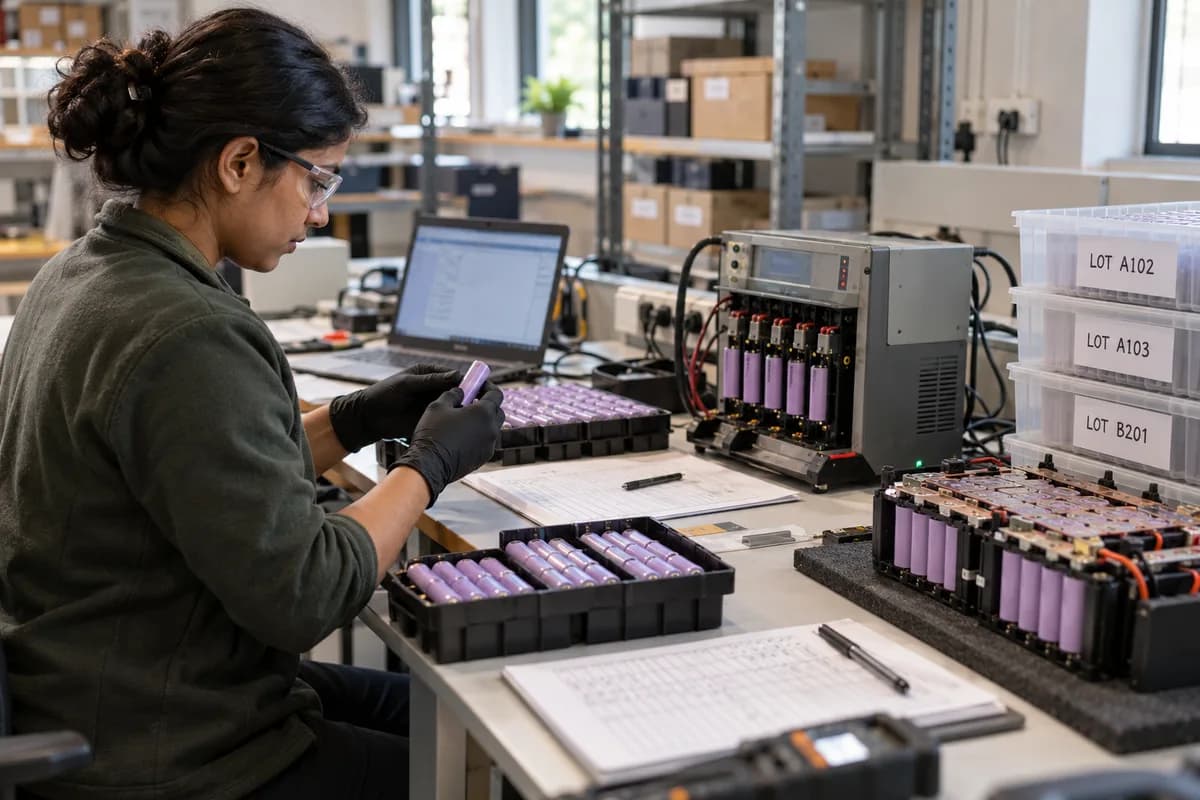
Start at the goods inward bench and record the cell supplier, its lot or date code, the cell model and the quantity received. Then photograph the carton label and attach the supplier’s test sheet. Nothing else comes first.
Hold every cell in quarantine until it is graded. An ungraded cell on the shelf must never reach a module build. No grade, no build.
If cells arrive in trays, label each tray and give every graded cell a short code matching its tray position. A printed sign on the quarantine shelf is enough to start, provided the receiving record names who may release cells to grading.
- Supplier, model and lot code
- Date received and quantity
- Supplier test sheet filed
- Storage location and state of charge on arrival
Grade each cell by capacity and resistance
Run each cell through a capacity test on a cycler, measure internal resistance on an AC or DC tester, and record both numbers against the cell code. Rest voltage after storage is a useful third check, because a cell that lost voltage faster than its neighbours is often a poor one.
Set grade bands in advance, such as A, B and reject, and write down who approved them. Keep the bands in one place so two graders cannot apply different rules. Bands change. Date them.
Rejects need a record too. One reason code per reject tray, such as low capacity, high resistance or swollen case, lets you compare supplier lots without reading every grader’s notebook. A bad lot shows quickly.
Match cells into modules
Cells wired in parallel or in series work best when capacity and resistance sit close together. Build each module from cells of one grade and one lot wherever you can. A mismatched cell drags its neighbours.
Record the matching at the spot welding or bolting station. Scan the module ID first, then each cell as it lands on its nickel strip or busbar position. That gives a list of cell codes by position for that module.
Where rework swaps a cell, record the removed cell, the new one and the reason. Never overwrite the earlier entry.
- Scan module ID before the first cell
- Scan every cell by position
- Keep a record of replaced cells
- Block a cell with no grade or an expired date
Keep the cell to pack link
The module then goes into a pack. The pack serial links down to its modules and each module links down to its cells, and three levels are enough for most builds.
This chain is what a service call needs, since a returned pack with one weak module can be opened and that module’s cell lot looked up in seconds. Three returns sharing a supplier lot make a pattern.
For a recall the chain runs the other way. Start at the lot and list every pack holding even one cell from it, then match those packs to customers.
Start small and test the chain
You do not need everything on day one. Begin with lot code, capacity, resistance and the module scan, and add rework and storage checks later. A paper traveller can carry a pilot batch if every cell code is written legibly and scanned before the module moves on.
Test the chain with a real question by choosing one cell lot and asking which packs contain it. If the answer takes more than a few minutes, find the missing scan and fix that station first.
Cell grading and module build sheet
A single sheet in two parts. The grading part is a table with cell code, supplier lot, capacity, internal resistance, rest voltage, grade and reject reason. The build part lists module ID, pack serial, cell codes by position, replaced cells with reason, welder or fixture ID and inspector sign-off.
Open a blank worksheet to printQuestions owners ask
Do we have to grade every cell?
For modules where cells share a parallel group, grading each cell is the safest approach. For lower risk builds, sample grading by lot may be agreed with your customer.
Why record internal resistance as well as capacity?
Two cells with the same capacity can heat very differently under load. Resistance shows which cells will run warm and age faster inside a module.
What if the supplier already grades the cells?
Keep their grade and lot on record, but check a sample yourself. Supplier sheets are a starting point, and your own test shows storage or transport damage.
How is the cell to pack link used in a recall?
You start from the affected lot, list every module with cells from it, and map those modules to pack serials and customers.