In this guide 6 sections
Manufacturing IoT use cases fall into four groups: machine condition, energy use, plant environment, and tracking of tools, pallets or work in progress. Each turns a signal on or near a machine into one operational decision. Start with one group and one or two machines, not the whole plant.
Four groups of manufacturing IoT use cases
Most plant applications sit in four groups. Four projects, four business cases. They need different sensors and justify themselves differently, so treat each as its own project rather than one plant-wide initiative with one budget line.
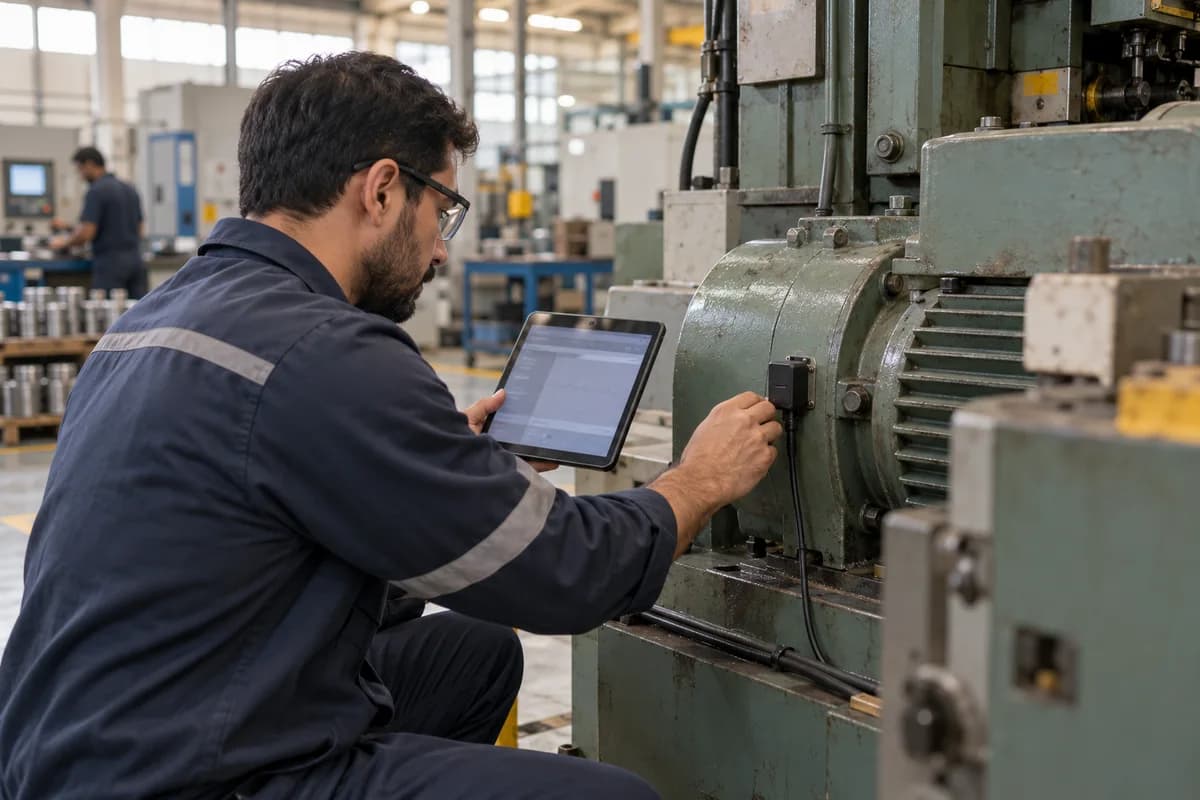
Machine condition uses vibration, temperature, current draw or run-hours on individual machines to flag a developing fault or confirm that a machine is running when scheduled. Energy use means submetering power by line, machine or shift to find idle-running waste or prove that an energy-saving change such as a new compressor controller actually worked.
Plant environment covers temperature, humidity or dust in storage, cold chain and clean areas, wherever the product or the process reacts badly to conditions drifting out of range. Asset tracking tags tools, pallets and work in progress with RFID or Bluetooth beacons, so nobody burns a shift searching for a missing fixture or a stuck batch.
Matching each use case to a signal and a decision
A use case is worth pursuing only when the signal is practical to capture and someone will act differently once they see it. A vibration spike matters if a technician will inspect the bearing, and an energy jump matters if someone will investigate it during the shift.
Write the mapping down first. It fits in one sentence: this signal, from this machine, checked against this threshold, triggers this action by this person within this many minutes. Unfinished sentences mean unused data.
Feasibility, installation and data quality
Older machines rarely have a data port, so condition monitoring on legacy equipment usually means an external sensor clamped or stuck to the housing. That is feasible on many machines once someone checks accessibility, available power and whether the mounting point will pick up the vibration or heat that matters.
Data quality needs the same scrutiny. A sensor on the wrong part of a machine, or one picking up a neighbouring press, produces readings that look fine and mean nothing. Compare a new sensor against a manual check for a week or two before letting it trigger an alert on its own.
Separating simple monitoring from predictive claims
Threshold monitoring is simple. It alerts when a reading crosses a known danger line, it can be running quickly, and it is where most plants should begin. Predictive maintenance is different. It flags a developing fault before any threshold is crossed, which needs months or years of history that includes labelled failure events, and most plants do not have that.
Consider an auto-components maker running a dozen CNC and stamping machines, where a realistic first phase is threshold alerts on the two machines with the worst unplanned-downtime record. A plant-wide predictive system is not a realistic first phase, however confidently a vendor pitches it, because the failures it would learn from were never recorded.
Selecting a pilot with plant staff and a measurable baseline
Ask operators and maintenance staff which machines cause the most trouble, since they also know about the heat, washdown spray and tight access that complicate installation. A machine-age spreadsheet is a weaker guide.
Record a baseline before the pilot starts, such as unplanned downtime hours per month or scrap rate, whichever number the pilot is meant to move. Without that figure, nobody can say afterwards whether the pilot helped or whether the improvement would have happened anyway, which turns the budget talk into opinion.
Manufacturing use-case matrix
A matrix with the four use-case groups down one side. Across the top sit the signal needed, the typical sensor, the installation difficulty and the specific decision it drives. Filling it in for your own machines makes candidates easy to compare, so the first pilot is a realistic one rather than the most talked-about one.
Open a blank worksheet to printQuestions owners ask
Which machines should we connect first?
Start with the troublesome ones. Choose machines your maintenance team already flags and that offer an accessible surface for an external sensor, and leave low-impact machines that are costly to instrument for later.
Is predictive maintenance possible immediately?
Not at the start. Most plants lack the labelled failure history that a predictive model learns from, so the realistic first step is threshold alerting, with every repair logged beside the readings.
How many machines should a first pilot cover?
One or two machines. A pilot on a single machine type lets the team learn mounting, calibration and alert handling once, while a pilot across ten machine types teaches ten separate lessons.