In this guide 6 sections
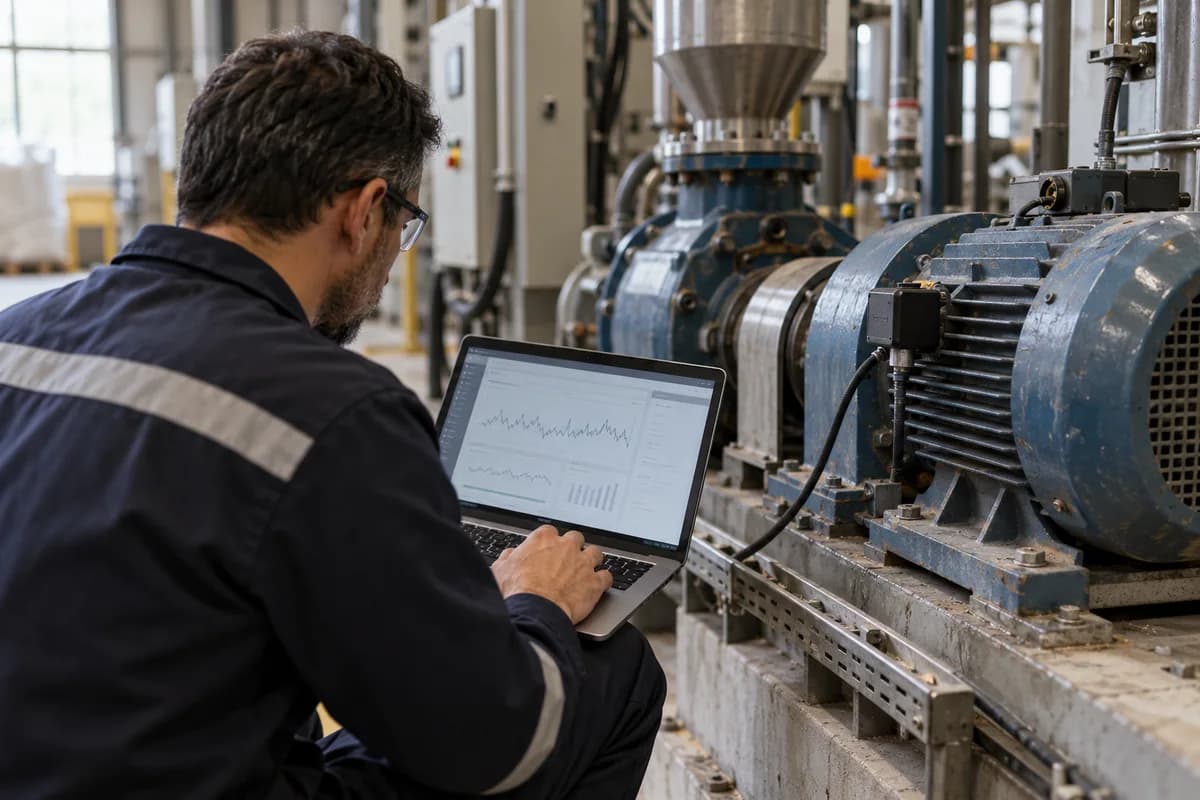
IoT supports predictive maintenance by supplying continuous condition data such as vibration, temperature, current draw and run-hours that reveal a developing fault before it causes downtime. Prediction is the final stage. Most small businesses should start one stage earlier, with condition-based monitoring that needs no failure history, because collecting that history is the real work still ahead.
Scheduled, condition-based and predictive maintenance
Scheduled maintenance services a machine on a fixed calendar whether or not it needs attention, so bearings, belts and filters get replaced with useful life left in them. That is reliable but wasteful. Condition-based maintenance compares a live sensor reading with a set threshold and raises a work order when the number looks abnormal, which needs no historical modelling at all.
Predictive maintenance goes one step further. It estimates how much life a component has left, using patterns learned from sensor history that led up to earlier failures on similar equipment. It is often oversold. The reason is simple: it depends on months of clean, labelled sensor data that most plants, workshops and cold stores have never collected.
What predictive maintenance needs: signals, history and failure labels
It needs three inputs. First come continuous sensor signals such as vibration, temperature, motor current and run-hours, which is the easy part because a gateway can collect them within days. Second comes enough history. Third come records of exactly when each past failure happened, so the readings from the weeks before it can be labelled as what a developing fault looked like.
The third piece is usually missing. Maintenance logs say a bearing was replaced on a given date, but they rarely hold the sensor readings from the days before, because nobody was recording them. A model then learns nothing. Buying one anyway means paying for a forecast built on guesses rather than on how your own pumps, motors and compressors actually behave before they fail.
Data quality and practical feasibility
Take a moulding unit with recurring bearing failures on two machines, where the record only says “bearing replaced” beside a date and no sensor was running. No signature exists to learn from. The honest first step is to fit condition sensors now, collect readings for several months, and build a predictive case from what those readings show about each failure.
Consistency of the failure matters too. A component that fails identically on every occurrence, with a distinctive lead-up pattern such as rising vibration before a bearing seizes, is a far better candidate. One that fails for many unrelated reasons is a weak candidate, and some plant equipment is simply not ready for prediction yet.
Validating alerts with maintenance specialists
Any model output, such as a predicted failure window or a confidence score, should be reviewed by someone who understands the equipment before it drives a maintenance action. Sensor data can mislead. Examples include a reading disturbed by a neighbouring machine, a sensor mounted slightly off its axis, or a genuine but harmless operating condition that looks abnormal on paper.
Do not skip this review. The model’s output is advisory input to a maintenance engineer’s decision rather than an automatic trigger, and that keeps false predictions from causing unnecessary downtime of their own.
Measuring false alarms avoided, downtime and lifecycle cost
Track three measures from day one. The first is how many alerts turned out to be real rather than false, and the second is how much unplanned downtime was avoided against the baseline. The third is whether component lifecycle cost fell once replacements happened closer to true end of life instead of on a fixed, early schedule.
Record a baseline before the system starts. Then compare results over a fixed period, since otherwise the system gets credit for improvements that had another cause, such as a new operator or a milder season. Every pilot needs one.
Maintenance maturity comparison
A side-by-side table of scheduled, condition-based and predictive maintenance. Four columns cover the trigger, the data needed, the running cost and the route from today. Use it to place each asset on the curve.
Open a blank worksheet to printQuestions owners ask
Can prediction work without failure history?
Not in any reliable way. A model learns warning patterns from readings recorded before past failures, so without those records it has nothing to learn from, and any forecast would be a guess. Start condition-based monitoring now so labelled history begins to build, and revisit prediction once several real failures have been captured with their sensor readings.
How do we avoid unnecessary maintenance?
Tune thresholds with the people who maintain the equipment instead of leaving factory defaults in place, and count how many triggered checks found nothing wrong. Adjust any threshold that cries wolf.
Which equipment suits prediction first?
Start with assets that fail identically on every occurrence, such as a main compressor or a critical pump, because their warning pattern repeats and can be learned. Irregular failures can wait.