In this guide 6 sections
Read your customers’ security questionnaires, because the answer follows their geography and their procurement habits. ISO 27001 certifies a management system and is common with buyers in Europe, Asia and government. SOC 2 is an auditor’s report on controls and is common with US software buyers.
What each one actually is
ISO 27001 sets the standard for an information security management system, and an accredited body audits your scope, risk register and statement of applicability. Surveillance audits return every year.
SOC 2 is an attestation report from a licensed CPA firm, and security is always in scope while availability, confidentiality, processing integrity and privacy are optional extras. It is a different animal.
One gives you a certificate. The other gives you a report. Buyers read them in very different ways.
Who asks for which
European banks, Asian telecom operators and public tenders usually name ISO 27001 outright, while American SaaS buyers and enterprise procurement desks ask for a SOC 2 report under NDA.
Check before you spend, because many mid-size buyers accept a completed questionnaire and nothing more, and a certificate nobody requested is an expensive poster on the wall. Ask the buyer first.
- Public tenders and regulated buyers: certificate, scope statement and expiry date
- US software procurement: the report, its audit period and any listed exceptions
- Mid-size buyers: a signed questionnaire and a short architecture note
- Resellers and channel partners: whichever their own auditor accepts
How the auditor gathers evidence
An ISO auditor samples records proving the system runs: access review minutes, a dated backup restore test, supplier assessments, the incident log, training attendance and the internal audit report.
A SOC 2 Type 2 auditor pulls samples across the audit period: one new joiner’s ticket, one leaver’s account removal and one production change with its approver.
A missing sample becomes an exception. Exceptions are no failure. Buyers still read each one.
What your systems must show
Both frameworks ask the same practical question, which is whether you can prove who had access to what and when, without a week of digging through inboxes. Your software must answer fast.
Most gaps are plumbing, not policy. Shared admin logins, a spreadsheet of leavers and logs that roll over after a few days will each cost you an audit sample and appear as an exception.
- Single sign-on with enforced MFA on cloud consoles, the code repository and admin panels
- Joiner and leaver tickets that trigger account creation and removal
- Application, database and cloud audit logs kept searchable for the full audit period
- Pull request approvals linked to deployment history
- Encrypted backups with a dated restore test
- An asset list covering laptops, servers and SaaS tools
Pick the first audit by counting, not guessing
Collect the last three questionnaires or tender documents you received, then highlight every line that names a standard, and count how often each framework appears. The tally costs nothing.
Controls overlap heavily, so access reviews, change records and backup tests gathered for one framework transfer to the other, which makes the first audit cheaper than it looks. Take legal questions on certification claims or contract wording to a qualified adviser, because this post covers technology readiness only and gives no legal opinion on any report.
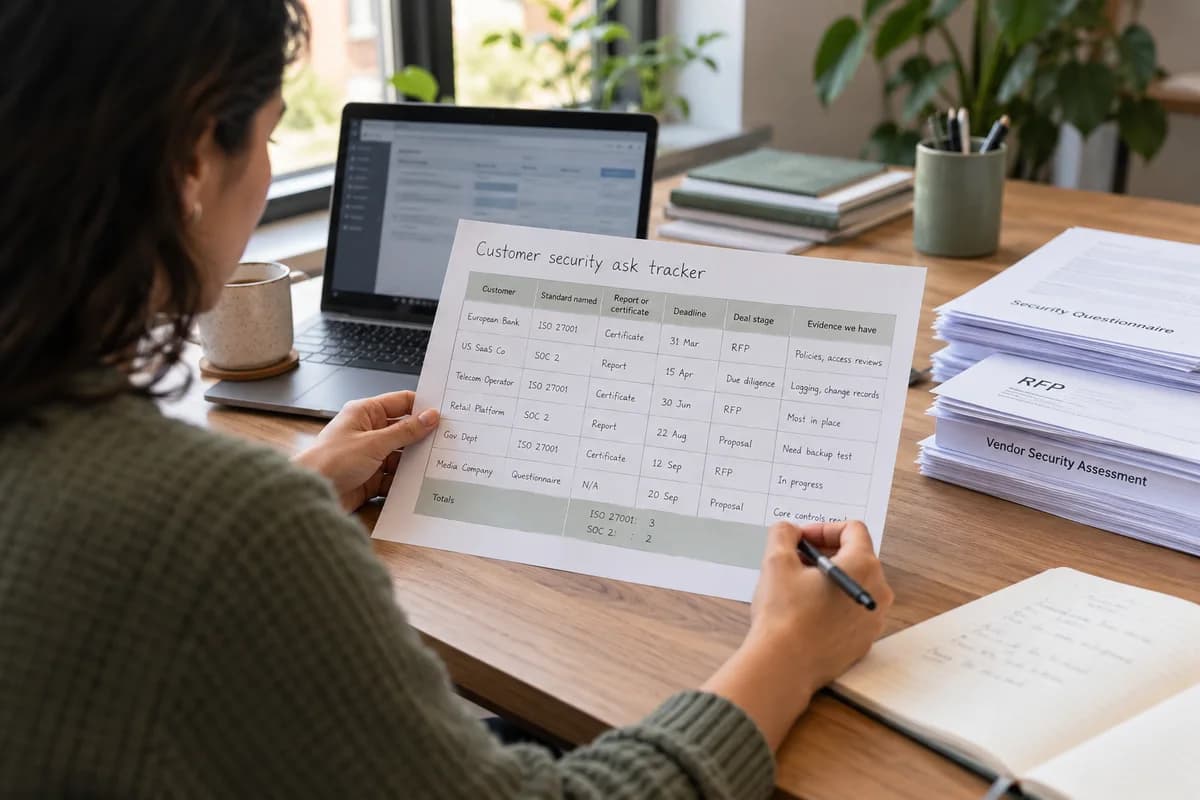
Start this week with one sheet holding the standard named, the customer, the deal size and the deadline for each request, then count the tally on Friday.
Customer security ask tracker
Every questionnaire or tender takes one line on a single printed page. Columns record the customer, the standard named, whether a report or certificate was demanded, the deadline, the deal stage and the evidence that already exists. A totals strip at the bottom counts requests for ISO 27001 and SOC 2, so the first audit choice is obvious.
Open a blank worksheet to printQuestions owners ask
Can we have both ISO 27001 and SOC 2?
Yes, and many companies do. The controls overlap, so access reviews, change records and backup tests serve both. Start with the one your buyers name most often, then extend.
Is SOC 2 Type 1 enough?
A Type 1 report describes controls at a single date. Larger buyers often want Type 2, which covers operation over a period. Type 1 can be a stepping stone while the evidence builds.
Does ISO 27001 mean our software is secure?
No. It shows that a management system exists and is audited within a stated scope. Software flaws still need testing, patching and access reviews on their own schedule.
How early should we prepare our systems?
Well before the auditor arrives. SOC 2 Type 2 samples an entire period, so controls missing in month one cannot be repaired later. Turn on logging and approvals first.