In this guide 6 sections
Use a marketplace to be found. Use your own store to keep the customer. Marketplace templates cut the specification fields that tools and hardware depend on, hide the buyer behind the platform and leave warranty serials in message threads. Your own store holds trade accounts, full attributes and the reorder list, though you must bring the traffic yourself.
The marketplace template decides which fields a product gets
Every marketplace category comes with a fixed template. A cordless drill gets brand, model, voltage and colour plus a title limit, so chuck size, torque settings and the charger in the box have nowhere to go. Sellers drop them or stuff the title.
Hardware buyers search by specification. A plumber wants a compression elbow in a stated size, and a site buyer wants an SDS-plus bit for the hammer already on the van. A joiner wants one gauge and one length. If the listing cannot carry those fields, the buyer cannot filter for them, and the wrong item arrives and comes back as a return.
Your own store has no such limit. You define the fields, the filters and a compatibility table that says which bit, blade or battery fits which tool, down to the model number.
- Chuck size, shank type and drive on drills and bits
- Battery platform and the chargers that fit it
- Thread pitch, length and material on fixings
- Pressure rating or ingress rating on fittings and power tools
- The list of tool models a spare part fits
Trade buyers order on account, not from a basket
A foreman does not shop like a consumer. The order carries a purchase order number, the price comes from an agreed list, the goods go to a named site, and payment follows on a monthly statement. A marketplace is built around anonymous buyers and one public price per product, so a different price for each contractor, or a statement at month end, rarely fits.
On your own store a trade account can hold agreed prices, a credit limit and several delivery addresses, plus a saved list of the fixings the crew uses. That list is what brings them back.
Some marketplaces run programmes for business buyers. Ask whether you can set account prices and see the buyer’s company name, because that decides whether you can invoice on terms at all.
Warranty claims need the serial number captured at the sale
A power tool, a laser level or a pressure washer carries a serial number, and the maker’s warranty runs from the date of sale. When the customer returns with a dead charger, you need the serial, the invoice date and the buyer’s name in one place.
The platform owns the order record. The serial may travel only in a message thread and the buyer’s contact details may be masked, so a later claim starts with a hunt through old chats. On your own store the order line can carry a serial field, filled at packing and read back when a claim arrives.
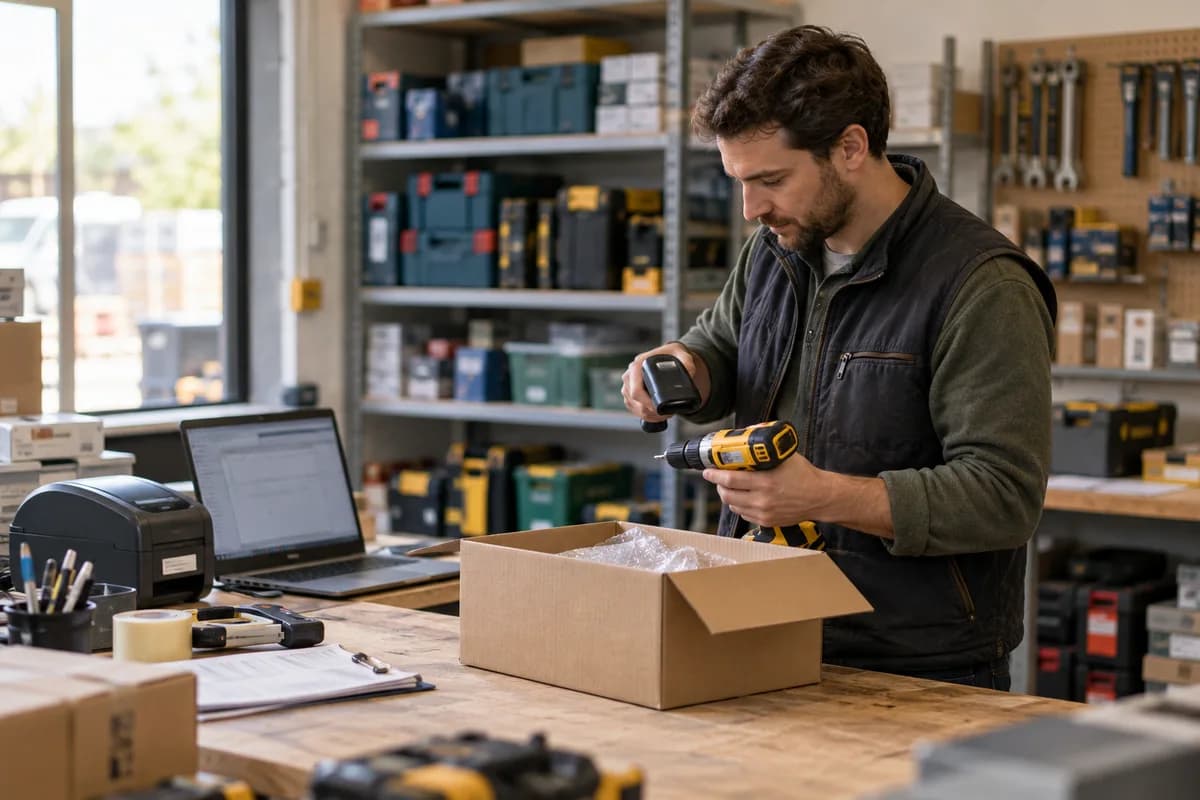
A scan at packing takes seconds.
- Serial number and model code
- Invoice date and order number
- Buyer name, phone and delivery address
- Dispatch scan or packing photo
- The manufacturer’s claim reference once one is raised
Whoever owns the order owns the reorder list
A marketplace owns the relationship. The parcel travels in its packaging, replies go through its messaging, and the buyer’s next search shows a rival’s drill bits beside yours. You earn the sale. The platform earns the customer.
Your own store keeps the buyer’s contact details and reorder list, so a tile fixer who bought a wet-cutting saw in March hears about diamond blades in May. No paid advert is needed.
Marketplaces still do a job. They bring buyers who have never heard of you, take payment on your behalf and run a returns routine that most shoppers already trust. Use that reach where it pays.
A split that suits most tool and hardware sellers
Most sellers do not have to choose. List simple, branded, fast-moving items on a marketplace, such as batteries, hand tools, work gloves and small fixings in blister packs that buyers know by name. Keep the full range, trade prices, spares and anything that carries a serial number on your own store, where you control the fields and the accounts.
Read the seller rules first. Many platforms restrict pointing buyers to your own site, so check before you add a card to a parcel or a link to a listing. Regulars will find you anyway.
Test the split on ten products. Copy the fields from each supplier data sheet into a table, then mark every field that the marketplace template cannot hold and a buyer would filter on. That list tells you which products belong where.
Channel comparison worksheet
Worksheet, one page, two parts. The top part is a table of ten best sellers, with columns for product code, supplier fields, the fields the marketplace accepts and the fields lost. The bottom part scores five questions for each channel: trade account pricing, serial capture, buyer contact kept, returns handled and reorder list kept. The last column names each product’s channel.
Open a blank worksheet to printQuestions owners ask
Can I sell on a marketplace and my own store at the same time?
Yes, and many sellers do. Keep stock in one place so a sale on either channel reduces the same count, and read the marketplace’s rules on pricing and on contacting buyers first.
Do trade customers buy tools on marketplaces?
Some do, mostly for one-off buys. Regular contractors order from the supplier who gives them account prices, a monthly statement and delivery to site, so offer them an account on your own store.
How do I record serial numbers for warranty on a marketplace order?
Scan the serial at packing into your own order system, against the marketplace order number, so a claim can be found by either number without searching message threads. Do it on every parcel.
Is an own store worth it for a small tool shop?
It is, once buyers start to repeat. A shop that sells mostly one-off consumer items may do better on a marketplace until the range needs specification filters.