In this guide 6 sections
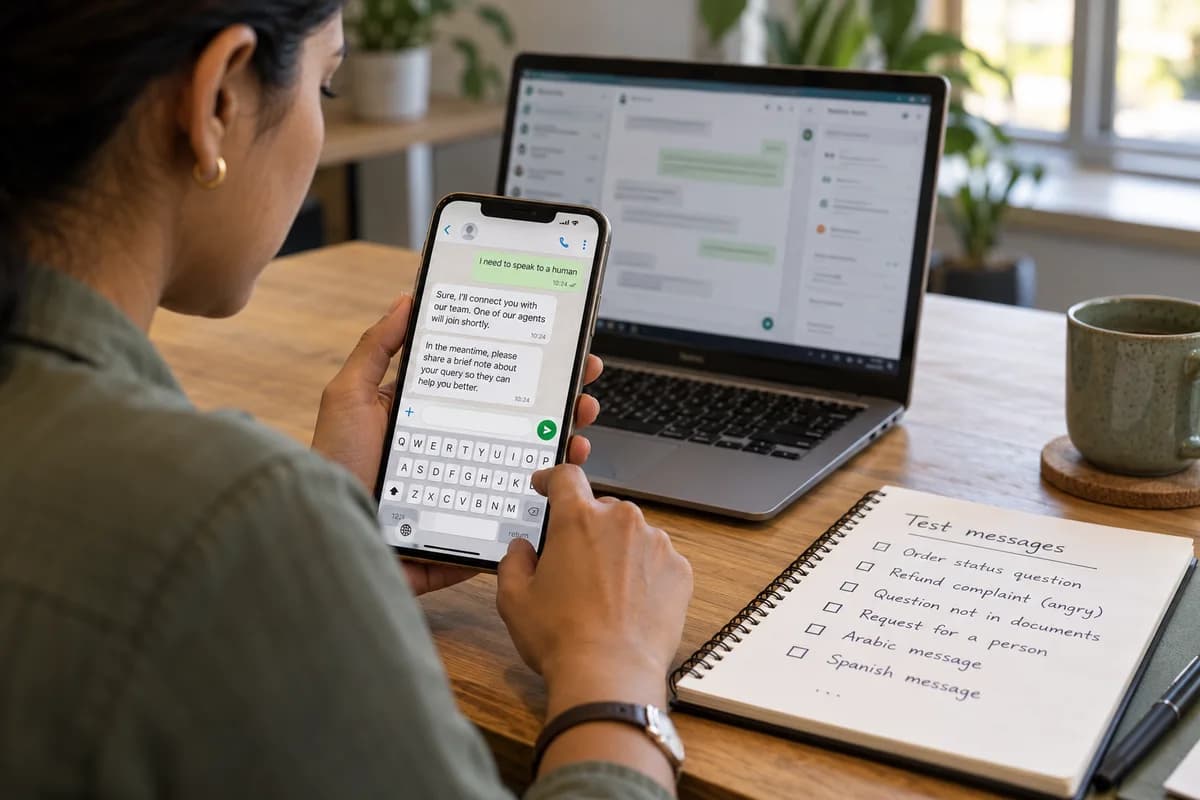
Ask five things before you sign: can a person take over, which topics are excluded, how replies stay in approved documents, who checks each language, what you keep. Get every answer in writing. Insist on a live demonstration on your own number, with your own awkward messages typed in by you rather than a vendor’s rehearsed script.
Can a person take over at every step?
A weak build hides handover behind one button on the welcome menu, which a frustrated customer will never scroll back up to find. A sound build differs. It lets a customer type the word human at any point, in Arabic, Spanish or Portuguese, and reach a named person within minutes. Make the vendor demonstrate it mid-conversation. Not on screen one.
Ask what the agent sees. The full thread should sit beside the customer’s name and number, because otherwise the customer repeats everything, which is the exact irritation the bot was meant to remove.
Ask about two in the morning. A handover with nobody there must say so, offer a callback slot and log the request, rather than leaving a typing indicator hanging. Silence is the worst reply.
- Free-text request for a person
- Agent sees the whole earlier thread
- Out-of-hours callback slot with ticket
- Bot stays silent once agent joins
- Handover tested with voice notes, photos
Which conversations should the bot never take?
Vendors list what the bot can do. Ask for the opposite list instead. Complaints, refund disputes, medical or legal questions, angry messages and any message naming a staff member all belong with a person, however polite the bot’s wording might be.
A good vendor proposes exclusions before you do, and can name three conversations their own bots refuse to touch because the risk outweighs the saving. A poor one boasts of everything. That boast previews how they will behave after launch, when one wrong reply costs you a customer and nobody on their side picks up the phone.
Ask how the exclusions are recorded. Keywords alone miss tone. Look for a rule set that you can read, edit and test with sample messages before it goes live, rather than a black box held by the vendor.
How are replies kept to your approved documents?
If the bot answers from your price list, warranty terms and delivery policy, ask how it is stopped from inventing a reply when the document is silent. It should say it does not know. Then it should offer a person.
Demand the source behind each answer. A reply that cites the page of your return policy can be audited, while a reply with no trail cannot be checked by anyone at all. Request a test with ten questions your documents do not cover, and read every reply for confident guesses dressed up as facts.
Ask who updates the documents and how soon a revised price list reaches answers, since a discount that ended last week must not linger.
- Named source document for each answer
- Fallback wording when documents are silent
- Revised PDF live the same day
- Weekly log of unanswered questions
Who checks each language, and what do you keep if you leave?
Machine translation fails native speakers. Ask for a named speaker of Arabic, Spanish, Portuguese or whichever language you serve to review the flows and sample replies before launch. Mixed-script messages, such as Arabic typed in Latin letters, deserve their own test, run by a speaker who types that way on a phone.
Exit terms matter as much as features. Ask who owns the WhatsApp Business Account, the verified number and the approved message templates, since registration under the vendor’s name can force you to restart verification.
Request an export in plain files: conversation history as CSV or JSON, the flow diagram, the document set and the template list. Fix the delivery date in writing.
Turn the answers into a decision
Score each vendor from zero to two on each group of questions and write the reason beside the number, so a later reader can see why one vendor won. Vague answers score zero. A live demonstration scores two.
Short list two vendors and give both the same twenty test messages, including three angry ones and two in a second language. Compare the replies side by side. Pick the one whose weakest answer is least bad, then ask for the exit export terms in the contract before signing.
Vendor questions scorecard
A single-sheet table lists the five question groups down its side: handover, excluded topics, approved documents, languages and exit, each with its own ruled row. Columns hold the vendor name, the answer given, a zero to two score, proof seen on screen and the contract clause number. Ownership gets its own last row.
Open a blank worksheet to printQuestions owners ask
Should the vendor register the WhatsApp account in their own name?
Prefer the account under your business name, with the vendor added as an authorised partner who can be removed by you alone at any time. If the account already sits under the vendor’s name, ask in writing how ownership will transfer and how many days the handover takes.
How do I test a bot before buying?
Use twenty fixed messages. Include an angry complaint, a question your documents do not answer, a request for a person and two messages in another language.
What should an exit export contain?
Conversation history, the contact list with opt-in dates, template text, the flow design and the source documents, each delivered in a file you can open without the vendor’s software. Request CSV, JSON and PDF. Refuse any vendor-only format.
Is a free pilot worth asking for?
Yes, if the scope stays narrow. Order status questions on a single number make a good pilot, because the answers are checkable against your own records, and a wrong answer costs little. Agree what counts as a pass beforehand, so the pilot does not drift quietly into a soft launch with real customers.