In this guide 6 sections
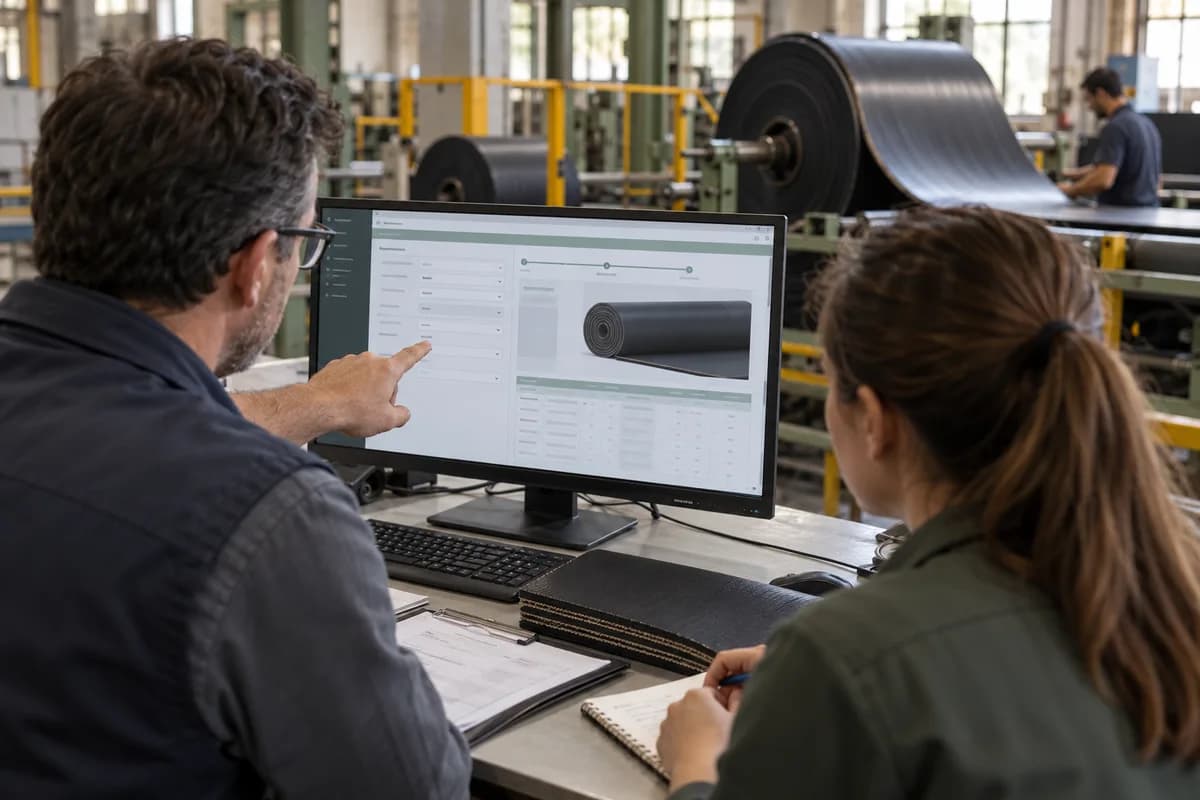
Have the seller show your own belt on screen: its ply count, cover grades, width, length and splice type, followed from quotation through calendering and vulcanising to dispatch. If the demo cannot cut a customer order from a roll with offcuts tracked, keep looking.
Can it hold a real belt specification
A belt is not a product code. It is a build: fabric type, number of plies, top and bottom cover grades, edge type, breaker layers and rated strength. Ask whether the system stores these as structured fields or only as a text description.
Give the vendor a recent enquiry and watch them enter it. Do the covers carry separate thicknesses? Can you record heat or oil resistance? Does a change in ply count produce a new version of the spec?
If every belt needs a new item code created by hand, quoting will stay slow.
- Ply count and carcass fabric type
- Top and bottom cover grade and thickness
- Edge type: cut or moulded
- Width, length and tolerance
How does it cut from rolls
Belt makers often vulcanise long lengths and then cut to orders, or press standard widths and slit them. Either way, stock is a roll, and a customer order is a piece of it. Ask how one roll becomes several pieces.
Watch for offcut handling. A leftover three metres of the right spec is stock, not scrap. Does the system record it, give it a location and offer it against the next order?
Ask to see the cut plan. The planner should be able to choose which roll to cut from to leave the most useful remnant.
Splices, joints and endless belts
Many orders are for endless belts, and the joint is the weak point. Ask whether the software records splice type, finger or step, length of overlap, the jointer who made it, press time and temperature, and the test that followed.
A belt that fails in the field will be traced to its splice. The record should connect to the order, the roll the belt was cut from and the compound used for the splice cover.
Ask also about repairs and re-splices on returned belts. They should link to the original order, not start a new history.
- Splice type and overlap length
- Jointer, press time and temperature
- Link from splice to roll and order
- Repair history on returned belts
Order tracking through vulcanising
A belt order passes through mixing, calendering, ply assembly, vulcanising, cooling, trimming, testing and packing. Ask where the system shows each order at this moment. A foreman should see it without walking the floor.
Look at how the press is scheduled. Vulcanising presses are long and expensive to run, so the plan matters. Can the system show which press is free, what the cure cycle is and when the platen will be ready?
Then raise a delay. A rejected length should push the dispatch date back and let sales see the change.
What the demo must prove
Do not accept slides. Send the vendor three real orders before the demo: one standard belt, one endless belt with a splice and one order cut from a part roll. Ask them to run all three live.
Ask about the people. Who will load your existing belt specs and customer history? How long until the first order runs? Ask for a reference you can call, running a similar rubber product.
After the demo, write your own score for each question above and compare it with your plant manager’s score before deciding.
Belt software demo scorecard
A single-page scorecard, one row per question in this article: belt specification, roll cutting, offcut stock, splice records, press scheduling, order tracking and reference call. Columns hold the demo result, a mark out of five, the evidence seen on screen and a note on what is missing.
Open a blank worksheet to printQuestions owners ask
Do I need software built only for belts?
Not necessarily. A rubber products system can work if it handles plies, covers, rolls and splices. The test is whether it models a belt as a build, not whether the label says belt.
Should I involve the shop floor in the demo?
Yes. The calender foreman and the jointer know where records go missing. Their questions often expose gaps the owner would not think to ask.
What data should I bring to the vendor?
Three recent orders, a sample specification sheet, your current roll register and a splice record if you have one. Real material shows how well the system fits.
Is a custom build better than a ready product here?
It depends on how different your process is. A ready product suits common flows. A custom build suits special tests, unusual cutting rules or links to an existing plant system.