In this guide 6 sections
Ship live fish only if you can control dispatch days, packing and claims. Many aquarium shops do better selling dry goods, water test kits and equipment online, and keeping livestock for the counter. Decide by checking which records each route needs. Then ask whether you can keep them.
What shipping livestock asks of the shop
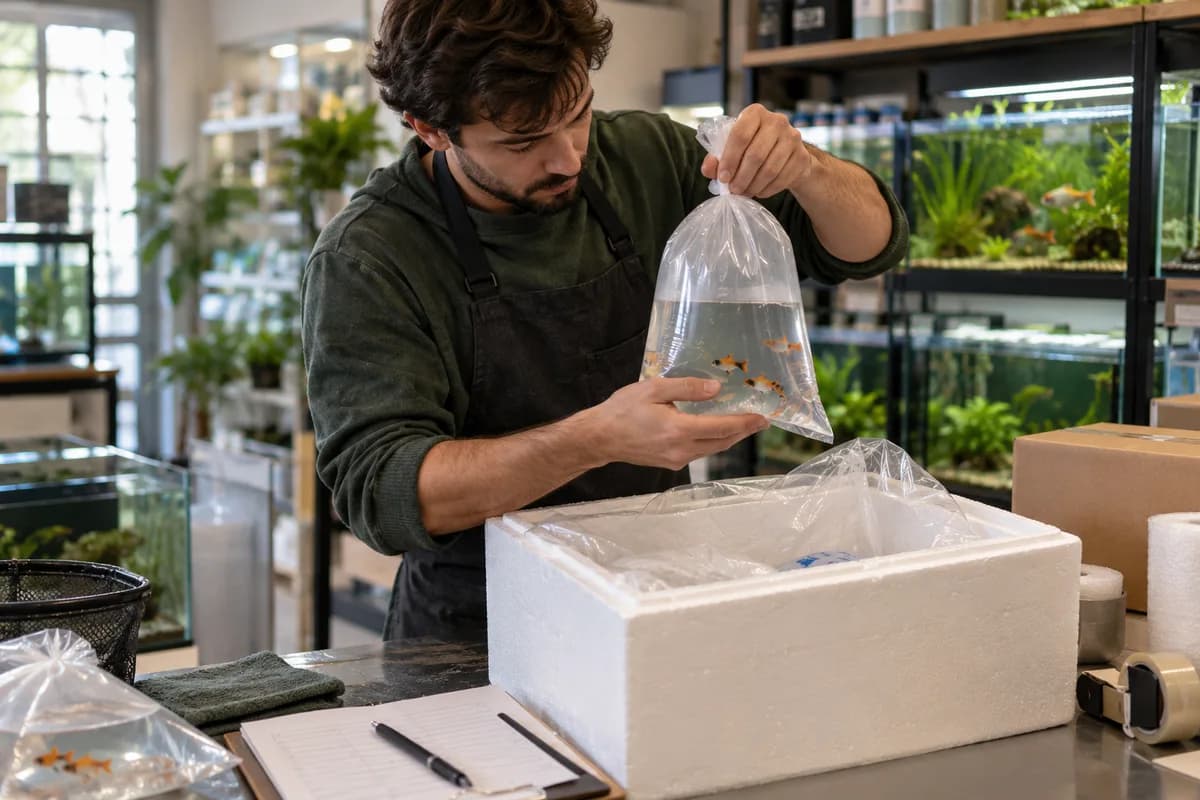
Fish travel in bags with oxygen, inside an insulated box, with a heat pack in winter or a cold pack in summer. They are fasted first. The parcel must ride an overnight service, and someone must be at home to open the box before the water warms or cools.
That puts the load on the shop. Someone must be there to pack on every dispatch day, someone must net the fish, and a quarantine tank must hold new arrivals before they are sold. A busy Tuesday can swallow the whole job.
Many carriers refuse live animals. Others accept them only on named services. Some species also need permits or are barred in certain places, and the rules change with the destination, so one list does not fit every order. Read the carrier’s terms and the local rules first.
- A carrier that accepts live animals, and the service it allows
- Insulated boxes, oxygen bags, heat packs and cold packs
- Staff on duty for packing on each dispatch day
- A quarantine tank for new arrivals
- Local rules on the species you plan to send
The arrival promise and what it must prove
An arrival promise says the fish will be alive when the box is opened. That is a bold promise to make by post. Write it with a time limit for reporting a loss, a list of what the customer must send, and a plain statement of what the shop gives back.
Most disputes turn on evidence. Ask for a photo of the unopened bag with the label in frame, taken soon after delivery, and a reading of the water temperature. Without these, a claim is one person’s word against another’s.
Keep the shop’s side of the record ready too. It should show, box by box, whether a loss came from the packing, the carrier or the weather, and it should be ready within minutes of a claim. Memory will not do.
- Packing time and the name of the packer
- Species, count and the tank of origin
- Weather at the shop and at the destination
- Tracking events and the delivery time
- Customer photos of the bag, label and fish
- Replacement or credit offered
The dry goods route and the records it needs
The alternative is to sell what keeps. Water test kits, conditioners, filter media, heaters, pumps, lighting, food and empty tanks all ship without a clock running. Each has its own risk, though.
Reagents in test kits carry batch codes and expiry dates, and fish food carries best before dates, so both need the same stock rules as pet food. Glass tanks break. Record the packing method and every breakage claim. Heaters and filters need fields for tank volume and power, so buyers pick one that fits the tank they own and the socket on the wall.
A middle route is reserve online and collect in store. The customer picks a fish from the listing, pays a deposit and collects it on a set day, after the shop has checked its health in the tank. You keep the livestock trade. You skip the parcel.
Compare the records each route demands
Set the two routes side by side. Livestock needs batch and tank records, quarantine dates, treatment notes, packing logs, weather checks and claim photos, all written up on the day. Dry goods need expiry dates, compatibility fields and breakage claims.
The first set is heavier. It runs daily. A missed quarantine date can put disease into a customer’s tank that took months to cycle, while a missed expiry date on a reagent is only a refund.
Count the hours, not just the stock. Add up the time to pack, the time to log each claim and the time to answer a worried message late at night. If those hours are not there, choose dry goods.
Decide with a short list and a small trial
Ask four questions. Does a carrier on an overnight service take live animals in your region, and will it do so in a heatwave or a cold snap? Is a quarantine tank free? Is someone present on every dispatch day? Can you absorb a bad week of losses?
If any answer is no, stop. Sell dry goods, and offer reserve and collect for the livestock you keep in the shop. If all four are yes, run a small trial. Ship one hardy species to one near region on Mondays only, log every box, and widen the range only after a month of clean records.
List the five species you would send. Mark which ones could survive one extra day in a bag if the carrier is late, and cross out any that need a permit where you ship. Start with those. Keep the rest for the shop floor, where a customer can see the fish before paying.
Ship or not decision sheet
One page with two columns, livestock route and dry goods route. Rows cover carrier terms, quarantine tank, staff on dispatch days, packing kit, claim evidence, records kept and hours a week. Each row has a yes, no or unsure box, and a line at the foot for the decision and the review date.
Open a blank worksheet to printQuestions owners ask
Can live fish be shipped safely?
Yes, when the fish are fasted, bagged with oxygen, packed in insulated boxes and sent on a fast service for a short transit. Results depend on the species, the weather and the carrier.
What should a live arrival claim include?
A photo of the unopened bag with the label visible, a water temperature reading and the time of delivery. The shop compares these with its packing record and tracking history.
What can an aquarium shop sell online instead of fish?
Water test kits, conditioners, filter media, heaters, pumps, lighting, food and tanks. Each needs its own fields, such as reagent expiry dates, tank size and power rating.
Can customers reserve fish online and collect them?
Yes. The customer picks the fish on the listing, pays a deposit and collects on an agreed day. The shop avoids packing, carrier terms and arrival claims.