In this guide 6 sections
Start with a spreadsheet. It works for BOM costing while one person owns the file, and an ERP takes over once stock, purchasing and costing need a single truth. An MES matters when you must see line status and trace reels to each board, and most small makers need the three tools in that order.
Where a spreadsheet works and where it cracks
For a first product a workbook is hard to beat, with one tab for the BOM, another for distributor quotes, and a founder who knows every cell by heart. It costs nothing and changes in minutes. Nobody needs training.
It cracks when a second person edits, because two copies of the BOM drift apart, a price break goes stale and nobody knows which revision reached the fab house.
Warning signs are plain: files named final_v3_new, VLOOKUP formulas pasted over as values, and the quote for a Gerber-ready board finished late on a Sunday.
- Two people open different copies of the BOM
- Price breaks typed by hand and never refreshed
- Reel counts that disagree with the shelf
- Date codes and lot numbers jotted on paper travellers
What an ERP fixes for BOM costing and stock
An ERP holds one item master, one stock ledger and one purchase trail, so a changed resistor value flows through cost rollup, open orders and kitting list. Nothing gets retyped twice.
Costing improves because scrap, rework and component price swings post to the same ledger, so you see the true cost of a panel, not the quote-time guess.
It does not watch the line. An ERP knows a work order is open, yet it cannot tell you the reflow oven tripped an hour ago, or that a feeder jammed on reel three.
What an MES adds on the shop floor
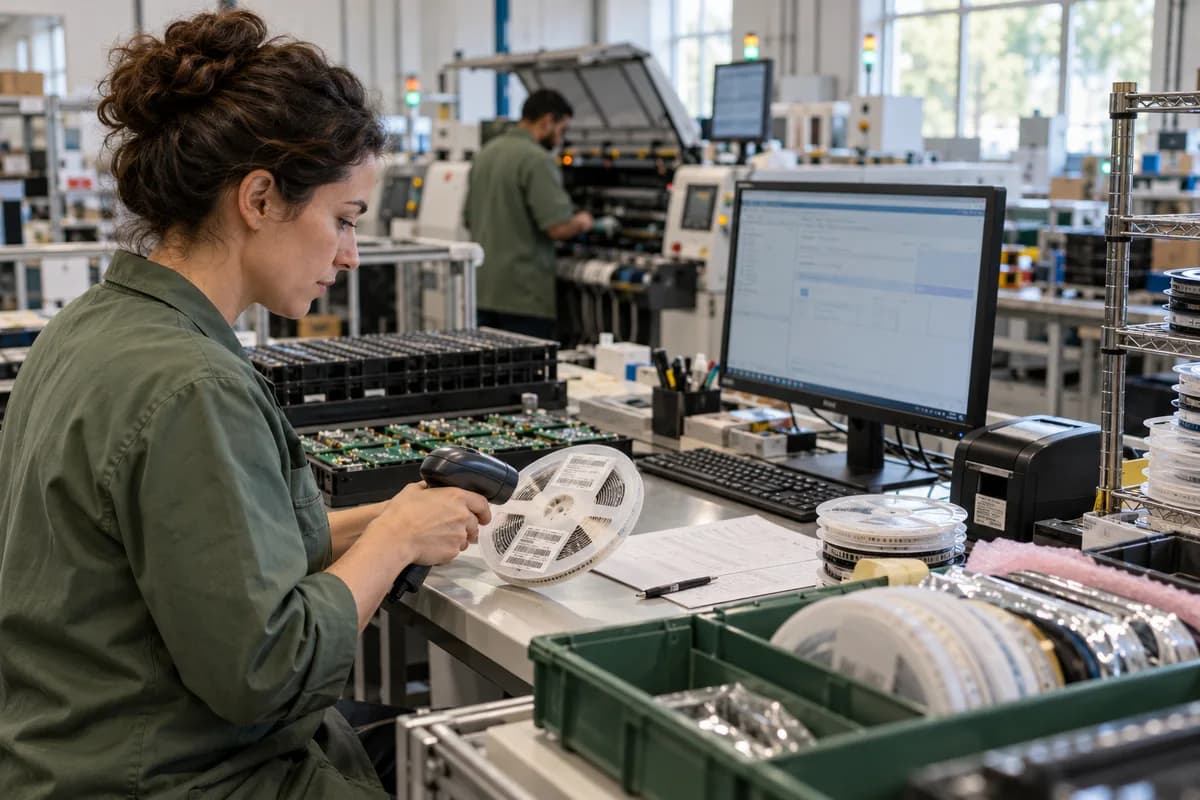
A manufacturing execution system sits between work order and machine, recording which operator ran which station, which feeder carried which reel and which board failed AOI.
That record makes traceability real. When a capacitor lot is recalled, you list every board that used it, by serial and ship date, and you open no cartons to find out.
A full MES is heavy for a ten person shop, but scan points at kitting, SMT, wave solder, test and pack often give most of the value.
- Scan points at kitting, SMT, test and pack
- Reel and lot linked to each board serial
- Live count of boards waiting at every stage
- Defect codes captured at AOI and functional test
- Operator and station stamped on every step
How growth pushes you up the ladder
Growth rarely arrives as one jump: a second customer brings a second BOM format and an approved vendor list, and a third wants a lot trace report. Each ask exposes the next weakness.
Watch customer demands closely, because automotive, medical and defence buyers often write traceability and revision control into their supplier audits long before your volume feels heavy.
Do not buy for the factory you hope to run in five years, because a tool chosen for volume you lack will sit unused while the real constraint stays. Buy for the next constraint.
Pick the next step, not the final system
List the three jobs that hurt most today, such as quote costing, stock accuracy or a trace request from a customer quality engineer. Match each job to one tool. Leave the rest alone.
Keep exports clean, because a tidy BOM in CSV with manufacturer part numbers, reference designators and revisions moves into any later system without rework.
Spend an hour this week cleaning your master BOM, fixing manufacturer part numbers and revision letters, then export it as a CSV and reopen it to check nothing broke. The hardest step is half done.
Tool fit worksheet
Spreadsheet, ERP and MES run across the top of this sheet. BOM costing, reel stock accuracy, purchase tracking, line status, lot trace and audit reports run down the side. Mark each cell fine, strained or broken today. Circle the costliest row.
Open a blank worksheet to printQuestions owners ask
When should a small electronics maker leave spreadsheets?
Once a second engineer starts changing the BOM, once reel counts stop matching the shelf, or once a customer asks for lot traceability. Any one is enough.
Do we need an MES if we already have an ERP?
Only if you must see line status or trace parts to each board, such as when a customer audit asks which reel went into which serial. Some makers add simple scan points instead.
Can an ERP handle traceability alone?
It can record lots at receipt and issue, but linking a reel to a placed board needs scanning at the line, and that usually comes from an MES layer.
What should we clean before moving?
The item master. Give each part one number, add the manufacturer part number, and fix revision labels so imports do not carry old mistakes forward.