In this guide 6 sections
Paper cards are cheap and familiar, but they lose wire lots, oven times and load test results between stations. A digital job record captures each step as it happens and links it to the wire coil. Small shops can keep paper longer if customers do not ask for lot proof.
What a paper route card does well
A card travels with the tray of springs. The coiler signs the first stage, the oven operator the second, the tester the third. Everyone knows the format. Nothing needs charging. Paper is also cheap to train on, which matters when operators change often.
For a small shop making repeat compression springs for a few steady customers, this can work for years. Cards are quick to change when a job needs a special step. A supervisor can read the whole job at a glance.
The trouble starts when someone asks a question the card cannot answer.
Where paper cards lose information
Wire arrives in coils with a heat number and a mill certificate. The card often holds only a coil sticker or a scribbled number. When a coil is split across two jobs, the link is easy to lose. Small coils mixed on a shared mandrel make the problem worse, because two jobs may use wire from the same spool within one shift.
Stress relieving needs a temperature and a soak time. Operators write them down after the oven runs, sometimes only when the shift winds down. Load testing results for rate and free length get copied to a separate sheet, if at all.
Oil ruins a card. A card sent to the next job by mistake is worse. Then comes the audit. A box of oily cards is a poor answer.
- Wire coil and heat number missing or partial
- Oven temperature and time written afterwards
- Load and free length results held elsewhere
- Rework passes not recorded
- No view of where a job sits right now
What a digital job record changes
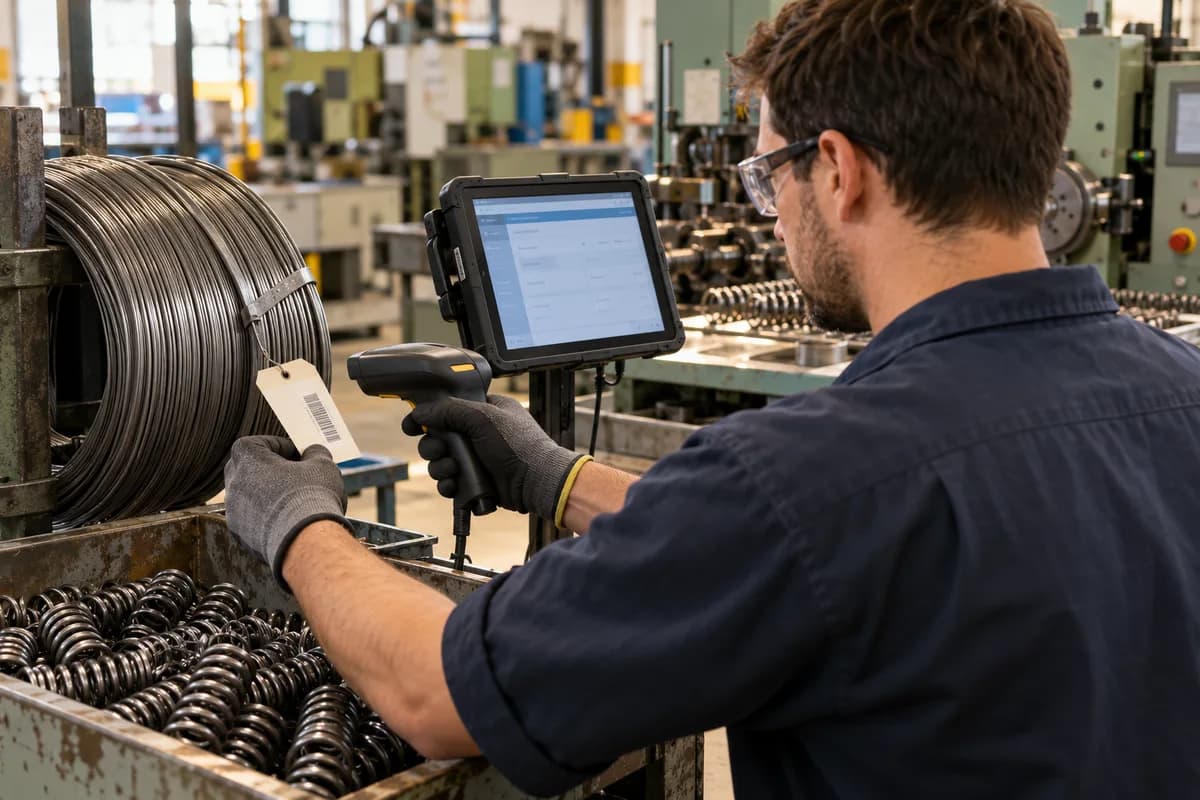
One record holds the order, the drawing revision, the wire lot, each operation and every measurement. The coiling operator scans the coil tag and the job. The record notes machine, wire diameter and the first-off check. The record also catches the odd step, such as shot peening or presetting, that a printed card might leave out.
The oven step logs the batch, the setpoint and the time. The load tester enters rate, length and pass or fail against the drawing limits. A failed spring routes to rework or scrap with a reason.
A supervisor sees every open job on one screen. A customer asking for a certificate gets it from the same record.
- Scan of wire coil and job at the coiler
- Oven batch with setpoint and soak time
- Load, rate and free length against limits
- Scrap and rework reasons by station
- Certificate printed from recorded data
Which one fits your shop
Choose by the questions you must answer. If automotive or medical customers ask for lot proof, paper will cost you in time and nerves. If you make general-purpose springs and nobody asks, paper stays viable. Honest accounting helps here. Add the cost of reprints and returns to the cost of searching.
Count how often you hunt for a card, argue about a missing temperature or repeat a test. Those hours are the real price of paper.
A middle path works too. Keep cards on the floor but type wire lots and test results into a shared sheet, then move to scanning when the sheet gets heavy.
Switch one product line first
Pick a family with a repeat customer, such as a torsion spring for a hinge. Build its steps, checks and limits in the digital record. Run the paper card beside it for two weeks.
Compare how long a lot query takes on each. Ask the operators what slowed them down. Fix the screen before adding the next family. Operators will tell you quickly what is clumsy. Listen to them.
Write down your three slowest questions from last year’s audits. Use them as the first test of the new record.
Route card versus job record worksheet
Worksheet on one page, with one line for each step: wire receipt, coiling, grinding, stress relieving, shot peening, setting, load testing and packing. Columns show what the paper card records, what a digital record would add, who enters it, and whether a customer asks for it.
Open a blank worksheet to printQuestions owners ask
Do spring makers need wire lot tracking?
If customers ask for material certificates or if a failure could trigger a recall, yes. Linking each job to a wire coil and heat number makes both easy to answer.
Can operators use digital records at the coiling machine?
Yes, with a rugged tablet or scanner near the machine. Keep entries short: scan the tag, confirm the first-off check, and move on.
How are load test results stored?
Each result links to the job, spring and drawing limits. Rate, free length and load at height are stored as numbers, so trends show before springs fail.
Will paper cards disappear completely?
Not always. Some shops print a card from the digital record for floor use. The record remains the source of truth.