In this guide 6 sections
A claim with no serial history cannot be judged, so it gets paid or argued. Fix it by creating a unit record at build: serial number, build date, key component batches and dealer. Add every repair to that record, and each claim can be checked in minutes.
What a blind claim looks like
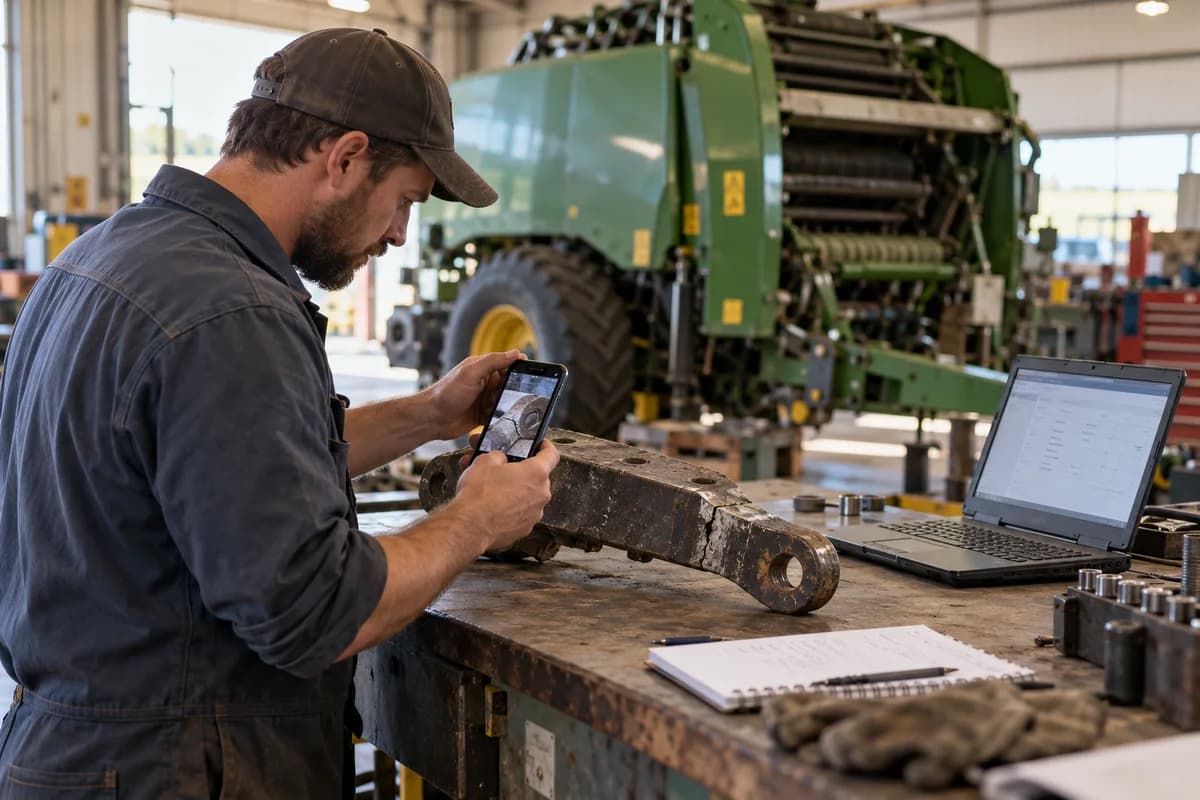
A dealer phones about a cracked drawbar on a baler. The service head asks for the serial plate. The dealer sends a photo with half the digits rubbed off.
Nobody can say when it was built, which steel batch went into the bar, or whether it was repaired before. The claim form says only that the machine failed.
The choice left is to pay without proof or to refuse and annoy a good dealer. Both cost something.
The record should be made on the shop floor
History cannot be rebuilt after the machine leaves. It has to be captured at the point of build, when the facts are cheap to record and the person who knows them is standing next to the machine.
Against that serial, store the build date, model, bill of materials revision, and the batch or lot of components that matter. For a baler that means the gearbox, the knotter, the drawbar steel and the hydraulic cylinder.
Add the dispatch date, the dealer and the invoice number. Now the unit has an identity.
- Serial number stamped on plate and frame
- Build date and bill of materials revision
- Lot numbers for gearbox, cylinder and steel
- Dispatch date, dealer and invoice number
Check the claim against the record
With the record in place, a claim becomes a short check. Is the unit inside the warranty period from dispatch? Does the failed part match a known batch? Has the unit been serviced by someone else?
The service head sees the answer on one screen. Approve, reject with a reason, or ask for the failed part to be returned for inspection.
Ask the dealer to send the failed part and photos with the serial. A returned part carrying a tag lets the gearbox or cylinder supplier share the cost when the fault is theirs. That is hard to argue from a phone call.
Repairs and spares belong in the same history
Every repair, whether under warranty or paid for, adds a line to the unit record. Note the date, the part replaced, the technician and the reading on the hour meter so that wear can be separated from defect.
Spares sold against a serial number join the record too. A dealer who buys three drawbars for one unit is telling you something.
Patterns appear after a season. Many claims on one lot of hydraulic cylinders point to a supplier problem you can act on.
- Repair date, part and technician
- Hour meter reading at repair
- Spares sold against the serial
- Claims grouped by component lot
Fix the past with a simple recovery step
Machines already in the field need a minimum record. Ask each dealer to send serial numbers, sale dates and customer villages for recent sales, because even a rough list gives you something to check the next claim against.
From the next batch, no machine leaves without a unit record. Tell the dispatch clerk to hold the gate pass until the serial has been entered.
Unit history card
A one-page card kept per serial number. The top block holds serial, model, build date and bill of materials revision. The middle block lists key component lots. The bottom block is a log with date, event, part, technician, hour meter and claim outcome. A side column holds dealer and dispatch details.
Open a blank worksheet to printQuestions owners ask
How do we handle claims on machines built before we kept records?
Treat them case by case with a short inspection and photos. Record each as the first line of a new unit history, so the next claim on that machine has something to check against.
Which components should be tracked by lot?
Track parts that cause the costly claims and that a supplier could share cost on. Gearboxes, hydraulic cylinders, castings and structural steel are common choices.
Do dealers need access to the record?
It helps when dealers can check a serial and warranty dates themselves. That cuts calls, though the approval decision stays with your service team.