In this guide 6 sections
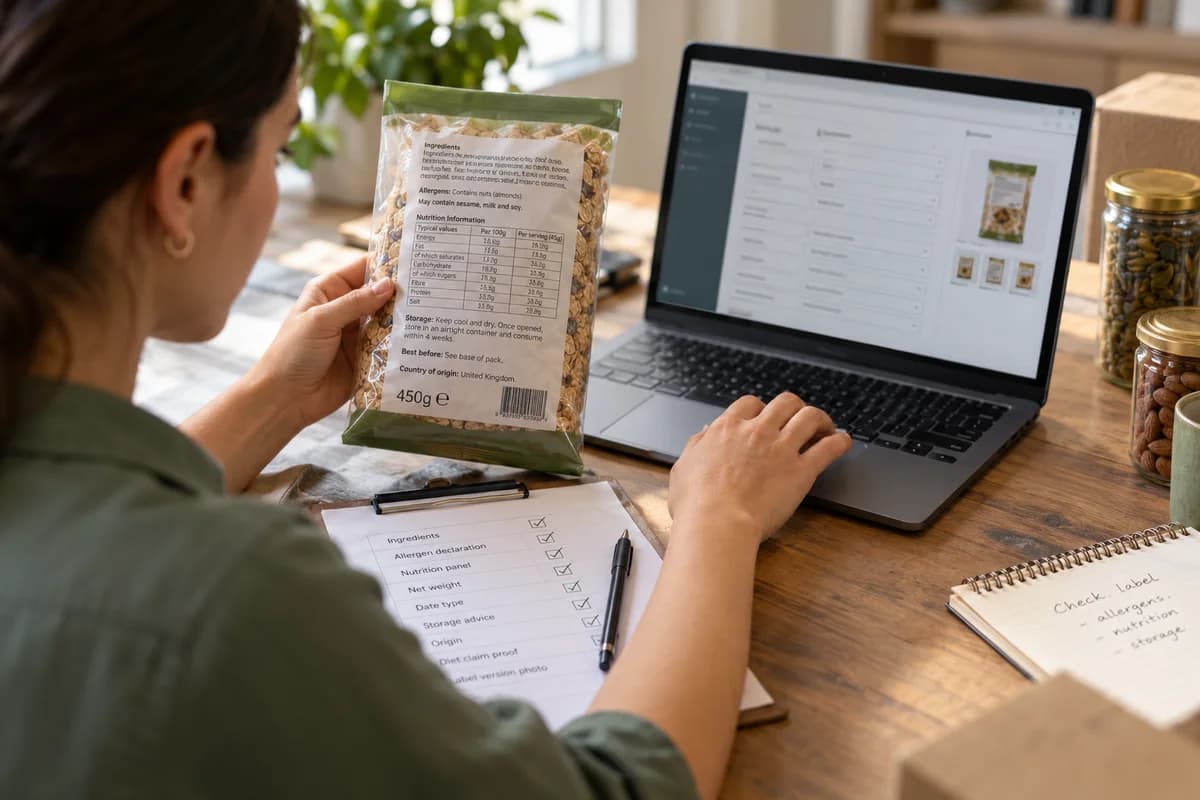
Every food record needs ingredients in order of weight, an allergen declaration, a nutrition panel, net weight, a date type, storage advice, origin and proof for any diet claim. Rules differ by market, and this is not legal advice. Nothing goes live with a field empty.
Ingredients and allergens lead the record
List ingredients in descending order of weight, exactly as printed on the pack, because buyers read that list to decide and inspectors read it to judge you. Copy it letter for letter.
Give allergens a structured field. For each allergen on your market’s list, store one of three states, which are contains, may contain or free from, so the shop filter never guesses at a typo.
Keep contains and may contain apart. A warning about a shared production line is a different fact from an ingredient, and a buyer with a sesame allergy reads the two very differently.
- Ingredients in pack order
- One state per allergen
- Contains and may contain lines kept apart
- Shop filters for gluten, nuts, milk, egg and sesame
- Date of the last label check
Nutrition panel and weights
Copy the nutrition panel from the pack, per 100 grams and per serving, with the serving size spelled out and the number of servings per pack. Do not calculate it. A recipe app’s rounded guess will not match the label that the buyer holds when the parcel arrives.
Weights need care too. Record net weight and, for tinned or brined goods, drained weight as well, then state the count where it helps, such as eight sachets of tea. Count and weight are different promises.
Update the record the day a recipe changes. A listing that trails the label by a month is a complaint waiting to happen, and in the worst case an allergen waiting to be missed.
Dates, storage and use after opening
Best before speaks to quality. Use by speaks to safety. Treat them as separate fields, so a listing never shows one date under the other’s name and a use by product can be blocked on its last day.
Store three things behind the date: its type, the days you promise at dispatch and the format of the lot code. Buyers see the first. Pickers need all three.
Storage splits in two, before opening and after. Before opening, write keep refrigerated, keep cool and dry, or freeze on arrival, and after opening add a use-within rule.
- Date type: best before or use by
- Days promised at dispatch
- Storage before opening
- Storage and window of use after opening
- Freezing advice, where it applies
Origin, claims and proof
Record the producer’s name and address and the country or region of origin, since some markets require both on the label. A recall starts with that name.
Every claim needs proof on file. Organic, vegan, halal or gluten-free each rests on a certificate, so attach its reference and expiry date to the record and pull the claim the day it lapses.
Marketing words need care as well. Natural, fresh and pure are not defined the same way in every market, so check them with your regulator or a food safety adviser before they reach a page.
Turn the checklist into a publishing gate
A rule written in a document gets skipped. A rule built into the product screen does not. Make each field required, and keep a new product in draft until every field is filled and the label photo is attached.
Add a second pair of eyes. One person enters the record and another compares it with the pack photo, line by line, before anything is published. Rules differ by market. Confirm yours with a food safety adviser.
Audit ten live products this week. Set each beside its pack, tick every field on the list, and rank the gaps by how many products share them. The commonest gap is your first rule.
- Required fields on the product screen
- Draft status until complete
- Second person compares record with label
- Label version date stored with the record
- Recheck when a supplier sends new artwork
Listing readiness checklist
A checklist that gives each field its own row: ingredients, allergen states, nutrition panel, net weight, date type, storage, origin, diet claim proof and label version. Columns hold filled yes or no, the source document, the person who checked, the date checked and a footer line for the pack artwork version.
Open a blank worksheet to printQuestions owners ask
Is a photo of the label enough on its own?
No. A photo helps buyers, but it cannot be searched, filtered or printed on a packing slip, and it goes stale the day the pack changes. Store the facts as fields. Show the photo as a second source.
What is the difference between best before and use by?
Best before marks when quality begins to drop, and the food is usually still safe to eat a few days afterwards, though it may taste flat or stale. Use by marks a safety limit. Past that date the food should not be eaten or sold.
Do loose or unpackaged items need allergen details too?
In most markets buyers still need to know. Hold the allergen states in the record even when no printed label exists, because a deli counter, a market stall and a gift hamper all raise the same question.
Who is responsible for checking a listing?
The seller is. Make one person the owner of each product record, and have a second person review it before it goes live. A supplier’s data sheet helps, yet the listing remains yours.