In this guide 6 sections
Offcuts vanish because the system consumes a full sheet when nesting finishes, and nobody books the leftover back into stock before the plate is carried off to a rack. The remnant loses its identity. Tag every remnant at the machine, then post it as stock.
Where the leftover sheet is lost
A nest is released, the laser cuts it, and the system writes off one full sheet against the job, while the usable drop lies on the bed unrecorded. The skeleton sits beside it. Both are invisible.
Operators stack the drops on a rack beside the machine, where some get a paint pen mark and others carry only a chalk number that rubs off. Marks fade. Memory fades faster.
Within weeks the rack holds plates that nobody can price, because nobody knows the grade, the thickness, the mill certificate or the job behind them.
- Full sheet written off at nest release
- No size recorded for the usable drop
- Grade and heat number lost with the barcode
- Job link missing, so no cost carried over
- Skeleton scrap mixed with reusable drops
Why the stock count drifts
The book count says twelve sheets of a given grade, yet the physical count finds nine full sheets and a heap of partials stacked against the wall. The gap is not theft. It is a definition problem.
If a partial counts as stock, the book must hold its dimensions, grade and location, and if it does not count, the rack is unpriced scrap. Most shops sit between the two. Stocktakes turn into arguments.
Reorders suffer too. Buyers order a fresh sheet when the system shows nothing usable, while three drops that would have nested the next job lie unseen on the rack. Money is spent twice.
A rule for what counts as a remnant
Decide a minimum usable size for each material and thickness, then call any drop larger than a bounding rectangle of that size a remnant and anything smaller scrap. Weigh the scrap and bin it.
Shape matters. An L-shaped drop left after a big cutout holds less usable area than its bounding box suggests, so save the true outline as a DXF. Keep it with the record.
Keep the rule short. Operators skip any rule that needs a calculator, a table lookup or a second opinion from the programmer at the end of a long shift.
Tag it, book it, quote from it
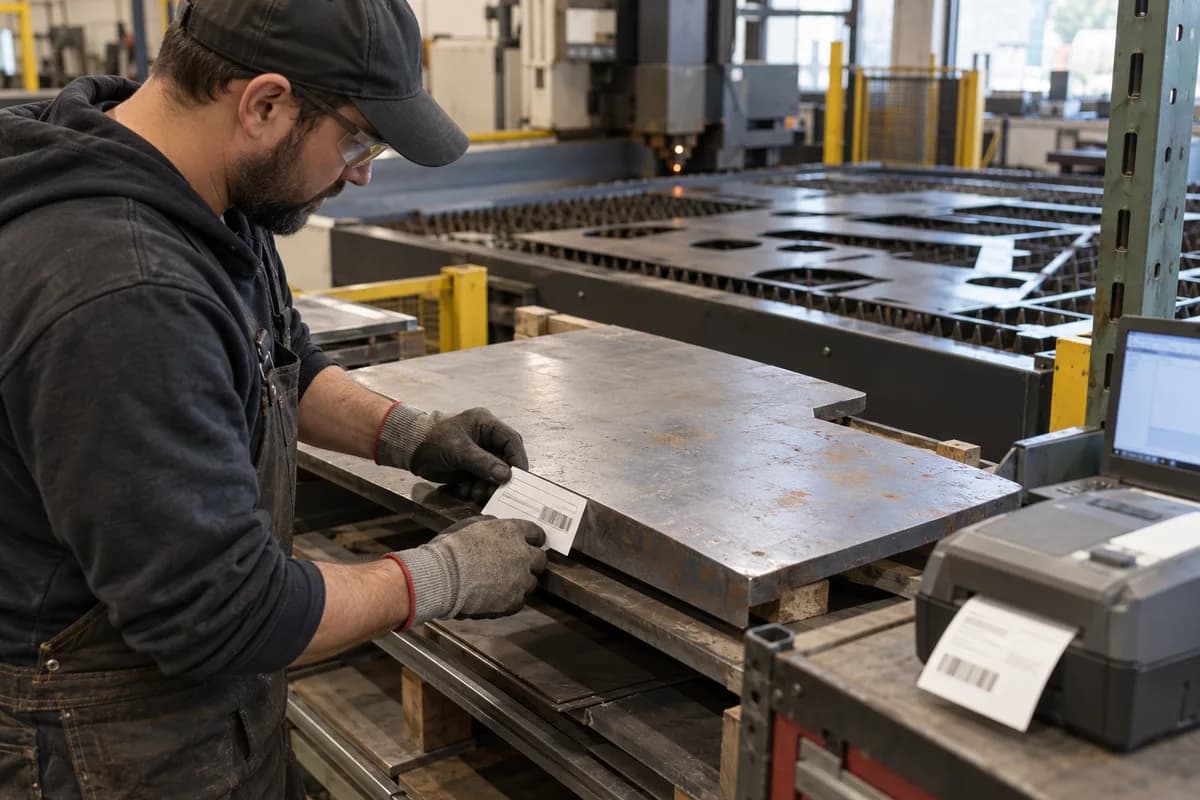
Print a label at the unload step carrying a remnant number, the parent sheet’s heat number, grade, thickness, outline file name and producing job. Stick it on before the plate moves. No label, no move.
Post the remnant into stock with its own location, say rack C, slot 4, and let the cost carry over from the parent sheet by area. The next nest tries remnants first. A fresh sheet comes last.
Quoting improves as well. An estimator can price a small bracket job from a drop the shop has already paid for, and the quote shows that saving in the material line.
A stocktake test this month
Count the rack this week. Measure ten drops, note grade and thickness for each, enter them as stock with a printed label, and rack them by location so anyone can find them tomorrow. Then run two nests with remnants. Count the sheets saved.
If the book and the rack agree afterwards, keep the routine and extend it to the next material in line, whether that is mild steel, stainless or aluminium. If they still diverge, find the step that lets plates leave the machine unlabelled, then fix that step before touching any other part of the routine.
Remnant booking slip
A slip printed at the machine. Fields cover remnant number, parent sheet, heat number, grade, thickness, bounding length and width, outline file, source job and rack location, so no planner needs a phone call. A tick box marks scrap or reusable. A lower block names the nest.
Open a blank worksheet to printQuestions owners ask
Should every offcut be tracked as stock?
No. Set a minimum usable size for each thickness and grade, and treat anything smaller as scrap, so the stock list stays short enough to trust.
How do we keep the mill certificate with a remnant?
Record the parent sheet’s heat number on the label and in the stock line, and the certificate can then be found through that number, even after the cut.
Who should book the remnant?
The operator at the unload step, because the plate is in their hands, with a supervisor’s end-of-shift walk along the rack to catch the ones that were missed.
Can nesting software reuse remnants automatically?
Many nesting packages can reuse a remnant automatically, provided the remnant has a saved outline and the stock record holds its grade and thickness. Without both, nothing is offered.