In this guide 6 sections
Serials go missing because receiving, the till and the pick list all scan the model barcode at SKU level and never read the unit itself. Fix it at pick. Capture the IMEI or serial there, scan it again at dispatch, and compare it with the sold record on return, so the number follows the unit.
Where the serial slips out of the flow
A carton of phones arrives with a packing list that names models and quantities, but it does not list the IMEI of each handset inside. Whoever receives it scans one EAN barcode. The stock count rises by the carton quantity, and the identity of each unit stays on labels that nobody reads again once the box is shelved.
The till repeats the habit. A cashier scans the model barcode on the box, takes payment and moves on, because any unit of that model will do. The invoice names a model, not a handset.
Online orders are worse. The pick list says SKU and quantity, so the picker lifts the nearest box from the bin and never reads the label on the unit inside it.
- Goods receipt: carton scanned, units not
- Branch transfer: model moved, IMEI not recorded
- Counter sale: EAN scanned, serial left off the invoice
- Online pick: any box of the right SKU leaves the bin
- Return restock: unit shelved without matching it to the sale
What the gap costs you months later
A customer walks in with a dead laptop. The service centre wants an invoice showing the IMEI or serial, but yours shows only a model name and a date, which proves nothing about this unit. You cannot prove you sold it.
Theft shows up as arithmetic. The system says four units of a model are in stock while the shelf holds three, and without serials you cannot say which one left. There is no IMEI to give the police. The loss stays a number in a count.
Return fraud is the quietest cost. A buyer sends back a box holding an older handset, a counterfeit or a unit with its parts swapped, and the model still matches the invoice. The refund goes out. You find the swap at resale.
Scan the unit at pick, not just the shelf
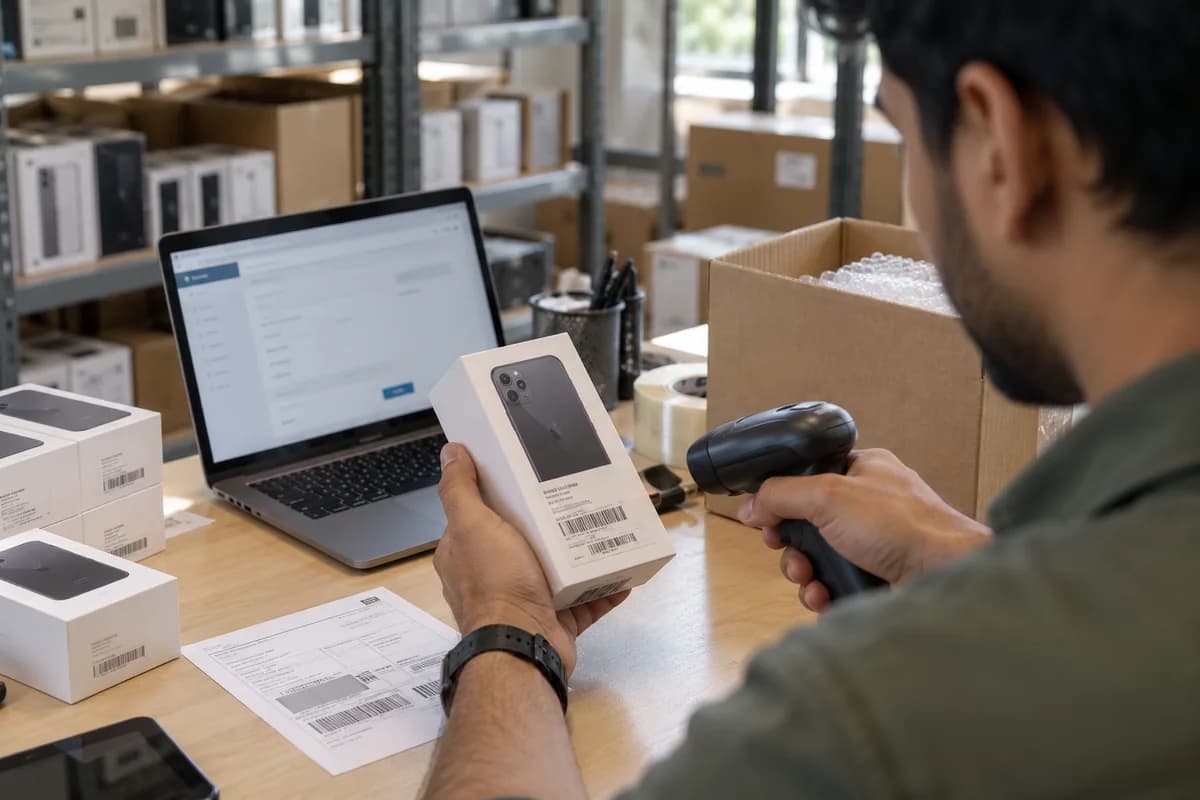
Scan-at-pick means two scans: the bin label, then the IMEI or serial on the unit in hand, which the system matches to the order line. The wrong unit is refused on the spot.
Dual-SIM phones carry two IMEIs and eSIM models add an EID, so choose IMEI1 as the key and store the rest against it. Any number then finds the unit. The serial on a laptop sits on the underside sticker.
Use a handheld scanner that reads the small barcode on the box label, because typing a long number by hand invites slips. Let the software run the Luhn check on the last digit, which catches any single mistyped digit and most swapped neighbours before the record is saved.
- IMEI1 as the key, IMEI2 and EID linked to it
- Laptop serial read from the underside sticker
- Order line, SKU and serial held in one row
- A refusal when the scanned unit is already sold
- Picker’s initials and time on every scan
Scan again at dispatch and when the box comes back
The second scan happens at the packing bench. The packer scans the unit, then the parcel label, and the system pairs the serial with the courier’s tracking number before the carton is taped. A red screen stops the box.
Returns run the same check in reverse. Scan the IMEI on the returned handset, not the box, and if it differs from the one you sold, hold the refund and open a case.
The same pairing settles a warranty visit fast. Search by IMEI to see the sale date, the buyer and the courier’s delivery scan, then print an invoice that carries the number. Service centres usually ask for exactly that.
- Serial paired with the courier tracking number
- Returned unit scanned and compared with the sold serial
- A mismatch puts the refund on hold
- Warranty search by IMEI returns sale date and buyer
Start with one shelf and one week
Do not retrofit the whole stockroom. Take your few best-selling models, count what sits on the shelf, and record each IMEI against its bin location in a plain sheet before you touch the software.
Run that for a week. Then compare the sold serials with the invoices, because every invoice without a serial marks a step where the scan is being skipped. That list is your fix order. It is usually short.
After that, move the capture to goods receipt, where the carton is opened once and every unit is in front of you. Receipt is the cheapest moment to scan. Tomorrow, open one carton, scan each handset into a sheet beside its bin location, and note in the margin how long the whole carton took.
Serial capture audit sheet
Each row covers one sale from the last week, with columns for invoice number, model, IMEI or serial, picker, scan at pick, scan at dispatch and a note. A blank cell exposes the weak step. A second block lists returns, with the sold serial and the returned serial side by side and a box for the match.
Open a blank worksheet to printQuestions owners ask
Do accessories need serial records?
No. Chargers, cases and cables are tracked by SKU, and serial capture belongs to the handsets, laptops, consoles, cameras and watches where warranty and theft are settled unit by unit.
What if the supplier will not send serial lists?
Scan the units yourself at goods receipt. An advance shipping notice with serials saves time, but you do not need one to begin, because a handheld scanner reads each box label in a second.
Can a till scan an IMEI?
Most barcode scanners can. The till field must accept it, and many systems ask for a serial only on items flagged as serialised, so cashiers are not prompted when they sell a cable.
How do marketplace orders fit in?
Pick them like any other order. Keep the serial on the order record, so a marketplace return case can be checked against the unit you actually sent, even weeks later.