In this guide 6 sections
Choose by site, not by fashion. Wi-Fi suits powered devices near an access point. 4G suits isolated sites with mains power and a SIM budget. LoRaWAN suits battery sensors sending small readings over long distances. Add a fallback link wherever a missed reading has a cost.
What separates the three links?
Wi-Fi gives high data rates over a short range and drinks power. It works well for a gateway with a mains supply and a nearby access point, but a battery sensor on Wi-Fi may need new cells every few weeks.
4G reaches almost anywhere with a tower in range. Each device needs a SIM, so you pay a recurring fee per unit. LoRaWAN carries tiny packets across hundreds of metres or more, with batteries lasting years, but it is slow and unsuited to video or large files.
Think of them as three different tools, not three grades of one tool.
- Wi-Fi: short range, high data, mains power
- 4G: wide reach, SIM fee per device
- LoRaWAN: long range, small packets, long battery life
- Reporting interval: every few seconds, minutes or hours
A poultry shed
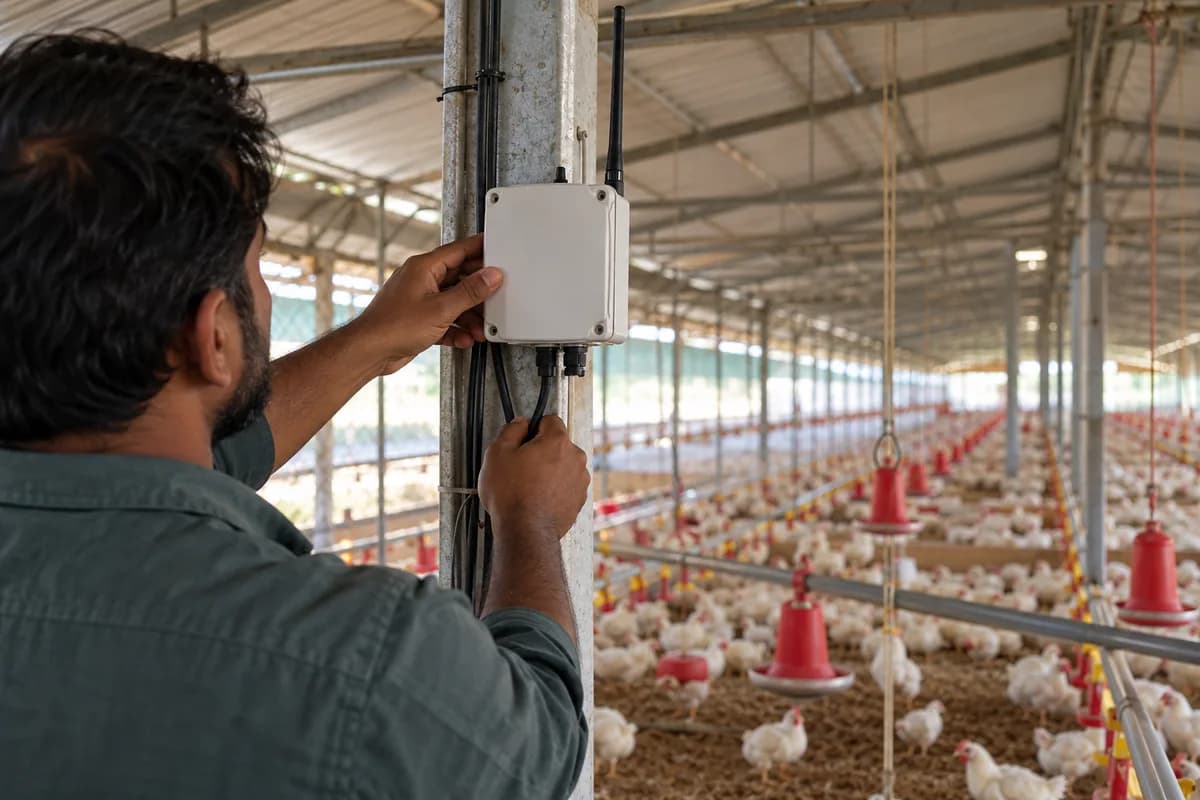
Long sheds of tin roofing and wet litter, dust, ammonia and humidity make a hard setting for radio. Wi-Fi from the farmhouse rarely reaches the far end. Sensors for temperature, humidity and water flow report modest data every few minutes.
LoRaWAN fits well here. One gateway on the roof ridge can serve several sheds, and the battery nodes survive the damp for a long time. Fan and heater controllers, which need fast response, can sit on a local wired link instead.
Where the farm has weak mobile coverage, a 4G backhaul from the gateway to the cloud completes the chain.
A campus pump house
Pump houses are often a concrete box at the edge of the campus, with a motor, a starter panel and mains power. Metal doors and thick walls block Wi-Fi. A starter panel with a mains supply can host a 4G gateway comfortably.
Pump houses near the main building suit LoRaWAN. Level sensors in the overhead tank and sump can report to a central gateway without a SIM per device. Dry-run and overload alarms need a quick path, so pair the link with a local relay.
Ask the facilities head who resets the pump after a trip, and make sure that person receives the alert.
- Motor current and dry-run protection
- Tank and sump level sensors
- Generator changeover status
- Alert path to the named responder
A basement cold store
Cold stores combine insulated walls, steel racks and sometimes underground placement. Radio signals struggle in all of these. A temperature logger inside a freezer room will often fail to reach any gateway outside it.
Place a gateway or repeater just outside the door, or run an Ethernet cable through an existing conduit and keep the sensors wired to the gateway. Compliance logs for food or vaccines cannot have gaps, so local storage on the device is vital.
Choose a link that records on the device first and sends later.
Where a fallback link earns its place
A second link costs a little and saves the day when the first one fails. Use one when a missed alarm risks stock, a pump, a regulated record or a night when nobody is on site.
A common pattern is Wi-Fi or Ethernet as the main route, with a 4G modem as the standby. The gateway switches on its own and flushes the stored readings when the main link returns.
Before you buy, list your three most critical readings and ask what a two-hour gap in each would cost. Then price the fallback against that answer.
Sensor link comparison worksheet
Worksheet grid, one row per site. Columns cover gateway distance, wall or metal in the path, power at the device, reporting interval, battery life needed, SIM count and monthly fee, and the chosen link. A last block lists the fallback link, the local buffer in hours and the person alerted.
Open a blank worksheet to printQuestions owners ask
Is LoRaWAN better than Wi-Fi for sensors?
For small readings from battery devices over long distances, yes. For powered devices near an access point or anything needing larger data, Wi-Fi is simpler.
Do LoRaWAN devices need a SIM?
The sensors do not. The gateway needs a backhaul, such as Ethernet or a 4G modem, which carries data from all nearby nodes.
Can one site use all three links?
Yes, and many do. Battery nodes on LoRaWAN, a powered gateway on Ethernet and a 4G modem as standby is a common mix.
How do we test coverage before buying?
Borrow a test gateway or a few nodes and place them at the real positions for a week. Check dropped packets, not just signal bars.