Business solutions for Hatcheries
Explore software for work such as “Advance booking of chicks by placement date”. Review each business function below, including when it fits and what to check before implementation.
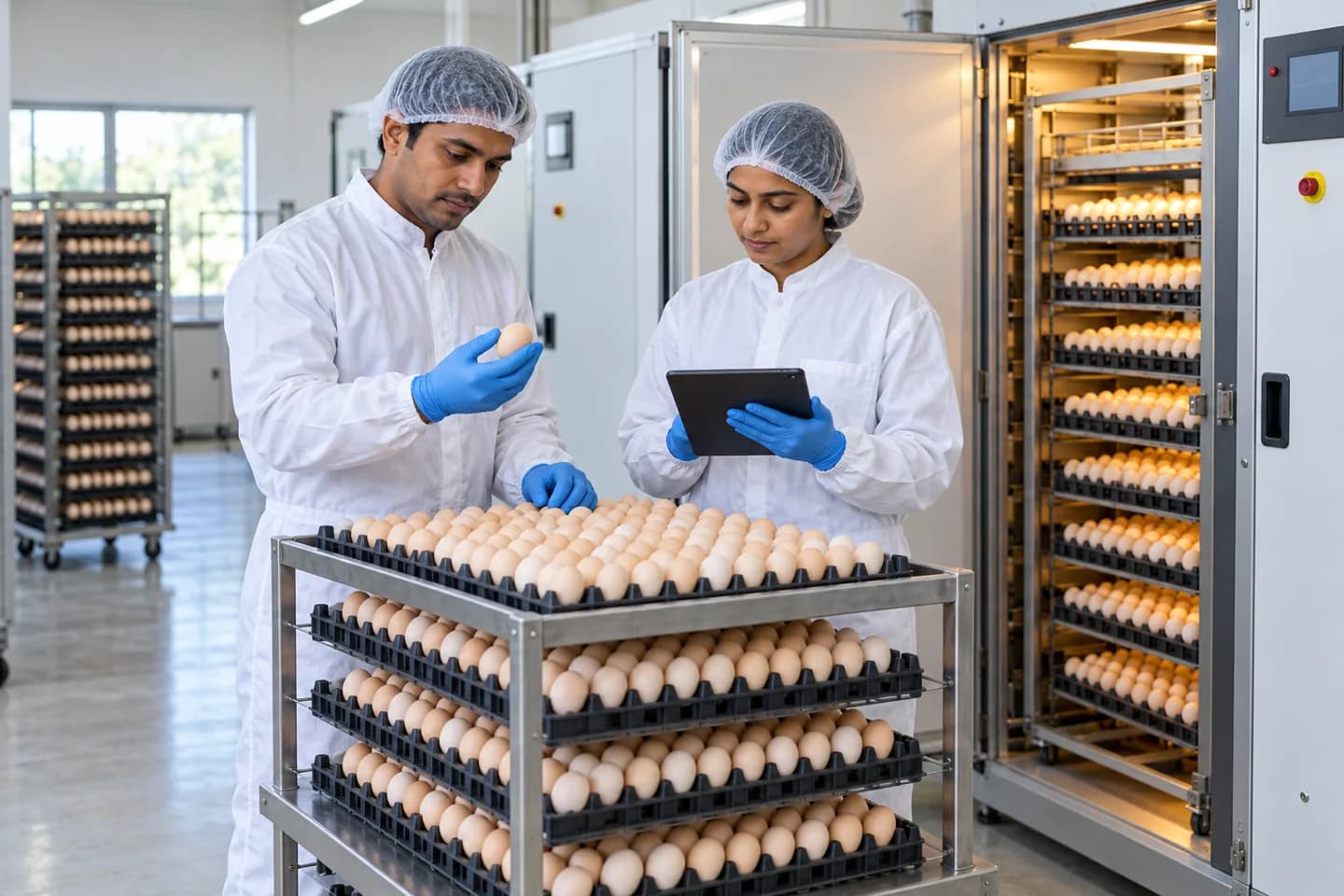
How the business operates.
Hatching runs on a fixed clock. Eggs go into a setter on one day, move to a hatcher on another, and chicks come out on a third. If a lot hatches badly, the answer lies in an earlier step that nobody wrote down. That is common.
The records that hold the operation together.
- Egg receiving and lot register. Number each lot on arrival with breeder flock, flock age, lay date, tray count and condition. The lot number stays on every later entry.
- Egg room and fumigation. Log cold room temperature, storage days and fumigation cycles for each lot, and flag eggs that have waited longer than your limit.
- Setter and hatcher loading. Assign lots to setter, trolley and tray positions, set transfer and pull dates, and keep temperature and humidity readings against each machine run.
- Candling and transfer. Enter clears and early deaths by lot at candling. Fertility by breeder flock is worked out without any hand counting. Each lot keeps its own figures.
- Hatch pull and breakout. Record chicks pulled, unhatched eggs and the breakout findings. Hatchability and dead-in-shell rates are read by lot, flock and machine.
- Chick grading and sexing. Capture grade A, grade B, culls and sex counts on the pull line, with the staff member and the lot, so quality can be discussed with evidence. Staff names stay on entries.
- Vaccination records. Log spray and injection vaccines, batch numbers, expiry dates and the lots covered, and check the stock of vials before the pull.
- Farm orders and setting plan. Hold orders by breed, farm and delivery date, and set them beside eggs on hand and setter space so the planner sees any gap early.
Operational bottlenecks to check
A poor hatch cannot be traced
Hatch results are compared by day, not by egg lot. When one breeder flock produces weak chicks, the pattern is spotted months later. Damage is done.
Machine logs live on paper
Setter and hatcher temperature and humidity are written on hanging sheets beside each machine, and a slow drift in one of them is found only after the pull has already gone badly. By then it is late.
Candling results are tallied late
Clears and early deaths are counted at transfer, then copied to a register. Fertility by flock is never worked out in time to act on. Decisions wait.
Chick grade is a verbal judgement
Grade A, grade B and culls are called out on the line. Customers dispute the box count and the culls with no record of either. Trust fades.
Orders overrun the setting plan
Farm orders arrive by phone for chicks three weeks away. Setting capacity is planned from a whiteboard, so some orders are short and others have chicks left over.
Follow the work across teams.
This is a planning flow. Confirm the steps, owners and approval rules against your actual operation.
Roles and responsibility boundaries.
Reports your managers need.
- Hatchability and fertility by breeder flock and flock age
- Candling clears and early deaths by lot and setter
- Breakout findings by hatcher, pull date and lot
- Chick grade split and culls by day and operator
- Egg storage days against hatch result
- Farm orders against chicks supplied, with shortages
- Vaccine batches used and vials remaining
Connections to scope
- WhatsApp or other messaging
- SMS
- Label printer
- Accounting export
Confirm data access, record ownership and the exchange method for each connection. Inclusion here does not mean every connection is available in a standard package.
Setup decisions and adoption risks.
Use these requirements to plan phases, data migration and user training. Agree the release sequence after reviewing your current systems.
Limitations to settle before implementation
- A farm that hatches a few trays in a small incubator for its own use does not need lot-level software.
- Farms that rear and sell the grown birds will find Poultry Farm Management Software closer.
Modules to consider first.
These functions connect to the operating model above. Confirm each one against the work your business actually runs.
Choose the operation you want to improve.
Use these activities to explain your scope. Your business does not need every function in the directory.
- Advance booking of chicks by placement date
- Dealer network growth
- Chick quality and early mortality records
- Country chicken chicks for small farmers
- Layer chicks with vaccination support
- Technical help line for farmers
- Repeat batch reminders
- Hatching egg sales
Explore the business functions.
Production, stock, fleet and recurring billing functions apply only where your business runs those activities. Read the suitability conditions on each page.
Assets and Fleet
Manufacturing
Batch and Serial Tracking
Trace goods using batch identifiers or individual serial numbers.
View workflow and suitability →Production Planning
Plan manufacturing quantities against demand, materials and capacity.
View workflow and suitability →Quality Control
Record specified inspections and the disposition of checked goods.
View workflow and suitability →
Procurement
Finance & Accounting
CRM
Inventory Management
Start with the problem your team can describe.
Bring a sample record and show where information is copied, missed or waiting for approval. Scope the first useful change from there.
What happens after you share your requirements
- We review your brief and the systems you already use.
- We clarify the workflow, missing information and the work to consider first.
- The proposed scope sets out the deliverables, responsibilities and dependencies.
- Review the scope and commercial terms before deciding whether to proceed.
Start with your requirements
Describe your current process, the people involved and the change you need. Start with the details you know; we can clarify the rest together.
Share your requirements