Document Management for Payment service providers
Store business papers with their owners, versions and renewal dates.
Does this function belong in your operation?
Use when business documents are scattered across folders or inboxes.
A document arrives, changes or approaches expiry.
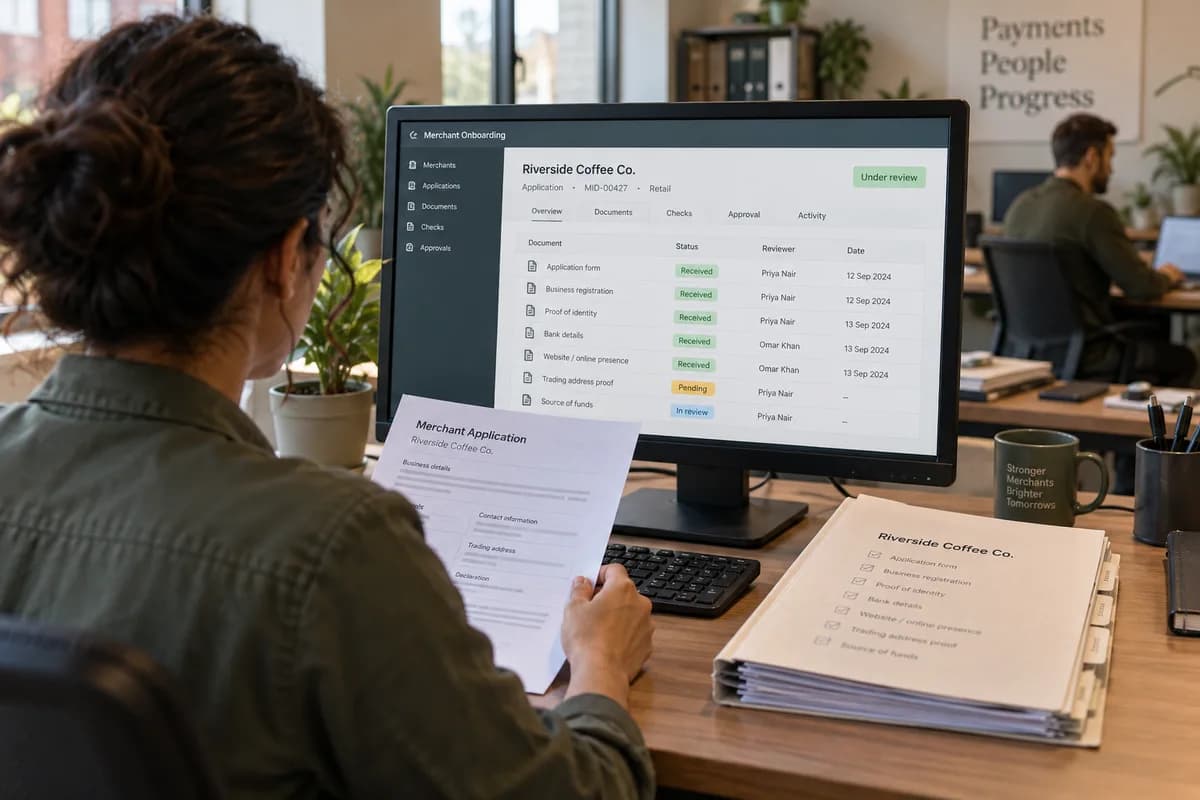
A merchant’s file holds the incorporation certificate, owner IDs, bank proof and website screenshots. Every paper has a date and an expiry where one applies. Analysts see what is missing before screening starts.
Bring the records the workflow depends on.
- Document types
- Access groups
- Files and renewal dates
Outputs to check
- Searchable document register
- Version and access history
- Renewal action list
Follow the document management workflow.
Use this sequence to compare your current process with the proposed module. Agree the owner, permission and exception at each step.
Who uses the module, and who approves?
Keep responsibilities distinct even when one person holds more than one role.
Decide how exceptions are handled.
These business rules belong in configuration and testing. A normal transaction alone does not demonstrate that the workflow is ready.
Can this work independently?
This can operate as a controlled document library without accounting or HR modules. Links to contracts, suppliers or employees attach files to business records; reminders require the agreed notification channel and recipient rules.
Systems and records it connects with
- Contract management: Operative agreement terms, amendments and obligation dates.
- Vendor management: Approved supplier identities, terms and sensitive-change controls.
- HR document management: Restricted employee documents and completeness status.
- Notifications: Approved event messages and delivery or failure status.
Configure, test and introduce the workflow.
- Start with an inventory. You tell us the kinds of papers and where they sit now, and we return folders by type and the dates that matter.
- The owner says who may open which type. You get a role screen to check. Hand over a sample. A trial import of your scans and files comes back with fields filled and gaps marked.
- Whoever scans and uploads practises naming, dates and linking. That group is trained before the rest.
Check the result before rollout.
Apply these checks to a sample from the agreed workflow, then repeat with an exception. Keep the expected result beside the test record.
- Documents are searchable by reference.
- Restricted files remain protected.
- Earlier versions remain identifiable.
How the business operates.
A payment business keeps two kinds of record. One is the transaction stream from your gateway or acquiring partner. The other is the context around it: who the merchant is, which merchant discount rate applies, what was paid out, what sits in reserve and what is disputed.
The records that hold the operation together.
- Merchant application and KYC file. Open one file per merchant with the application, ownership papers, director identity documents for know-your-customer checks, bank proof and website review. A checklist shows which paper is missing and who is chasing it.
- Screening and risk review log. Record each sanctions and adverse-media check with its result, reviewer and date. Assign the merchant category code and a risk tier, and keep the reasoning for an approval or a decline.
- Contracts and rate cards. Store the signed merchant agreement beside its pricing: discount rate, per-transaction fee, scheme pass-through and payout terms by payment mode, each with an effective date.
- Capture and transaction file import. Load the capture, refund and fee files from your gateway or acquirer in the layouts they send. Totals per merchant and per day are shown before any payout is built.
Operational bottlenecks to check
Onboarding stalls on one paper
One identity-check file is parked for a director’s address proof, but the team cannot count other files waiting for the same document. Merchants sign with a rival gateway.
Rate cards live in a spreadsheet
Someone keys the negotiated rate by hand. The payout then runs at the standard rate. Finance posts a reversal a fortnight later.
How work flows across this business
This module sits within a wider operating process. Use the sequence to identify the other teams and records affected by a change.
1. Application
A merchant applies through a form or a sales contact. The business type, expected volume, payment modes and website are captured, and an analyst is assigned.
2. KYC and screening
Papers are collected against a checklist. Ownership is mapped, names are screened, a category code and risk tier are set, and approval is recorded with its reasons.
3. Pricing and go-live
The signed agreement and rate card are attached with effective dates. Settlement account details are verified before the merchant is switched on in your gateway.
4. Capture and payout
Capture and fee files are imported each cycle. A batch is built net of fees, refunds and reserves, reviewed by an approver and passed to the bank process.
5. Reconciliation
Batches are matched with the sponsor bank statement and partner files. Breaks get a cause and an owner, and clear before the cycle is closed.
6. Disputes and support
Chargebacks, refunds and merchant queries are worked from one desk. Evidence is attached, deadlines watched, and outcomes posted to the next payout advice.
Industry reports to connect with
- Applications by stage, reviewer and missing document
- Merchants by risk tier, category code and payment mode
- Payout batches by cycle, with fees, refunds and reserves deducted
- Reconciliation breaks by cause, age and owner
Questions before implementation.
When should payment service providers consider document management?
Use when business documents are scattered across folders or inboxes. A document arrives, changes or approaches expiry.
What should we bring to the requirements discussion?
Bring anonymised examples of Document types; Access groups; Files and renewal dates. Show who creates, checks and changes each record. Use only records from an activity that meets the suitability conditions above.
Does this replace our existing business software?
The starting point is your current system and the gap you need to close. Store business papers with their owners, versions and renewal dates. Configuration, a connected module or a custom build are evaluated against that gap before a replacement is proposed.
What is outside this module?
Storage does not establish legal validity or provide legal review.
How are scope, price and rollout decided?
The proposal follows a review of your records, user roles, branches and existing software. Data migration, connections, training and support are scoped separately where needed. Documents are searchable by reference. Use this check when reviewing the first working version.
Related functions for payment service providers.
Discuss document management for your business.
Tell us which workflow needs attention and which systems your team uses. The next step is a requirements discussion and a written scope.
What happens after you share your requirements
- We review your brief and the systems you already use.
- We clarify the workflow, missing information and the work to consider first.
- The proposed scope sets out the deliverables, responsibilities and dependencies.
- Review the scope and commercial terms before deciding whether to proceed.
Start with your requirements
Describe your current process, the people involved and the change you need. Start with the details you know; we can clarify the rest together.
Share your requirements