Estimate/Quotation Management for Rubber gasket manufacturers
Keep itemised estimates and their approved revisions together.
Does this function belong in your operation?
Use when scope and prices are agreed before an order.
A buyer asks for pricing before confirming work.
A sketch or an old gasket becomes a quote once diameters, bolt circle, thickness and grade are read. The estimator prices material by nested sheet area. Die cost shows when needed.
Bring the records the workflow depends on.
- Items and units
- Rates and tax settings
- Approval terms
Outputs to check
- Versioned estimate document
- Approval and acceptance history
- Accepted billing or order input
Follow the estimate/quotation management workflow.
Use this sequence to compare your current process with the proposed module. Agree the owner, permission and exception at each step.
Who uses the module, and who approves?
Keep responsibilities distinct even when one person holds more than one role.
Decide how exceptions are handled.
These business rules belong in configuration and testing. A normal transaction alone does not demonstrate that the workflow is ready.
Can this work independently?
An estimate can be prepared independently from entered items and rates. Item catalogues, pricing and tax settings improve consistency when connected. Order creation and invoicing are downstream processes; acceptance should preserve the agreed version rather than overwrite the estimate with later rates.
Systems and records it connects with
- Lead management: Enquiry sources, owners and qualification decisions.
- Proforma invoice: Provisional supply amounts and related advance requests.
- Invoice management: Issued invoice references, line amounts and outstanding balances.
- Price lists and schemes: Effective-dated rates and customer eligibility rules.
Configure, test and introduce the workflow.
- We read quotations you sent recently. You pass over the rate list and a few finished quotes, and we sketch the screen layout.
- Items, units, discount limits and standard terms go in. Proofreading the list is yours. The printed quotation is matched to your letterhead. A draft PDF is sent for your comments.
- Executives raise real quotes in parallel with the old method. Mismatches are logged and discussed. New enquiries start in the system. Estimators and executives get a short session each.
Check the result before rollout.
Apply these checks to a sample from the agreed workflow, then repeat with an exception. Keep the expected result beside the test record.
- Earlier revisions remain available.
- Totals use approved settings.
- The accepted version is identifiable.
How the business operates.
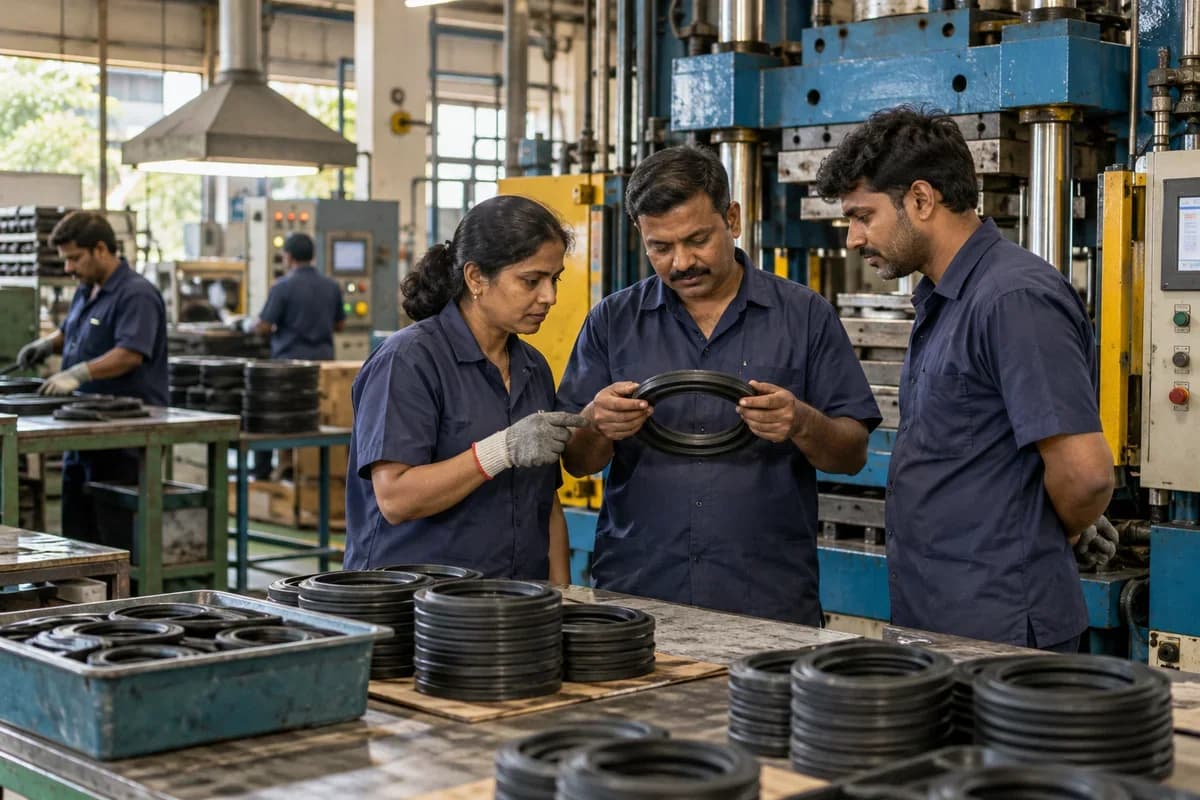
A rubber gasket shop supplies the flat ring, the full-face gasket, the door seal and the sump gasket. Each sits between two parts. Its job is to keep a fluid or a gas where it belongs. Some are cut from sheets of nitrile, EPDM, neoprene or silicone with steel rule dies, a water jet or a knife cutter. Others are moulded or extruded and joined into loops. Each type needs its own record.
The records that hold the operation together.
- Part numbers, drawings and patterns. Hold sketch, rubbing, DXF and revision under one part number, with compound, Shore hardness and tolerance band.
- Quotations by sheet yield. Price a gasket from sheet cost, expected nesting yield, knife time and finishing, then set the figure beside the yield the job actually returned.
- Sheet and profile stock. Receive sheets by compound, hardness, thickness and size, and extruded profile by section and coil length, then issue each against jobs.
- Offcut register. Return leftover sheet with its dimensions to stock, so the next small order is cut from a remnant before a full sheet leaves the rack.
Operational bottlenecks to check
Drawings arrive in whatever form the buyer sends
A hand sketch, a photo of an old gasket and a drawing file all arrive for the same part. With no revision on record, a repeat order is cut from whichever copy turns up first, and the buyer sees the difference.
Nesting waste is invisible
Operators nest parts on a sheet by eye, and the offcut goes on a pile. The yield of each job is unknown, so quotes ignore it. Waste is money on a pile.
How work flows across this business
This module sits within a wider operating process. Use the sequence to identify the other teams and records affected by a change.
1. Enquiry and pattern
A buyer sends a sketch, a drawing or a worn gasket. The estimator records inside diameter, outside diameter, bolt circle, hole count, thickness and compound, and files the rubbing.
2. Cutting file or die
A knife file or steel rule die is made and filed under the part number. A first piece is cut and checked against the drawing with a vernier caliper.
3. Sheet issue
Stores issue sheets by compound, Shore hardness and thickness. The operator nests the parts on the plotter bed, and the sheet area used is written to the order.
4. Cutting and finishing
Parts are cut by clicker press, oscillating knife or water jet. Bolt holes are punched, edges cleaned and pressure sensitive backing applied where the drawing asks.
5. Splicing and inspection
Extruded profile is mitred to length and bonded into loops. Inspectors check bolt hole positions, thickness and the corner bond with a pull test.
6. Kit, pack and deliver
Parts are counted into labelled bags or kits, and a delivery note naming the compound travels with the carton. The invoice follows.
Industry reports to connect with
- Orders by stage with sheet area used
- Nesting yield by job, compound and operator
- Offcut stock by compound and size
- Dies and blades past their impression limit
Questions before implementation.
When should rubber gasket manufacturers consider estimate/quotation management?
Use when scope and prices are agreed before an order. A buyer asks for pricing before confirming work.
What should we bring to the requirements discussion?
Bring anonymised examples of Items and units; Rates and tax settings; Approval terms. Show who creates, checks and changes each record. Use only records from an activity that meets the suitability conditions above.
Does this replace our existing business software?
The starting point is your current system and the gap you need to close. Keep itemised estimates and their approved revisions together. Configuration, a connected module or a custom build are evaluated against that gap before a replacement is proposed.
What is outside this module?
An estimate is not a tax invoice or proof of acceptance.
How are scope, price and rollout decided?
The proposal follows a review of your records, user roles, branches and existing software. Data migration, connections, training and support are scoped separately where needed. Earlier revisions remain available. Use this check when reviewing the first working version.
Related functions for rubber gasket manufacturers.
Discuss estimate/quotation management for your business.
Tell us which workflow needs attention and which systems your team uses. The next step is a requirements discussion and a written scope.
What happens after you share your requirements
- We review your brief and the systems you already use.
- We clarify the workflow, missing information and the work to consider first.
- The proposed scope sets out the deliverables, responsibilities and dependencies.
- Review the scope and commercial terms before deciding whether to proceed.
Start with your requirements
Describe your current process, the people involved and the change you need. Start with the details you know; we can clarify the rest together.
Share your requirements