Business solutions for Rubber gasket manufacturers
Explore software for work such as “WhatsApp and phone reply for urgent sizes”. Review each business function below, including when it fits and what to check before implementation.
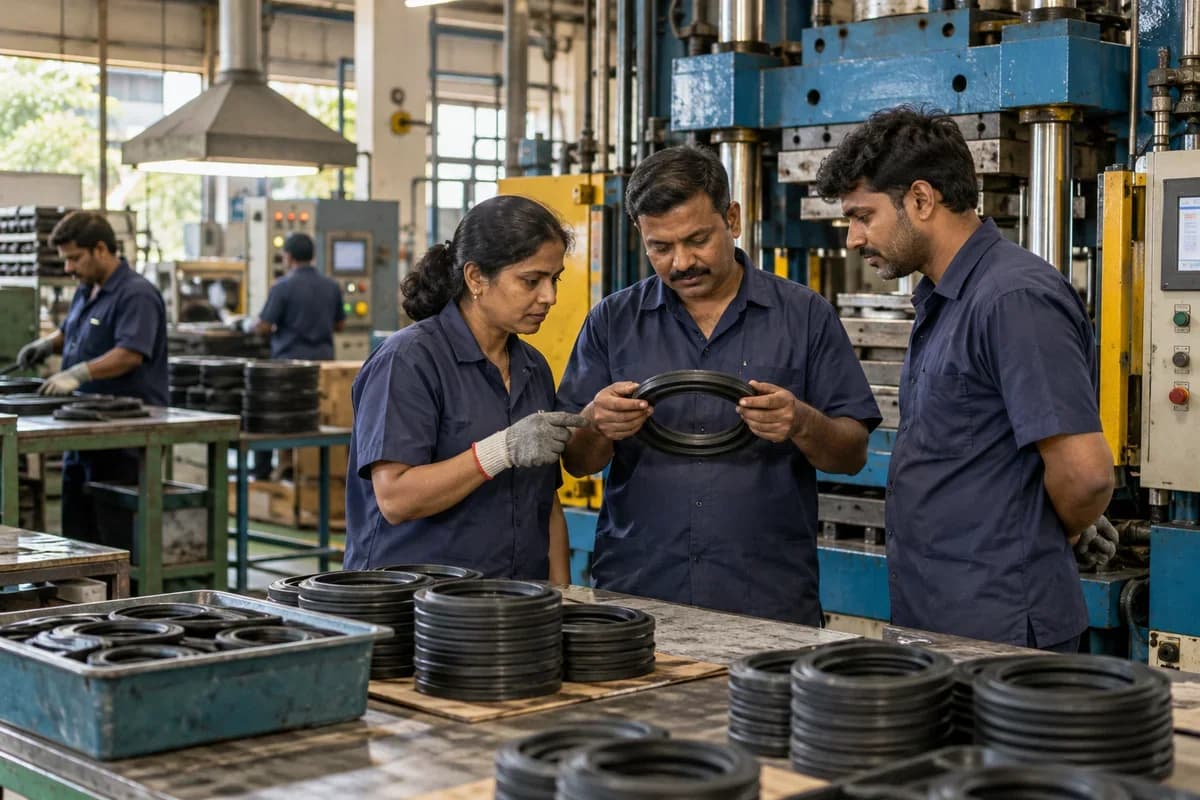
How the business operates.
A rubber gasket shop supplies the flat ring, the full-face gasket, the door seal and the sump gasket. Each sits between two parts. Its job is to keep a fluid or a gas where it belongs. Some are cut from sheets of nitrile, EPDM, neoprene or silicone with steel rule dies, a water jet or a knife cutter. Others are moulded or extruded and joined into loops. Each type needs its own record.
The records that hold the operation together.
- Part numbers, drawings and patterns. Hold sketch, rubbing, DXF and revision under one part number, with compound, Shore hardness and tolerance band.
- Quotations by sheet yield. Price a gasket from sheet cost, expected nesting yield, knife time and finishing, then set the figure beside the yield the job actually returned.
- Sheet and profile stock. Receive sheets by compound, hardness, thickness and size, and extruded profile by section and coil length, then issue each against jobs.
- Offcut register. Return leftover sheet with its dimensions to stock, so the next small order is cut from a remnant before a full sheet leaves the rack.
- Nesting and cutting programs. File each knife program and nest, record yield per sheet and show which jobs in the same compound can share one sheet.
- Die and tooling register. List steel rule dies and cutter blades by part number, with rack location, impression count and resharpening dates.
- Cutting and finishing run sheets. Record parts cut, rejects, bolt holes punched and backing applied for each order and each operator.
- Profile cutting and splicing. Log lengths mitred, bonding adhesive, joint peel result and loop size for extruded frames.
Operational bottlenecks to check
Drawings arrive in whatever form the buyer sends
A hand sketch, a photo of an old gasket and a drawing file all arrive for the same part. With no revision on record, a repeat order is cut from whichever copy turns up first, and the buyer sees the difference.
Nesting waste is invisible
Operators nest parts on a sheet by eye, and the offcut goes on a pile. The yield of each job is unknown, so quotes ignore it. Waste is money on a pile.
Sheets of similar grade get mixed
Nitrile, EPDM and neoprene sheets in several hardnesses and thicknesses look alike on the rack. A wrong material is cut because the label has gone.
Dies and programs go astray
Steel rule dies are stored by shelf and cutting programs sit on one operator’s machine, so a repeat order waits while someone looks for them across the whole shop. Time is lost looking.
Kits and counts are packed by hand
A buyer orders a kit of several gasket sizes for a pump or a valve. Packers count the pieces by eye, so a missing one turns up on the customer’s bench.
Follow the work across teams.
This is a planning flow. Confirm the steps, owners and approval rules against your actual operation.
Roles and responsibility boundaries.
Reports your managers need.
- Orders by stage with sheet area used
- Nesting yield by job, compound and operator
- Offcut stock by compound and size
- Dies and blades past their impression limit
- Rejects by part and cause, such as torn web or oversize bore
- Kit packs completed and short
- Buyer balances, oldest due first
Connections to scope
- Cutting machine file transfer
- Barcode and bag label printing
- Weighing scale input
- WhatsApp or other messaging
- Accounting software export
Confirm data access, record ownership and the exchange method for each connection. Inclusion here does not mean every connection is available in a standard package.
Setup decisions and adoption risks.
Use these requirements to plan phases, data migration and user training. Agree the release sequence after reviewing your current systems.
Limitations to settle before implementation
- A workshop that cuts a few gaskets by hand each week may only need a notebook and a shelf.
- Moulders of bushes and mounts will find Rubber Moulding Company Management Software closer, and O-ring and seal makers may prefer Seal and O-ring Manufacturer Management Software.
Modules to consider first.
These functions connect to the operating model above. Confirm each one against the work your business actually runs.
Choose the operation you want to improve.
Use these activities to explain your scope. Your business does not need every function in the directory.
- WhatsApp and phone reply for urgent sizes
- Material suggestion tied to fluid, temperature and cleaning
- Rate contracts with plant stores
- Distributor supply of finished and cut gaskets
- Food-grade and pharma-grade documentation
- Pre-cut stock offers ahead of planned plant shutdowns
- Custom gaskets from a customer's torn sample
- Export enquiries for standard sizes
Explore the business functions.
Production, stock, fleet and recurring billing functions apply only where your business runs those activities. Read the suitability conditions on each page.
Retail and POS
Finance & Accounting
Assets and Fleet
Manufacturing
Job Work Management
Track material sent to an outside processor and returned after work.
View workflow and suitability →Production Planning
Plan manufacturing quantities against demand, materials and capacity.
View workflow and suitability →Work Order Management
Track a production job from material issue to completed output.
View workflow and suitability →
Inventory Management
Start with the problem your team can describe.
Bring a sample record and show where information is copied, missed or waiting for approval. Scope the first useful change from there.
What happens after you share your requirements
- We review your brief and the systems you already use.
- We clarify the workflow, missing information and the work to consider first.
- The proposed scope sets out the deliverables, responsibilities and dependencies.
- Review the scope and commercial terms before deciding whether to proceed.
Start with your requirements
Describe your current process, the people involved and the change you need. Start with the details you know; we can clarify the rest together.
Share your requirements