Ticket Management for Waterproofing contractors
Track support requests with an owner, status and resolution record.
Does this function belong in your operation?
Use when requests need tracking through investigation and resolution.
A complaint, fault or service request is logged.
A leak after treatment is a ticket against the original job and warranty. The supervisor sees the system applied and the test photos before visiting. Valid claims are separated from fresh leaks elsewhere.
Bring the records the workflow depends on.
- Request categories
- Priority and ownership rules
- Status and closure criteria
Outputs to check
- Numbered support-work register
- Assignment and status history
- Resolution and reopening record
Follow the ticket management workflow.
Use this sequence to compare your current process with the proposed module. Agree the owner, permission and exception at each step.
Who uses the module, and who approves?
Keep responsibilities distinct even when one person holds more than one role.
Decide how exceptions are handled.
These business rules belong in configuration and testing. A normal transaction alone does not demonstrate that the workflow is ready.
Can this work independently?
Tickets can be entered independently with customer and issue details. Contract cover, scheduling and job cards provide related evidence, while notifications carry updates. Closing a ticket is a recorded service decision; billing, refund approval and technical certification remain separate processes.
Systems and records it connects with
- Customer support: Customer conversations, unresolved questions and response history.
- Helpdesk automation: Rule-triggered ticket assignments and escalation outcomes.
- AMC contract management: Contract coverage, dates and planned service obligations.
- Technician scheduling: Assigned field jobs and technician availability.
Configure, test and introduce the workflow.
- Tell us how complaints reach you. We write back intake points and who answers each.
- You decide the priority levels and promised times. A rule set arrives to try on sample tickets. Customers, sites and products are imported. Tickets then open with their history.
- Support and technicians use live tickets. Phone use is tested on site.
Check the result before rollout.
Apply these checks to a sample from the agreed workflow, then repeat with an exception. Keep the expected result beside the test record.
- Open tickets have owners.
- Status changes retain history.
- Reopened tickets preserve the earlier resolution.
How the business operates.
Nobody judges waterproofing on the day. They judge it in the rain. Your warranty record needs the material applied, covered area and application date.
The records that hold the operation together.
- Enquiries and leak complaints. Log enquiries from clients, builders and referrers, with the address, the type of leak and the inspection visit assigned. A tender request from a builder keeps its own due date.
- Site inspection records. Record measurements, surface condition, damp patches, cracks, expansion joints and photographs for each area before anything is quoted, so the supervisor’s notes travel with the estimate to the office.
- Quotations by area and system. Price terrace, bathroom, basement, sump and tank work from measured square feet and the treatment system chosen for each area, whether membrane, slurry, injection grout or crystalline coating.
- Treatment stage records. Log hacking, surface preparation, primer, coats, mesh and protection screed as each stage is finished, with the date and the crew, so a skipped stage shows.
Operational bottlenecks to check
What was applied cannot be proved
There is no record of the coats, the client says the leak came from your work, and nothing shows the ponding test ever happened.
Re-visits are free and endless
Every wet season brings calls from jobs finished years ago, and nobody checks whether the leak is even in the area you treated. The crew goes out anyway.
How work flows across this business
This module sits within a wider operating process. Use the sequence to identify the other teams and records affected by a change.
1. Enquiry
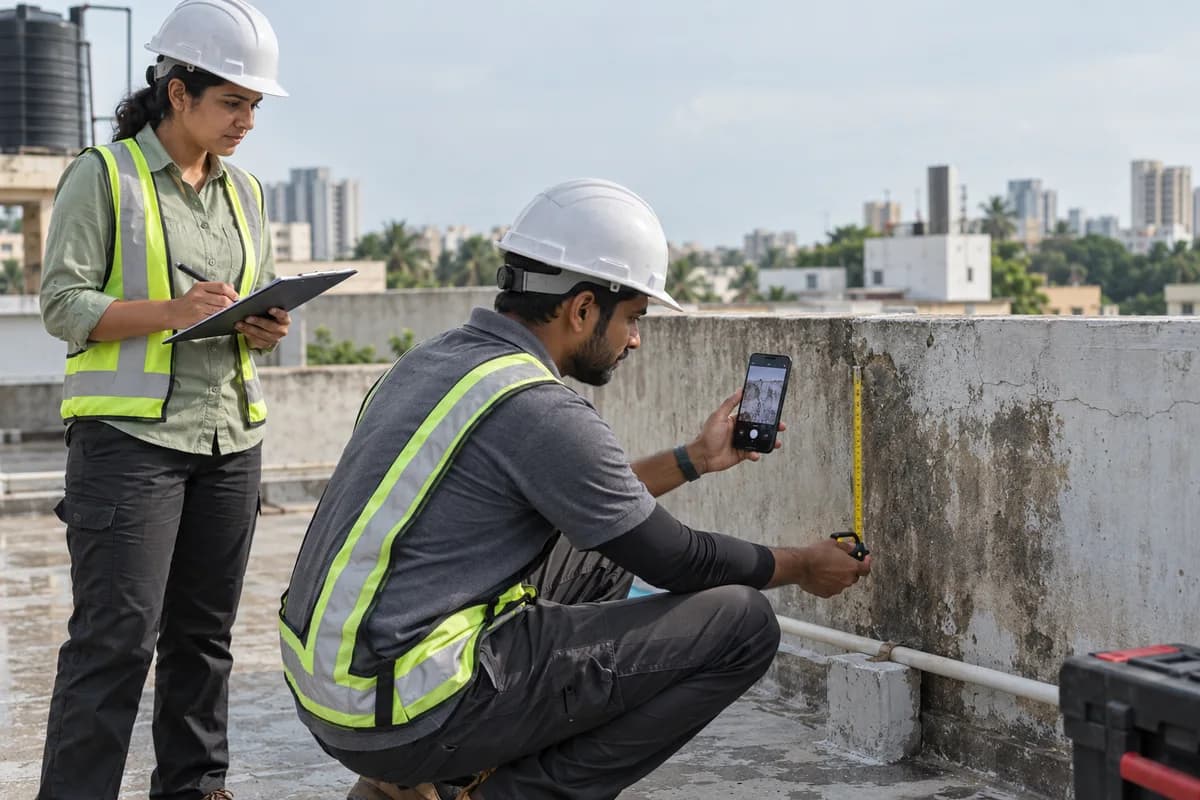
A leak complaint or a builder’s tender request is logged with the address, the area affected and who referred it. An inspection visit is booked for a supervisor, who carries a moisture meter and a tape.
2. Inspection
The supervisor records measurements, the surface, cracks, damp patches, expansion joints and any earlier treatment, with photographs for each area, so the quotation starts from facts and not from a guess.
3. Quotation
The estimator picks the treatment system for each area, such as polyurethane membrane, cementitious slurry or crystalline coating, and prices it from the measured square feet. The client receives the quotation and the proposed warranty terms.
4. Treatment
Crew are assigned to the job and material is issued from the store. Each stage is logged as it is finished, from hacking and surface preparation to the final coat and protection screed.
5. Test and handover
The ponding test is recorded with start and end times and the result. The client signs the handover, and the warranty register opens for that area.
6. After the job
Stage bills and retention are followed up. Leak callbacks within the warranty are logged against the original treatment, and warranty end dates raise a reminder for the office to call the client.
Industry reports to connect with
- Enquiries by source and quotations converted
- Jobs in progress by stage and crew
- Material issued against quoted use, by site
- Warranties ending soon, by client and area
Questions before implementation.
When should waterproofing contractors consider ticket management?
Use when requests need tracking through investigation and resolution. A complaint, fault or service request is logged.
What should we bring to the requirements discussion?
Bring anonymised examples of Request categories; Priority and ownership rules; Status and closure criteria. Show who creates, checks and changes each record. Use only records from an activity that meets the suitability conditions above.
Does this replace our existing business software?
The starting point is your current system and the gap you need to close. Track support requests with an owner, status and resolution record. Configuration, a connected module or a custom build are evaluated against that gap before a replacement is proposed.
What is outside this module?
Ticket status does not independently prove that a fault is repaired or a customer accepts the outcome.
How are scope, price and rollout decided?
The proposal follows a review of your records, user roles, branches and existing software. Data migration, connections, training and support are scoped separately where needed. Open tickets have owners. Use this check when reviewing the first working version.
Related functions for waterproofing contractors.
Discuss ticket management for your business.
Tell us which workflow needs attention and which systems your team uses. The next step is a requirements discussion and a written scope.
What happens after you share your requirements
- We review your brief and the systems you already use.
- We clarify the workflow, missing information and the work to consider first.
- The proposed scope sets out the deliverables, responsibilities and dependencies.
- Review the scope and commercial terms before deciding whether to proceed.
Start with your requirements
Describe your current process, the people involved and the change you need. Start with the details you know; we can clarify the rest together.
Share your requirements