Book the courier from the order, and see the tracking status on the same screen.
Shipping integration connects your orders to the courier you already use, so a shipment is booked from the order itself. The label prints, the tracking number comes back onto the order, and the customer gets it on WhatsApp. Returns and cash on delivery payments are matched to their orders and are not worked out from a courier statement at month end.
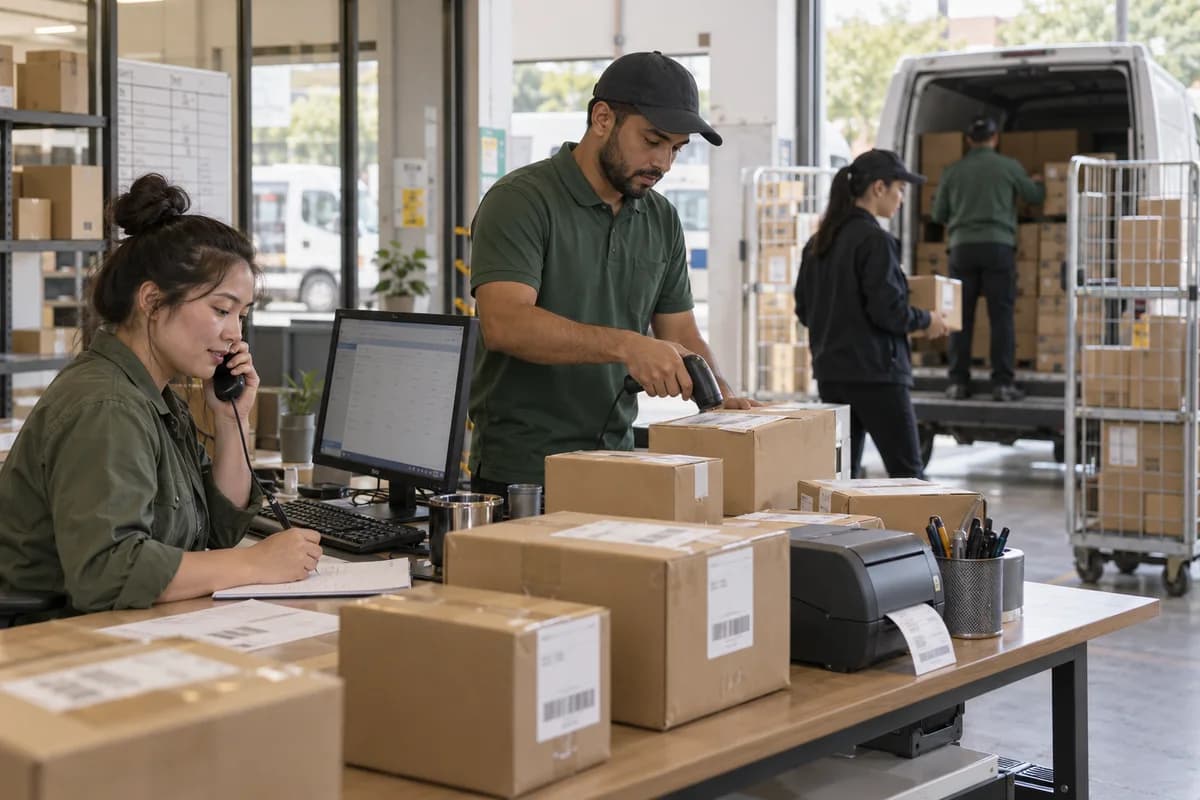
Orders come in from the website, from Instagram and from the phone. Somebody copies each address into the courier portal, prints a label, writes the tracking number in a register, and pastes it back into a WhatsApp reply. Fifteen parcels take a morning, and one address gets mixed up.
With the courier connected, the shipment is booked from the order. Address, weight and value go across once. The tracking number returns to the order, and the status updates against it while the parcel travels.
What your team uses today.
The module takes over these, one at a time, so nothing has to stop while it is set up.
- Typing orders into a courier portal
- A sheet of tracking numbers shared in chat
- A courier statement matched by eye at month end
The problems this is meant to ease.
What shipping integration for order fulfillment does.
What this looks like in a working week.
Illustrative scenarios, written to show the shape of the work. They are not accounts of client systems.
The people who open this every day.
From first conversation to daily use.
Name your couriers
You list the couriers and aggregators you use. You get a note on what each allows through a connection.
Share account details
Your team enters the credentials for each courier account. A test booking is made in the courier’s test mode. Approval waits can occur.
Print sample labels
Labels and a manifest are produced for sample orders. The dispatch staff check the layout.
Add customer messages
WhatsApp or SMS wording is agreed. Test messages reach your own phones.
Reconcile a remittance
A past remittance is matched to orders on the trial. Accounts confirm the shortfall list.
How you would know it is working.
Record where you stand before it goes live, so the change is measured against your own figures.
- Orders shipped with a tracking number
- Parcels in transit past the expected date
- Cash on delivery collected against remitted
- Returns and failed deliveries, by reason
- Customer messages sent at dispatch
It is one part of a system, not an island.
A module earns its place by what it passes to the next one. These are the connections we set up most often.
- Order management
- Invoice management
- Stock tracking and alerts
- Courier and aggregator systems
Products that include it.
How we would put it in.
Questions owners ask about shipping integration for order fulfillment.
Which couriers can you connect to?
The ones you already hold an account with, provided they give an interface for it. Aggregators cover several carriers through one connection. Name the courier you use and we check whether it offers any interface we can connect to, so your plans rest on fact.
Is this needed at eight parcels a week?
No. At that volume the courier portal and a register are cheaper than anything we would build. This starts making sense when packing is a full-time job for somebody and where-is-my-parcel calls arrive daily.
Does it give us better shipping rates?
No. Rates come from your agreement with the courier or the aggregator, and we have no part in that. What you get is the rate actually charged, recorded per parcel, which is useful the next time you negotiate.
How is cash on delivery money reconciled?
Each remittance from the courier is matched against the orders it covers, with the courier’s charges shown separately. What is short stays on a list until somebody chases it.
How is shipping integration priced?
Courier count and order volume shape it, while label formats, customer messages and cash on delivery matching add effort. The quotation lists each piece of work apart, so dropping one changes the total plainly.
What decides how soon we can book shipments?
Whether the courier offers a connection and how fast your account is approved decide it. A release for a lead courier with labels and tracking can come first. Account details and dispatch rules come from you, and the plan we write fixes the order of work. Courier approvals set the pace.
Businesses that ask for this.
Modules that work with it.
Tell us how you handle shipping integration for order fulfillment today.
A spreadsheet, a register or another system: say which, and we will tell you plainly what is worth changing.
What happens after you share your requirements
- A senior engineer reads your answers. Nobody phones first.
- Within one business day you get a written note: what we understood, what we would start with, and the questions we still have.
- If it fits, a proposal follows with the order of work, what we need from you and what you receive at each step.
- No call is booked and nothing is paid until you have read the note. Your details stay with us.
Start with your requirements
Seven short steps that tell us what you need. A senior engineer reads them before anyone gets in touch.
Share your requirements