In this guide 6 sections
Offer the service level your crew can carry out every time: kerbside drop, delivery to the room of choice, or full installation with a test run. Ask about stairs, lifts and doorway width before dispatch. A commercial gym order is a site job.
Three service levels, and what each one promises
Kerbside means the machine, still crated, is left at the kerb or the front door and the buyer does the rest. It is the cheapest level to run. Expect more phone calls.
Room of choice means the crew carries the crate to a named room, opens it and takes the packaging away. Full installation goes further: frame assembled, deck levelled on its feet, plug checked, belt run up to speed and back down before anyone signs.
Delivery and installation mean different things to different buyers, so name the level in plain words on the product page and again at checkout. Never leave it implied.
Ask about the route before the machine leaves the warehouse
Treadmills are awkward at corners. Failed deliveries usually come from the route rather than the truck, because the crate that left the warehouse safely meets a stairwell that nobody measured.
Send these questions with the order confirmation, and hold dispatch until the buyer has answered every one, including a phone photo of the narrowest stairwell on the route. No answers, no dispatch.
Tell buyers to measure the clear gap with the door standing open, since hinges and frames take space away, and quote the crated width and height beside the question. Give them a target.
- Flights of stairs, turns and landings between the door and the room
- Lift car depth and door width, since a crate may not stand upright
- The narrowest doorway on the route
- Ceiling height in the room, as a belt at full incline stands tall
- Walking distance from truck parking to the front door
- A power point near the planned spot, and a person present to sign
Match the crew and the kit to the machine
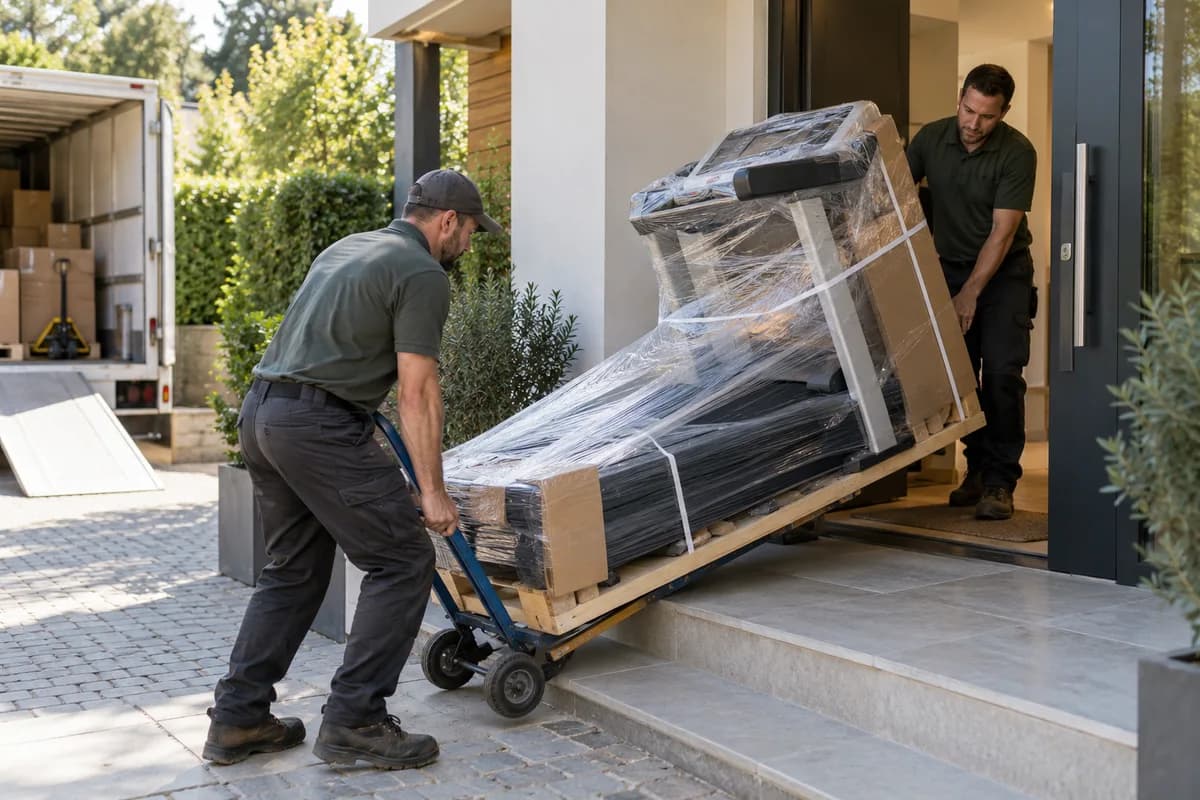
Size the crew to the machine. A folding home treadmill needs two people and a stair trolley, while a selectorised strength machine arrives in several cartons with a weight stack. Assembly takes tools and half a day.
Decide which jobs go to your own crew, which to a carrier with a two person service, and which to the maker’s installers. Put the name of the party on the order.
Write a rule for the day the machine will not fit. The crew stops, photographs the blocked doorway, phones the buyer and offers a drop at the nearest safe spot or a new date. Settle the second visit in advance.
A commercial gym order is a site job, not a parcel
A gym orders a floor, not a machine. Racks and cable stations are bolted to the floor, so the buyer has to confirm the slab or the plinth, and who will drill it, before anything arrives.
Delivery runs around opening hours. Each machine is commissioned on its own, and the service contract and warranty start should be dated from the signed handover rather than from the day the truck left.
Large orders often arrive in stages, with cardio first, racks a week later and cable stations once the floor is sealed. Each stage needs its own delivery sheet. Never let one stage block the door for the next.
- Floor plan showing where each treadmill, rack and cable station stands
- Delivery window and a booking for the loading dock or goods lift
- A site contact who meets the crew
- Floor protection on the route and anchoring points on the slab
- Commissioning list by serial number
- Handover sheet signed by the gym manager
Put the terms where the buyer will read them
Show the service level three times: on the product page, at checkout and in the confirmation email. Say what is left out. Carrying past the front door and removing the old machine are the usual exclusions, and buyers assume both unless told otherwise.
List the access questions, the failed delivery rule and the signing step in a short block of plain text. Skip the legal paragraph nobody reads.
Test the wording on two recent buyers. Ask each to say, in their own words, what the crew will do on the day and what the crew will not do, then rewrite whatever they get wrong.
Delivery access form
One page, sent with the order confirmation. The home block asks for address, room, floor, stairs and turns, lift size, narrowest door, ceiling height, power point, parking and a photo of the route. The commercial block asks for site contact, dock hours, floor plan file, machine list with serial numbers and a handover signature line.
Open a blank worksheet to printQuestions owners ask
Should installation come with every treadmill?
Not always. Light folding models suit buyers who can unbox them with a second person, while heavy and commercial machines should include a crew. Offer installation as a clear option on everything between.
What if the treadmill will not fit through the door?
The crew follows the rule written on the order. They stop, photograph the doorway and phone the buyer, then either leave the crate at the nearest safe spot or rebook the visit. Improvising on the day is how machines get damaged.
Who removes the packaging?
Decide it for each service level. Room of choice and full installation usually include taking away the crate, the foam corners and the strapping, while kerbside does not. Print that line on the confirmation email.
How does the paperwork differ for a gym order?
A commercial order needs a floor plan, a site contact, a delivery window at the dock, serial numbers for every machine and a signed handover sheet. A home order needs an access form and a signature at the door.