In this guide 6 sections
A fabrication shop needs job tracking by order: drawings, cut lists, welding stages and fitting, all against one job card from release to dispatch. An assembly line needs serial flow. Kits, station checks and torque records per serial number matter there, and plants doing both must link the sides so a welded frame arrives with its history.
Two kinds of work in one plant
Fabrication is job work. A plate is cut, bent, welded and ground against a drawing, and each job can differ from the last one on the same bench. Assembly is serial work, where the same sequence of stations repeats, parts arrive in kits, and a missed step shows up two stations later.
Farm machinery plants usually hold both. The fabrication side makes frames, hoppers, tanks and hitches, while the assembly side bolts on axles, gearboxes, hydraulics, wiring and sheet metal.
The two sides think in different units. Fabrication counts jobs and hours, while assembly counts machines and takt time, so one report rarely suits both sides or the foreman who reads it.
What the fabrication side needs
Each job needs a drawing revision, a cut list and a route through laser, press brake, weld and finishing, so the supervisor can see what waits at each bench. Rework and scrap need a reason code. A note is not enough.
Material matters here. Plate comes in different grades and thicknesses, and offcuts go back to the rack as tagged remnants that a nesting run can use before a fresh sheet is opened. A system that tracks remnants saves steel and stops people cutting fresh sheet for a small gusset or bracket that an offcut from last week would have covered.
Labour is booked by job. Hours booked against the estimate show which quotes ran too low on press brake or weld time, and which welder or bench keeps running over.
- Drawing revision on every job card
- Cut list with plate grade and thickness
- Weld stage sign-off by welder
- Remnant stock and nesting reuse
- Scrap and rework reason codes
What the assembly line needs
Assembly runs on kits. A station should not start until its kit is complete, because a missing bolt set stops the line, so the shortage must show on a screen a shift earlier.
Each machine carries a serial number from the first station, and torque readings on wheel hubs, hydraulic pressure tests and final inspection results attach to that number. Paint and decal checks go there too.
A model changeover needs its own step on the line, otherwise kits for the old model sit beside kits for the new one and a wrong bracket gets fitted.
- Kit completeness before each station starts
- Serial number issued at the first station
- Torque and pressure test records per serial
- Model changeover checks
- Final inspection and dispatch release
Where the two sides must meet
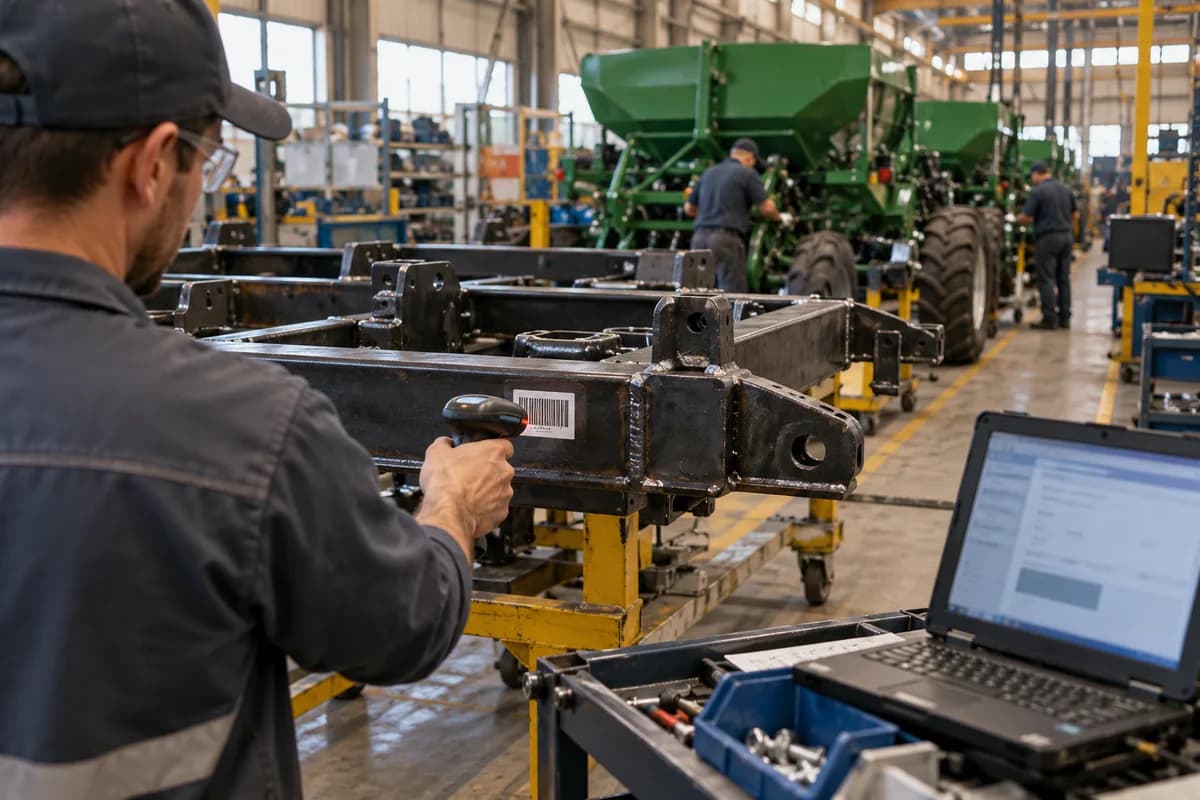
A frame leaves fabrication and enters assembly. It should arrive carrying its job number, drawing revision and weld sign-off, because a line that must phone the fabrication office loses time and breaks the trail. Scanning a frame tag at the first station is enough, as long as the tag was printed at the last weld and not typed later.
The handover also decides stock. A frame built for a specific order should not be taken for another by mistake, so reserve it against the order or the serial number.
Dealer claims trace back through this link. A cracked hitch is only worth investigating if the weld record is one click away, with the welder, the date and the wire batch beside it. Otherwise the claim stalls.
How to pick what to buy first
Start where the pain is loudest. A plant that loses jobs on the shop floor needs job tracking first, whereas a plant that stops for missing kits needs the bill of materials and stock first.
Write one sheet for each side listing the records you keep today and where they live, whether a register, a whiteboard or a spreadsheet. Bring both sheets to any vendor meeting. Have the vendor demonstrate each record on screen, starting with the frame handover, and note every field it cannot hold or must retype.
Fabrication and assembly needs map
A two column worksheet. The left column lists fabrication records: drawing revision, cut list, weld sign-off, remnants and scrap reasons, and the right lists kit status, serial number, torque, pressure test and inspection. A middle row marks each handover field.
Open a blank worksheet to printQuestions owners ask
Do we need separate software for fabrication and assembly?
Not necessarily. One system can hold both if it handles job routes and serial based flow, and what matters is that the frame carries its record into assembly without retyping.
Which side should we digitise first?
The side that loses the most time or records, so job tracking if the shop misses delivery dates, or kit and serial records if the line stops for shortages.
What is a kit in assembly?
A kit is the full set of parts for one station or one machine, picked and staged before work starts, in a bin or on a trolley. Gaps show early.
Why does the handover between the two sides matter?
It is where history is lost. A frame without its job number and weld record cannot be traced when a dealer reports a failure, and the plant guesses at the cause.