In this guide 6 sections
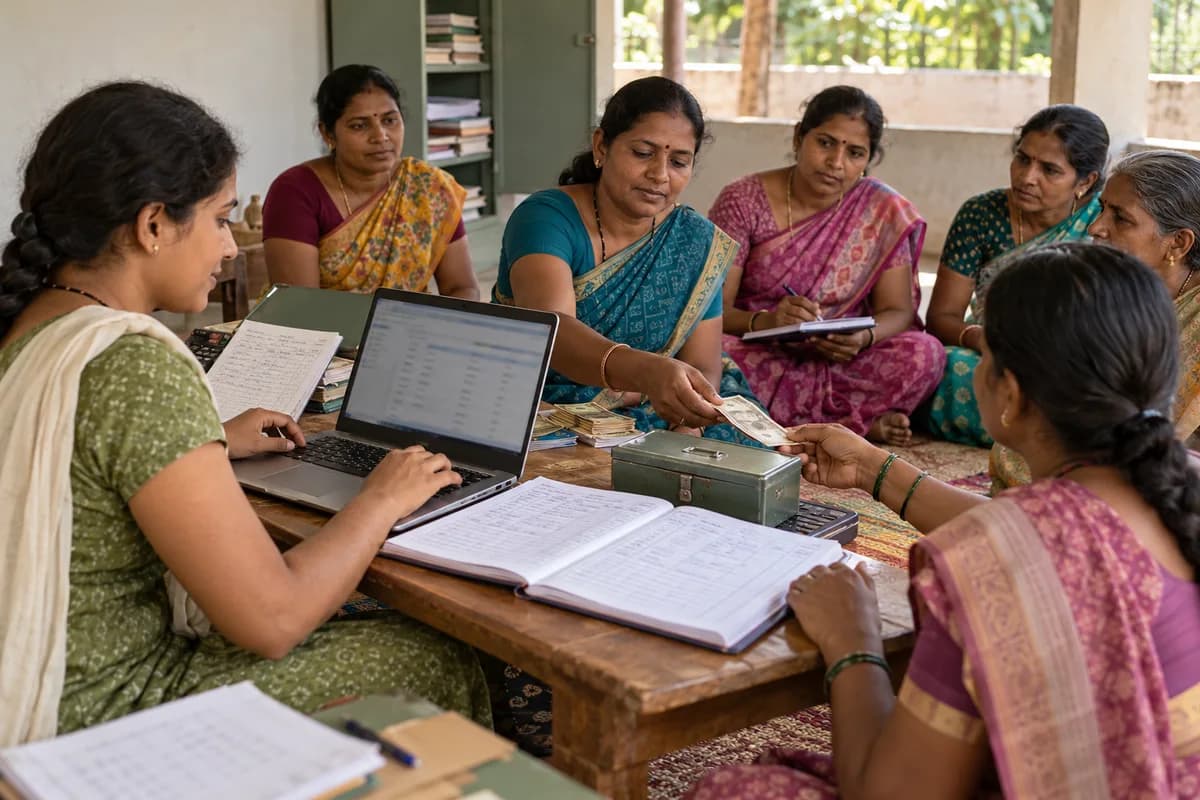
Record every member’s savings, internal loans and repayments against her own name, and let the group totals come from those entries alone. Do it at the meeting itself. The SHG Management System works out interest, sends reminders, and turns the treasurer’s registers into statements any committee member can check on the same day.
What the treasurer’s registers hold
A typical group keeps a members’ register, a savings ledger, a loan ledger, a minutes book and a cash book, each filled in by hand after the meeting. The entries come from scribbled notes.
List your books first. Write down which books your group or federation keeps and who fills in each one, which takes a single evening with the treasurer.
The software must match them. It should produce the same member-by-member information from a single set of entries, in the format the bank or federation asks for. Anything less adds work.
Savings and attendance at the meeting
Most groups meet on a fixed day. Each member pays her savings there and then, and entries made two days later are where the trouble and the disputes begin.
A member who paid but was marked absent raises it publicly, and half an hour goes on that instead of the loan under discussion.
Record both at once. Each contribution goes against the member’s savings plan while attendance is marked at the same moment, so the group total equals the sum of its members. SMS or email reminders for payments and meetings go out before the meeting day, so fewer members arrive without their savings ready.
Internal loans and bank loans
Groups lend their own savings. Many later take a bank loan and lend that on to members too, and mixing the two in one ledger is where interest and balances go wrong.
Keep the two apart. Each internal loan gets its own request, disbursement, repayment schedule and interest per member, while the bank loan keeps a schedule of its own. Anyone falling behind appears on the overdue list before the next meeting begins, rather than when the annual audit finally starts and the books are opened.
The bank’s statement remains the bank’s record. Four reports are worth printing monthly.
- Member-wise savings and loan balance
- Meeting attendance by month
- Overdue loans, and how late each one is
- Profit and loss, balance sheet and cash position
Shared figures for the committee and members
An SHG runs on trust. Trust depends on everybody seeing the same figures, yet often one woman holds the books and the rest rely on her word until a doubt appears.
Roles and logins help. The group leader, treasurer and NGO coordinator each get a login with their own permissions, every entry keeps its date, and members can see their own balance.
Backups protect the history. A lost register, or a treasurer who moves to her husband’s town, no longer takes the group’s history away with her for good.
Deciding at federation level
One careful bookkeeper may be enough. A single group with well-kept registers and a monthly bank reconciliation may not need software, because phones and training can cost more effort than they save.
Federations feel the weight. The case is stronger for NGOs, federations and rural development organisations that support many groups and total all their registers every month.
It is built for that work. Lenders working through groups can also look at the Loan Management System, which records every member inside her own group, so individual repayments can still be followed.
SHG books-to-software map
Go through this map with your bookkeeper, matching each paper register to the software entry that replaces it, so nothing a bank or federation asks for is dropped.
Open a blank worksheet to printQuestions owners ask
Can we bring in registers that go back several years?
You can, but start smaller. Enter members with their current savings and loan balances, agreed aloud at a meeting before anyone types a figure into the system. Older history can follow later.
Can members see their own savings and loan balance?
Yes, each has her own view. A member can be given access to her own record while the committee sees the whole group, and reminders for payments and meetings reach each member directly.
Is it an NRLM app?
No, it is not. It is not a government system and does not report into NRLM portals because it only keeps the group’s own books and accounts. The group’s own books can be printed or exported whenever a bank, a federation or mission staff ask for them in their own format.