In this guide 6 sections
A team kit order form holds one row per player for name as printed, number, size and position, plus a proof page the coach approves in writing before printing. Log every reprint with its cause. Spelling errors then show up as patterns.
Give every player one row and every column a job
Clubs send lists as photographed notes, forwarded emails and half-filled sheets, so someone at your end retypes every name, number and size and the typos start there. Ask for one shared form.
Every player gets a row. The columns do the checking. A name column headed as printed on the back stops nicknames, and a size drop-down stops anyone ordering a medium and a half.
Position matters, since a goalkeeper’s shirt differs in style and colour from the outfield shirt and the wrong one is only found at the packing bench. Collect it on the form.
- Name exactly as it should print on the back
- Shirt number, with a second choice in case it is taken
- Size from your size list, adult or youth
- Position, so keeper kit is not mixed with outfield kit
- Extras such as shorts, socks, training top or bag
- Contact for questions about that row
Set the rules for names and numbers up front
Start with the printer’s limits. Back names have a character limit, so a long surname may need a smaller font or two lines, and that changes the look of the whole set.
State how to treat apostrophes, hyphens, accents and capital letters, and say whether numbers go on the back only or on the front and shorts as well. Duplicates get caught at the form. Write the cutoff date at the top.
After it, changes become a new order. Clubs accept this when they read it in plain words before filling in a single row, which saves an argument when a late change arrives.
Send a proof and get the coach’s name on it
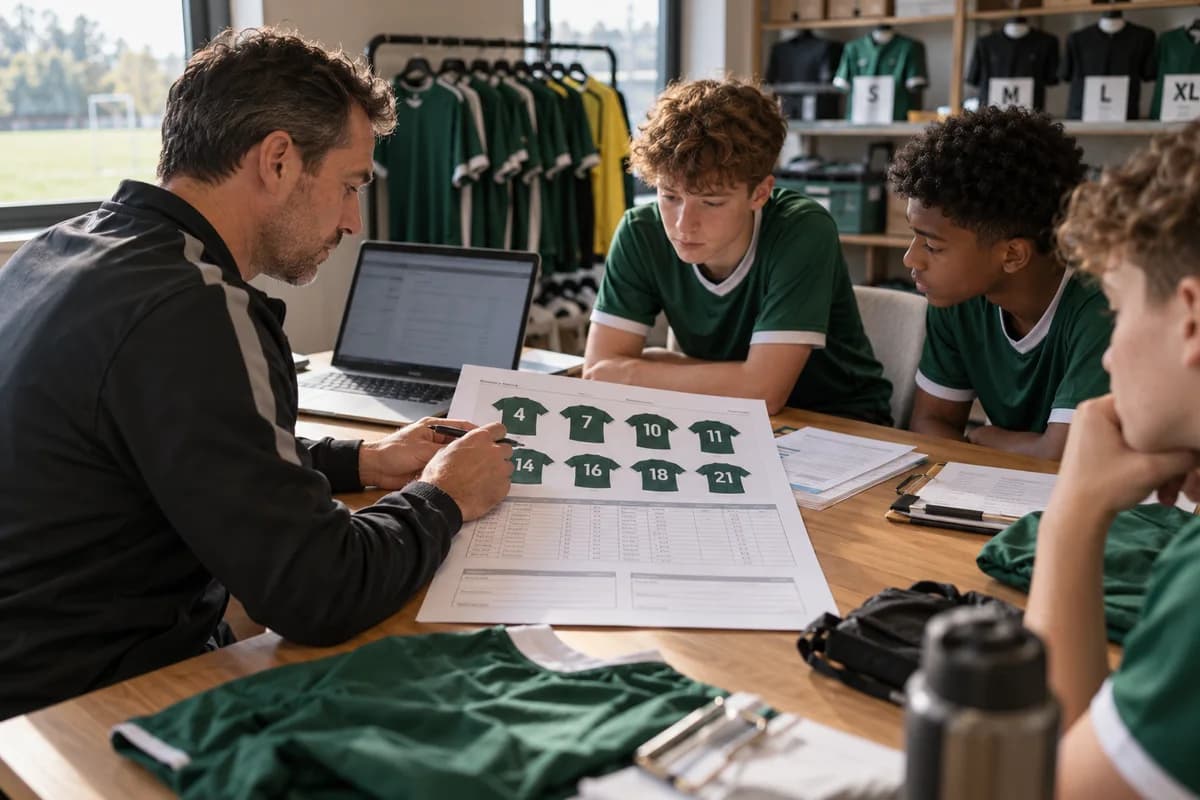
Before printing, send a proof page showing each player’s name and number set in the print font and laid out like the back of a shirt. A table of text is not enough, because people spot a wrong letter in a shirt layout and miss it in a spreadsheet cell. Only one person signs.
That is the coach, the secretary or the teacher named on the form, and they write their name, role and the date beside the proof. A phone yes does not count.
Anything that changes after the signature becomes a new line on a new order, with its own date and its own approval from the named signer. Keep the signed proof with the job. When a parent says the spelling is wrong, you can show who approved it and when, which ends the argument before it grows.
- Proof shows each name and number in the print font
- Signer’s name, role and date
- Cutoff date and what happens after it
- Version number if the proof is reissued
Plan for size swaps and late joiners
New clubs need a sizing set. Players try shirts in the room and the form is filled from what fits, but youth and adult cuts run differently, so label each sample.
A late joiner is an add-on. Give the add-on the same style code and print file as the main order so the shirts match, and note the date, since fabric lots can vary between runs. A size swap before printing costs nothing.
After printing, a name already pressed onto a shirt cannot move to a smaller one, so the swap becomes a full reprint on a fresh shirt. Say so on the form.
Log every reprint with its cause
Keep a reprint log from day one. Each line records the order, player, item, cause and the signer, with causes picked from a short fixed list so you can count them at season end. Typical causes are a spelling copied wrongly from the form, a number taken from an old print file, a size changed after sign off and a printer fault.
The first three start with the form. The last belongs to the supplier.
At season end, count the causes. If spelling dominates, tighten the name column, and if late size changes dominate, move the cutoff earlier so fewer swaps arrive after the proof is signed. Before the next club order, add a cause column to your reprint sheet and fill it in for the last five orders.
Team kit order sheet with proof sign off
One page, three blocks. The top block holds club name, contact, delivery date and cutoff date, while the middle block is the player table with name as printed, number, size, position and extras. The bottom block has the proof approval box with signer, role, date and version, plus a small reprint log with order, player, item, cause and signer.
Open a blank worksheet to printQuestions owners ask
Who should sign off the proof?
Only the coach, secretary or teacher named on the form should sign, never a parent or a player, because one name stops two people approving two different versions.
What if two players want the same number?
Collect a second choice on the form. If a clash survives to the proof, the coach decides and the change goes in as a dated line after the first version.
Can a school use the same form?
Yes, with small changes. Swap position for house or year group, add a class column, note the date each size was taken and keep the proof and sign off steps unchanged.
Who pays for a reprint caused by a spelling error?
Set the rule before the order. If the print matches the signed proof, the error belongs to the club, and if it differs from the proof, the error is yours to fix.