In this guide 6 sections
Actual use drifts from the recipe because of over-scooping, moisture loss in drying or frying, spillage, and rework that is never entered. Comparing issued quantity with the standard recipe quantity for each batch shows which cause is at work, and on which shift.
Start by comparing issue with standard
Every batch has two numbers for each ingredient. One is what the recipe says. The other is what the store actually issued.
Write both on the same line for ten batches of one product, say a garam masala or a moong dal namkeen, and the gap between them is the drift. Do not judge it yet.
Look at the pattern, not the single batch. A gap that repeats on one shift points to a habit, while a gap that swings with the season points to the raw material.
- Recipe quantity per batch
- Quantity issued from store
- Quantity returned unused
- Output weight after the process
- Shift and operator
Over-use at the blending table
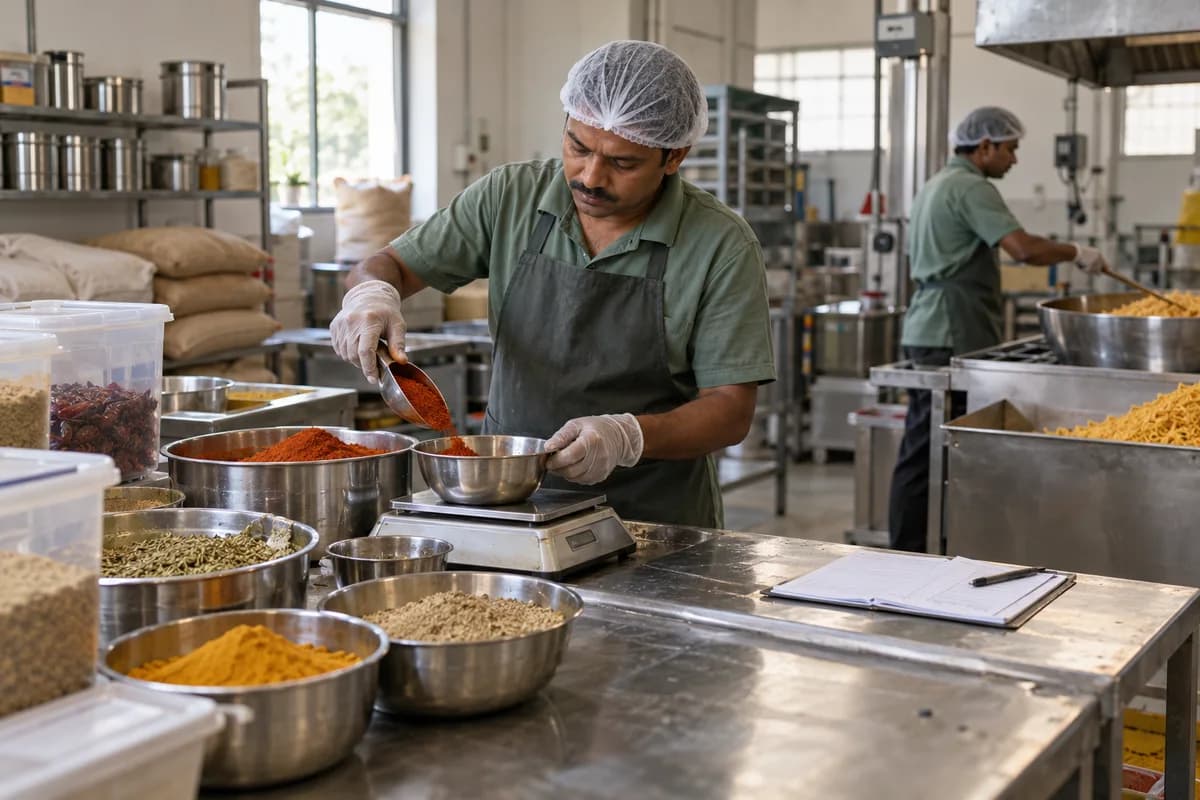
Spice blending is done by scoop and by eye. A heaped scoop of coriander powder carries noticeably more than a levelled one, and nobody sees the difference on a single batch.
Over-use shows first on the costly items. Chilli, cumin and asafoetida drift more than salt or filler, because operators add a little extra to protect the flavour. The habit spreads from shift to shift.
The cure is a weighed issue. The store hands out each ingredient in a labelled tub at recipe weight. The blender returns what is left.
Moisture loss and yield in frying and roasting
Namkeen and roasted blends lose water. Sev dough loses weight in the fryer, roasted seeds lose it in the drum, and sun-dried chilli loses it before it ever reaches your gate.
So output below input is not always theft or waste. Each product has a normal yield band, and that band moves with the incoming moisture, so measure it on batches you know were good.
Once you know the normal yield, a batch that falls below it gets a flag. The cause could be oil absorption, burnt product thrown out, or a scale that has drifted out of calibration.
- Moisture of the raw lot at receipt
- Oil temperature and frying time
- Weight before and after roasting
- Rejected or burnt quantity
Rework that nobody records
Broken sev, undersized sieve rejects and under-filled pouches go back into the next batch. It feels sensible. So it is done without a note.
The effect on the books is odd. One batch seems to give more output than its inputs allow, and the next seems to use less than the recipe. Both come from the same unrecorded pour.
Make rework a transaction. Give the rework tub a label, a weight and a source batch, and let the next batch draw from it by entry.
Turn the gap into a weekly routine
Review variance once a week, product by product. Rank the top three gaps by value and ask the shift leaders what they see on the floor.
Set a tolerance for each ingredient, wider for moisture-sensitive items and tight for costly spices, so that anything outside it starts a conversation rather than a penalty.
Revise the recipe when the drift is real and stable. A standard that nobody can meet only teaches people to ignore the report.
Recipe variance tracker
A single sheet for one product over ten batches. Columns are batch number, shift, standard quantity, issued quantity, returned quantity, output weight and rework added. A final column shows the gap and a note on the likely cause. Below the table sits a block to set tolerance per ingredient.
Open a blank worksheet to printQuestions owners ask
What gap between recipe and actual use is normal?
It depends on the product and the ingredient. Measure ten good batches to find your own band, then treat batches outside it as worth a look.
Is drift always a sign of theft?
No. Moisture loss, scoop size, scale error and unrecorded rework explain most of it. Look at the pattern by shift and ingredient before assuming anything about people.
Do we need weighing scales at each station?
You need a trustworthy scale at the store issue point and at the output point. Those two readings give the issue and yield figures that the comparison needs.
How does software help here?
It stores the standard recipe, takes the issue and output entries, and shows the gap per batch. That saves the manual subtraction and lets you sort by shift or ingredient.