In this guide 6 sections
Four breaks cause most mismatches. Fat and SNF are keyed late, the rate chart changes mid cycle, can weights differ from the centre slip, and advances are deducted by hand. The cure is to lock each reading, rate version and deduction to the entry that produced it, before the payment sheet is built and the cycle closes.
Where the centre slip and the payment sheet part ways
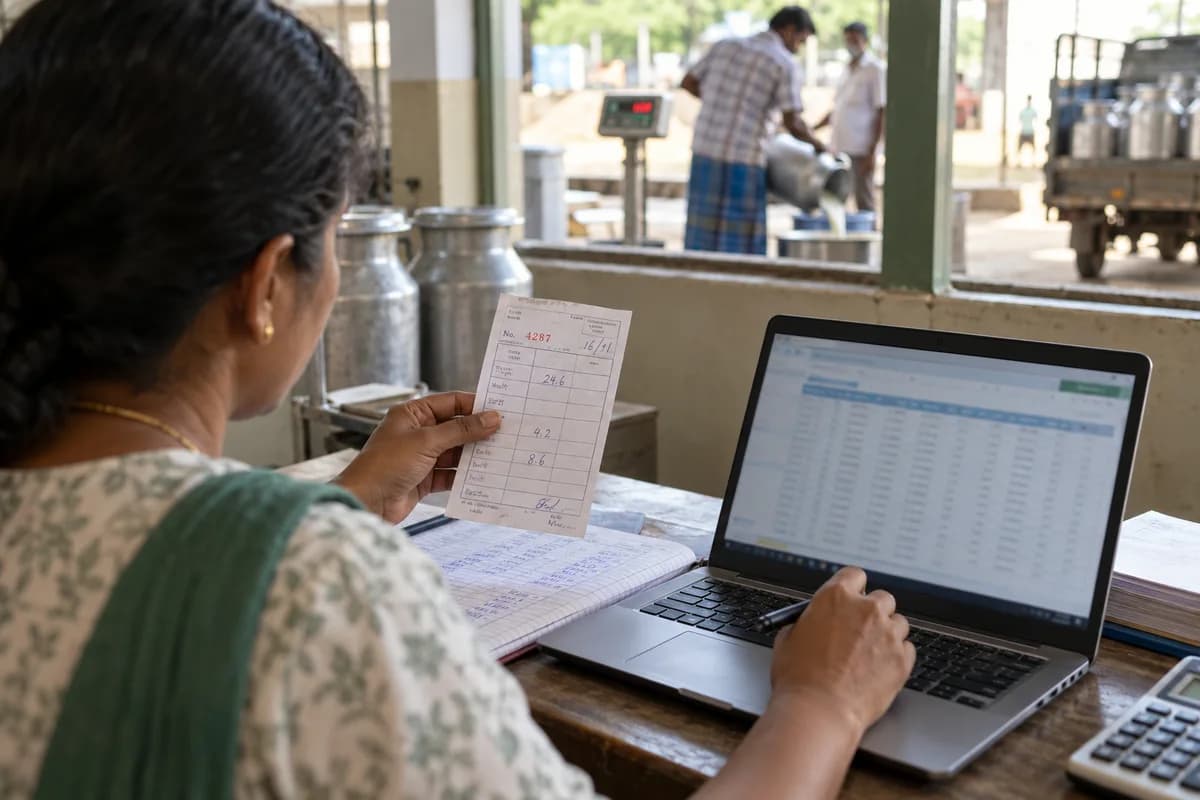
Milk arrives at the centre. The operator weighs the can, draws a sample, reads fat and SNF on the analyser, and prints or writes a slip that every later calculation will depend on. That slip is the first record.
Days later, often in the evening after the shift has closed, a different person builds the payment sheet from a different copy of the register. Any difference between the two becomes a dispute, so start by asking which copy the secretary trusts when a farmer stands at the window and complains.
Pick ten disputed farmers. Lay each slip, register line and payment line side by side, and the first column that disagrees names the break, whether weight, reading, chart or deduction.
Fat and SNF readings keyed late
The weight is entered at the counter, but the analyser result is often noted on paper and keyed in the evening by someone who was not at the counter. If the operator misses a shift, the cycle closes with a blank, and the payment run applies a default reading or yesterday’s.
A default reading pays rich milk at an average value, so that farmer loses, while the farmer with thin milk is overpaid and keeps quiet. The loser complains loudly at the meeting.
A missing reading is a hard stop. A collection line without fat and SNF should not enter the payment run until someone fills it in or signs it off.
- Reading entered at the counter, not copied later
- Analyser ID and sample number stored with the line
- Blank fat or SNF flagged before cycle close
- Manual override needs a name and a reason
Rate chart changes in the middle of a cycle
Plants revise the rate chart whenever procurement prices move. The new chart starts on a stated date, yet the sheet holds one chart, so whoever opens it on payment day decides the rate for the first ten days.
Store every chart with a start date. Every collection line carries the chart version in force on its own date, so re-running an old cycle returns the same payment every time.
Cooperatives add a second layer of rules, such as a seasonal bonus, a deduction for the society fund, or a feed subsidy that applies to members only. Store those as dated rules too. Never type them into a cell.
Can weights, route totals and cash advances
Milk is weighed twice on a route, once at the centre and again at the plant gate, and spillage, foam and dirty cans open a gap between the two. The gap is small but it repeats. If the plant pays on gate weight and the farmer is shown the centre weight, the numbers will never agree, and the secretary explains the gap at every meeting.
Decide which weight pays and record the other as a variance by route, because a steady gap points to a worn scale, a driver or an operator. Check the tare of the measuring can first.
Advances are the last break. Farmers take cash against feed or an emergency, and the recovery is meant to come off the next cycle’s milk bill, yet handwritten entries get missed. Some are taken twice. Record each advance with an opening balance, a fixed instalment per cycle, a stop date and the approver’s name.
- Centre weight, gate weight and variance per route
- Advance balance with instalment and stop date
- Feed or vet items deducted as separate lines
What to lock in the record before the next cycle
Write one rule for each of the four breaks and replay it against last cycle’s slips, registers and payment sheets before anyone relies on it. An untestable rule is not yet a rule.
Then check where the numbers live. Spreadsheets copied between centres drift apart. One collection record, fed from each centre and closed on a fixed date, ends most arguments before the secretary hears them at the window or the monthly meeting.
Before the next close, list every manual step between slip and payment, and give each one a lock or a log that names who made the entry. Start with the keyed fat reading.
Collection to payment reconciliation sheet
One page, one row per disputed farmer. Columns cover slip number, centre weight, gate weight, fat and SNF read, chart version used, gross payment, advance recovered and net paid. The last column names the first break found, whether late reading, rate version, weight variance or deduction, so the secretary can sort disputes by cause before the meeting.
Open a blank worksheet to printQuestions owners ask
Why does a farmer see a different fat reading than the payment sheet?
Probably keyed late. Either the reading was typed in after the slip was handed over, or a default replaced it when the field was left blank on the shift. Compare printout and register for that shift.
Should payment use centre weight or plant weight?
Pick one in writing. Apply it to every route and record the other weight as a variance, so a leaking can, a drifting scale or a careless handover shows up by route.
How do we handle a rate chart that changes on the sixteenth?
Store each chart with a start date, stamp its version on every collection line, and keep the old chart readable after the new one starts. Old cycles then re-run cleanly.
Is a spreadsheet enough for a small cooperative?
A spreadsheet can work. It needs one owner and one copy. Add a locked cycle after every close and the sheet stays honest, but trouble starts when several centres keep their own copies of the register. Then a shared record pays for itself.